Why Peptide Discovery Needed a Faster Way to Search Sequence Space
A peptide only 20 amino acids long, built from the 20 standard residues, has more possible sequences than there are atoms in a reasonable sample of the material itself. Traditional discovery approaches — phage display, rational mutagenesis, combinatorial libraries — have always worked by sampling a tiny, biased slice of that space and hoping the slice contains something useful.
That approach has produced real drugs, including several of the GLP-1-class peptides in wide use today. But it is slow precisely because it is not directed: a library doesn't know what it's missing. Computational tools attracted research interest because they let a scientist specify a target first — a receptor pocket, a binding partner, a desired property — and search toward it, rather than hoping a fixed library happens to contain the answer. This is a complement to lab science, not a replacement for it; every candidate a model proposes is still a hypothesis until it is synthesized and tested.
How AI Is Reshaping the Traditional Discovery Workflow
A conventional discovery project moves roughly from target identification, to library selection, to broad empirical screening, to hit confirmation, to optimization. Each step is wet-lab-heavy, and most of the cost sits in the screening stage, where thousands of candidates are tested to find a handful of hits.
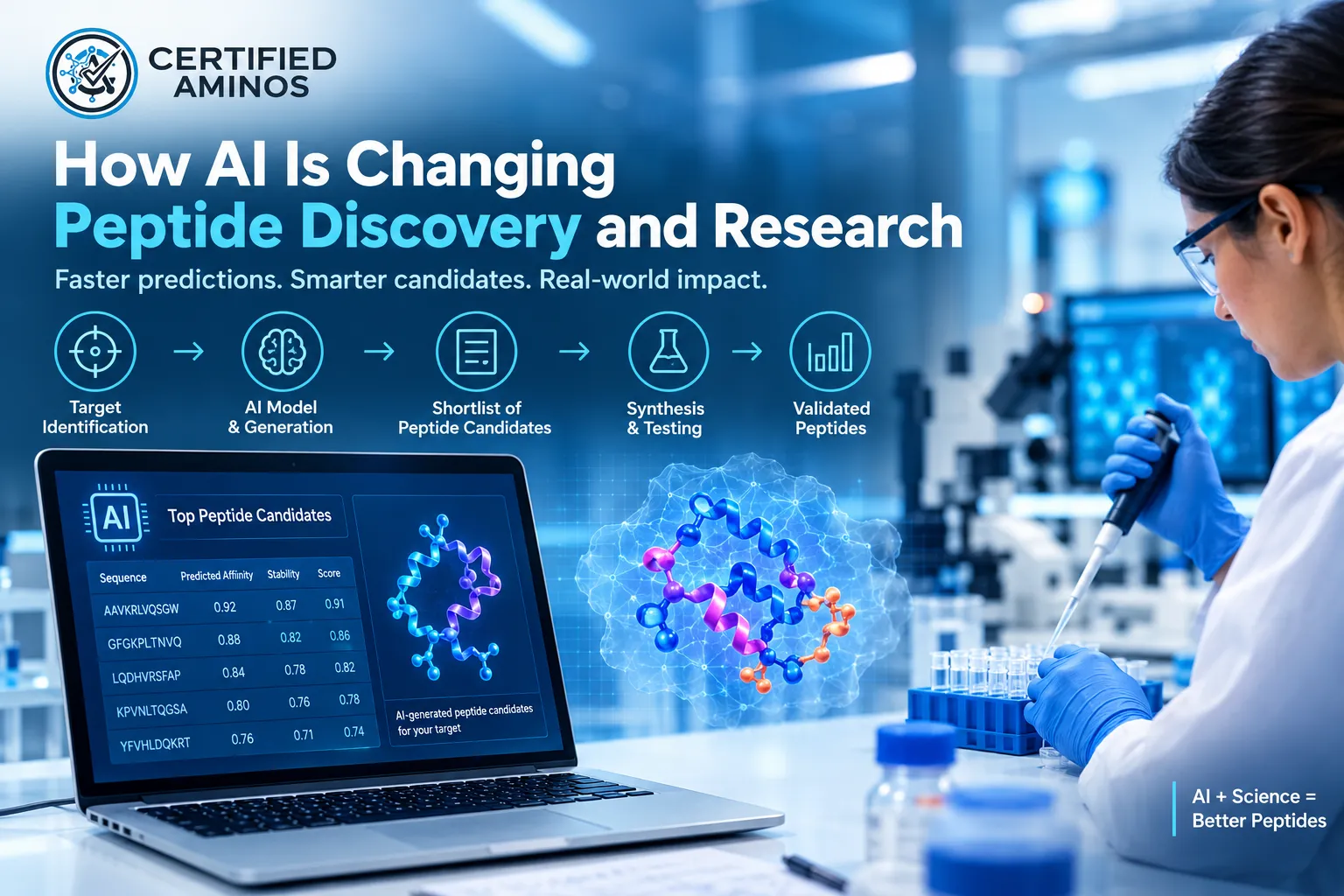
An AI-assisted project restructures that order. Target data (a receptor structure, a set of known actives) goes into a generative or predictive model first. The model proposes or ranks candidate sequences computationally, a much smaller shortlist is synthesized, and the lab's role shifts toward validating and refining rather than searching from zero. A 2025 peer-reviewed review of AI in peptide-based drug design describes this shift concretely: deep generative models are now used specifically to design peptide binders against defined protein–protein interaction targets, rather than to search a static library. The workflow is iterative, not linear — results from synthesized candidates typically feed back into the next round of model refinement, and no two research groups run an identical pipeline.
What Machine Learning Actually Sees in a Peptide Sequence
Before a model can generate or rank anything, it has to represent a peptide numerically. Most approaches combine physicochemical descriptors (charge, hydrophobicity, helix propensity) with learned embeddings from protein language models — transformer-based models trained on tens of millions of protein and peptide sequences to recognize statistical patterns in which residues tend to appear together.
These embeddings let a classifier or regression model predict things like binding class, stability class, or rough activity level from sequence alone, without first solving the structure. That is useful for triage, but it is also where a common misunderstanding creeps in: a model's predicted activity score is a statistical estimate conditioned on its training data, not a measured value. Reporting a predicted IC50 or predicted potency without noting it is a prediction — not a titration result — is one of the more common ways computational findings get overstated in secondary coverage of this field.
Generative AI and the Rise of Peptide Sequences With No Natural Template
The most significant practical change by 2026 is the normalization of de novo design — generating a candidate sequence that has no natural counterpart, rather than modifying a known one. The architecture behind most of this work is the diffusion model, the same general class of model used in image generation, retrained to propose three-dimensional molecular backbones instead of pixels.
RFdiffusion, published in Nature in 2023 by the Baker Lab at the University of Washington, popularized this approach for proteins and peptide binders: given a target structure, it generates a novel backbone conformation that complements it. A second model — commonly ProteinMPNN, an inverse-folding network published in Science in 2022 — then assigns an amino acid sequence most likely to fold into that generated shape.
Generating a plausible-looking sequence this way only proves one thing: it's consistent with the model's learned sense of what should work. Folding correctly, binding with useful affinity, and surviving synthesis intact are three separate questions a diffusion model never actually answered — which is exactly why every credible lab in this space treats a generated sequence as a hypothesis, not a result.
AI-Assisted Screening: Ranking Candidates Before a Single Vial Is Synthesized
Once a pool of candidates exists — generated de novo or pulled from an existing library — predictive models are used to rank or filter them before committing synthesis budget. This typically means scoring each candidate across several properties at once: predicted binding, predicted stability, predicted solubility, and flags for known problem motifs.
This multi-property screening is where AI delivers its clearest, most defensible benefit: fewer dead-end syntheses. It is not evidence that AI reliably cuts discovery timelines or costs by any specific percentage — no large-scale, peer-reviewed, prospective study comparing AI-assisted and traditional discovery costs head-to-head was located for this article, and claims to that effect should be treated as unverified until one exists.
Structure Prediction and the Limits of Modeling a Flexible Molecule
Structure prediction tools improved sharply with AlphaFold 2 (2021) and extended to biomolecular complexes — including protein–peptide interactions specifically — with AlphaFold 3 in 2024. These tools predict the three-dimensional shape a sequence is likely to adopt, and in peptide design pipelines they are typically run in reverse, as a check: does the structure predicted for a newly designed sequence actually match the shape the sequence was designed to have?
The catch is that peptides are disproportionately hard cases for structure prediction compared with larger, more rigid proteins. Short, flexible, and intrinsically disordered sequences — a meaningful share of biologically interesting peptides — resist confident structural prediction, because training data is skewed toward the well-folded, crystallizable structures that are easiest to determine experimentally in the first place. A predicted structure is a hypothesis about shape, not an experimentally determined one, and treating the two as equivalent is a documented source of downstream errors in this field.
A related, more specific finding worth flagging: a 2026 study introducing a unified peptide-property-prediction platform reported that structure-prediction confidence scores from a current open structure model showed negligible correlation with experimentally measured peptide–protein binding affinity. That is a single study, not a universal law, but it is a concrete illustration of a broader pattern — confidence and correctness are not the same thing, and binding-affinity prediction in particular remains far weaker than structure prediction.
Can AI Flag Stability and Solubility Problems Before Synthesis?
A sequence that binds its target beautifully in a prediction can still be useless in practice if it aggregates in solution, degrades within hours, or cannot be synthesized cleanly. “Developability” research — stability, solubility, protease susceptibility, aggregation propensity — has its own, separate line of AI tooling.
A 2023 Nature Communications method (CamSol-PTM) demonstrated sequence-based solubility prediction specifically for peptides carrying non-natural amino acids, screening tens of thousands of candidate variants computationally before narrowing to a small set for experimental confirmation. More recent 2026 work has gone further, building benchmark datasets that span aggregation, membrane permeability, kinetic stability, and thermodynamic stability together, because optimizing one of these properties in isolation routinely makes another one worse. A sequence engineered for better protease resistance, for instance, can simultaneously become harder to synthesize or less soluble — and a model trained on one property in isolation has no way to see that trade-off. Every output from this class of model still needs confirmation by an appropriate wet assay; a solubility prediction is not a solubility measurement.
What's the Data Quality Problem Hiding Inside Every Peptide Model?
A model is only as good as the labeled data it learned from, and peptide datasets have specific, well-documented weaknesses: inconsistent assay protocols between labs, duplicated or near-duplicate sequences split across training and test sets, and activity labels that skew toward whatever happened to get published.
A 2026 benchmarking effort built specifically for peptide machine learning identified a particular failure mode it called “shortcut learning”: models that appear to perform well because short, repeated sub-sequences (k-mers) are statistically associated with the activity label in the training data, rather than because the model has learned anything about the underlying biology. A separate review of antimicrobial-peptide prediction tools reached a similar conclusion from a different angle, flagging train–test data leakage and inconsistent performance reporting as recurring problems across the published tool landscape. Reproducibility suffers as a direct result: a model that performs well on one benchmark and poorly on an independently curated one has very likely learned a dataset artifact rather than a generalizable pattern. No amount of model sophistication compensates for that; it requires better dataset curation and genuinely independent validation splits, not a bigger model.
From a Predicted Structure to a Validated Result: What the Lab Still Has to Confirm
Every computational step described above ends at the same checkpoint: synthesis and experimental confirmation. For a newly designed or newly prioritized sequence, that typically means solid-phase peptide synthesis, followed by identity confirmation through mass spectrometry and purity assessment through HPLC, and then whatever biochemical or cell-based assay actually measures the property the model predicted.
This step is not a formality. A sequence can fold exactly as predicted and still fail for reasons prediction tools don't model well: aggregation at working concentration, degradation in assay buffer, or binding an unintended off-target receptor. In silico predictions, preliminary in vitro findings, and anything resembling clinical or regulatory evidence are three different tiers of confidence, and conflating them — describing a computational prediction with the language appropriate to a confirmed laboratory result — is one of the more common ways peptide research gets overstated in public-facing writing.
Where AI Is Actually Being Used in Peptide Research Right Now
Computational peptide design has moved furthest in a few specific subfields:
Antimicrobial peptide discovery has become one of the most active applications, partly because large, labeled public datasets already exist and activity is strongly sequence-driven. A 2026 framework called Termini combined a diffusion-based generative model with classification and regression scoring to design antimicrobial candidates, and the research group behind it synthesized and tested 120 designed peptides in vitro against 11 pathogenic species — a notably broad validation panel for a generative-design study. A separate 2026 project, AMPGAN v3, extended generative antimicrobial design to include D-amino acids and terminal chemical modifications, validating five candidates experimentally, two of which showed measurable activity against Gram-positive bacteria. Both studies make the same point in different ways: generative output has to clear a real experimental bar, and only a fraction of designed candidates do.
Metabolic and incretin-pathway research — the GLP-1 class of compounds and related multi-receptor agonists — is another area where computational modeling of receptor–ligand interactions is now routine, largely because these receptor structures are unusually well characterized and the published dataset around known agonists is dense. (For how one of those agonists, semaglutide, was engineered for its week-long half-life, see Why Does Semaglutide Last a Week?.)
Tissue-repair and recovery-focused peptides, often studied in combination, are harder computational targets: several of the most-studied compounds in this space are short and structurally flexible, which is precisely the category where structure prediction is least reliable.
What AI Still Can't Reliably Do in Peptide Discovery
Six places where the hype and the published record still don't match:
- Binding-affinity prediction remains substantially weaker than structure prediction. Models can often rank candidates sensibly relative to each other; predicting an absolute binding constant with confidence is a different and much harder problem.
- Short, flexible, and intrinsically disordered sequences predict poorly, because training data is skewed toward well-folded, crystallizable structures.
- Training data quality and reproducibility remain unresolved across much of the field, as the data-quality findings above document directly.
- A model's confidence score reflects internal certainty, not experimental truth — the structure-confidence-vs-affinity finding above is one concrete example of this gap.
- Synthesizability and manufacturability are not guaranteed by a successful computational design; some generated sequences are difficult or costly to produce at bench scale.
- No AI-designed peptide has FDA approval as of October 2026. AI-discovered compounds — rentosertib (ISM001-055), a small molecule rather than a peptide, is the most-cited example — have reached Phase II clinical trials, but investigational status is not approval, and the published record for peptide and miniprotein binders specifically is still dominated by preclinical and in vitro work.
Where This Goes After 2026
The most plausible near-term developments are incremental rather than revolutionary: better peptide-specific benchmark datasets, tighter integration between generative design and automated wet-lab feedback loops, and continued improvement in affinity prediction specifically, since it remains the weakest link in the computational pipeline.
A useful way to evaluate any AI-related peptide research claim going forward: ask whether it distinguishes a computational prediction from an experimental result, whether the sample size behind an experimental validation claim is stated, and whether the comparison being made is to a specific, cited study or to a vague industry average. Claims that hold up under those three questions are worth taking seriously. Claims that don't, generally aren't.
AI-Driven Design vs. Traditional Library Screening
Neither column replaces the other. Computational work narrows the field of candidates; laboratory work still decides which ones are real.
A Typical AI-Assisted Peptide Research Workflow
- Define the target and constraints. Identify the receptor, binding pocket, or desired property, and pull any available structural data.
- Generate or select candidates. Use a generative model to propose novel sequences, or apply predictive filtering to an existing library.
- Score computationally. Rank candidates for predicted binding, stability, solubility, and known problem motifs.
- Check structure where relevant. Run structure prediction to see whether a designed sequence is likely to fold as intended.
- Shortlist for synthesis. Narrow to the candidates that clear every computational filter.
- Synthesize and verify identity. Produce the shortlist (typically by solid-phase peptide synthesis) and confirm identity by mass spectrometry and purity by HPLC.
- Test experimentally. Run the appropriate biochemical or cell-based assay, and feed the results back into the next round of model refinement.
Computational Predictions vs. Experimental Validation: Why the Distinction Matters
These are not interchangeable levels of evidence, and research write-ups that blur them cause real confusion. A computational prediction is a model's output given its training data and the input it was given — useful for prioritization, not proof of anything on its own. A preliminary in vitro finding is a real measurement, but typically from a single assay, a limited sample, or an early-stage model system, and it has not yet been independently replicated. Preclinical and clinical evidence sit at a different tier again, built on structured study design and, eventually, regulatory review. None of these tiers substitutes for the one above it, and a compound's computational origin says nothing about where it sits on this ladder — it still has to earn its place the same way any other candidate does.
Conclusion
By 2026, AI has changed where peptide research starts, not whether laboratory work is still required. Generative models and structure prediction have made it realistic to propose and filter candidates computationally before committing to synthesis, which is a genuine efficiency gain over blind library screening. But the published record is consistent on one point: binding-affinity prediction, developability, and real-world behavior in solution remain substantially harder problems than generating a plausible-looking sequence, and every credible study in this space treats a computational output as a hypothesis rather than a conclusion. For anyone sourcing or evaluating research peptides in this environment — including newly designed or less-characterized sequences — that distinction is worth holding onto: a design pedigree is not evidence of identity, purity, or safety, and documentation still has to come from the bench, not the model.
For Researchers
Related reading: Are Peptides Safe? What Research Shows and Do You Need a Prescription for Peptides? for the broader regulatory and safety context behind any newly designed or AI-proposed research compound.
Research Use Only Disclaimer
This article is intended for general scientific and research education. It does not describe a protocol, dosing guidance, or therapeutic use. Peptides referenced throughout are discussed strictly in the context of laboratory and in vitro research. Certified Aminos supplies research peptides for laboratory use only; products are not intended for human or animal consumption, diagnosis, or treatment, and have not been evaluated by the FDA for any use outside a research context.