Understanding a biological mechanism is not the same as establishing a treatment. This guide covers what Kisspeptin-10 is, how it fits into the KISS1/KISS1R signaling system, what human dosing studies have specifically found (including that follicular-phase null result), and where the evidence stops. This is a research-use-only compound, not a treatment, and nothing here is dosing, administration, or self-experimentation guidance.
What Is Kisspeptin-10?
Kisspeptin-10 is a ten-amino-acid peptide (Tyr-Asn-Trp-Asn-Ser-Phe-Gly-Leu-Arg-Phe-NH2) corresponding to the C-terminal fragment of kisspeptin, the protein product of the KISS1 gene. KISS1 was first identified in 1996 as a metastasis-suppressor gene in human melanoma cells (Lee et al., 1996); its role in reproductive endocrinology was established afterward, once kisspeptin was identified as the natural ligand for KISS1R.
The full-length peptide, kisspeptin-54, is cleaved into shorter fragments — kisspeptin-14, -13, and -10 — all sharing the same receptor-binding C-terminal sequence. KP-10 is the shortest fragment that retains full activity at KISS1R in standard assays, which is why it's the form most often used in physiological research as a defined probe of the pathway.
Kisspeptin-10 at a Glance
How Does Kisspeptin-10 Relate to the KISS1/KISS1R Signaling System?
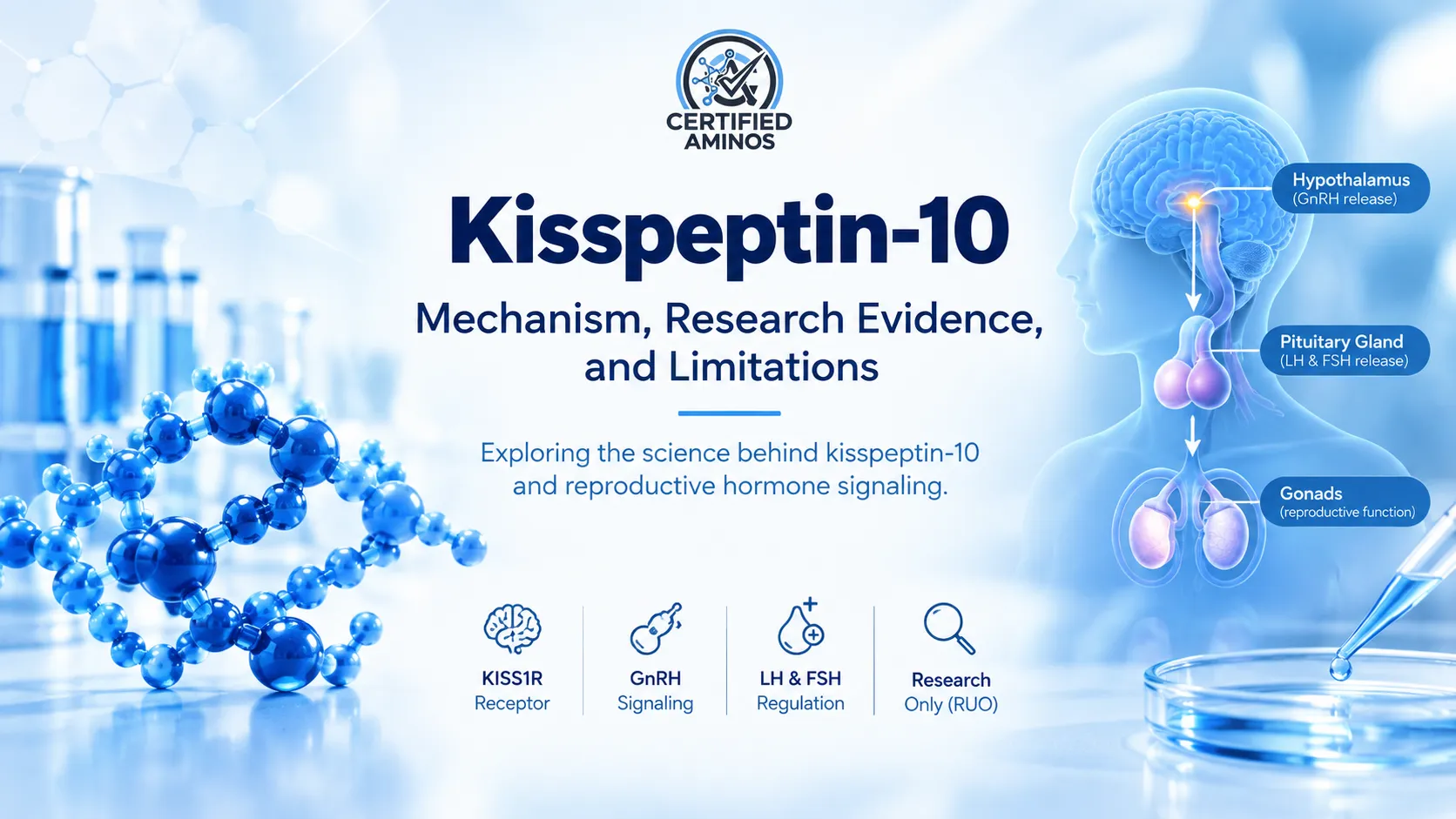
KISS1R is expressed on hypothalamic neurons, most densely in a region regulating pubertal onset and ongoing reproductive cycling. When kisspeptin binds KISS1R on these neurons, it triggers signaling that increases the activity of GnRH neurons immediately downstream.
The strongest evidence that this pathway matters in humans comes from naturally occurring mutations, not from kisspeptin administration. Loss-of-function mutations in KISS1R cause normosmic idiopathic hypogonadotropic hypogonadism (de Roux et al., 2003); a gain-of-function KISS1R mutation (Arg386Pro), shown in vitro to prolong receptor signaling, was identified in a child with idiopathic central precocious puberty (Teles et al., 2008). Together these human genetic findings are stronger evidence that KISS1R signaling is required for normal gonadotropin output than anything derived from giving synthetic Kisspeptin-10 to healthy adults, which only tests whether acutely raising kisspeptin exposure changes hormone levels — not whether the pathway is required for normal function.
How Does Kisspeptin Signaling Interact With GnRH and Downstream LH/FSH Signaling?
GnRH neurons sit at the top of the hypothalamic-pituitary-gonadal (HPG) axis: they release GnRH in pulses, GnRH drives pituitary LH and FSH secretion, and LH/FSH drive gonadal sex-steroid and gamete production. Kisspeptin is an upstream excitatory input onto GnRH neurons, not a direct regulator of the pituitary.
This has been tested directly with Kisspeptin-10 in humans. A single intravenous bolus raised serum LH at doses as low as 0.3 nmol/kg and FSH at 1.0 nmol/kg in healthy men, with testosterone also rising downstream (Jayasena et al., 2011). A head-to-head comparison of intravenous Kisspeptin-10, Kisspeptin-54, and GnRH in healthy men found GnRH produced roughly 2–3 times greater LH/FSH area-under-curve than either kisspeptin isoform at matched doses — kisspeptin is a real but comparatively gentler stimulus of the axis than direct GnRH administration (Jayasena et al., 2015).
What's the Difference Between Kisspeptin-10 and Kisspeptin-54?
This is one of the most common points of confusion in peptide-retail content, and it matters scientifically. Both isoforms activate the same receptor and share the same bioactive C-terminal sequence, but they are pharmacologically distinct molecules with different plasma half-lives — and much of the foundational human infusion data, including the original 2005 study establishing that elevating circulating kisspeptin raises LH, FSH, and testosterone in men, used Kisspeptin-54, not Kisspeptin-10 (Dhillo et al., 2005).
A study that reports a "kisspeptin" finding does not automatically describe Kisspeptin-10's behavior specifically — the isoform used has to be checked against the source.
What Does Human Research Say About Kisspeptin-10?
Across the identified human studies, intravenous Kisspeptin-10 consistently increases LH in men, with FSH responses present but less consistent across doses. The single most important finding for interpreting any "kisspeptin benefits" claim is that the response is sexually dimorphic and hormonal-context-dependent, not uniform: Kisspeptin-10 stimulated LH and FSH in men, produced no measurable gonadotropin response in women during the follicular phase of the menstrual cycle even at substantially higher doses, and did stimulate LH and FSH in women during the preovulatory phase (Jayasena et al., 2011).
A related study found the response in women is further modulated by circulating sex-steroid levels: the LH/FSH response to Kisspeptin-10 was enhanced in postmenopausal (low sex-steroid) women and suppressed in women taking exogenous hormonal contraceptives (George et al., 2012). Both studies involved small participant groups and measured acute responses over hours, not long-term outcomes — the findings should not be generalized across doses, administration routes, or clinical situations.
A direct 2015 comparison of intravenous Kisspeptin-10, Kisspeptin-54, and GnRH in healthy men similarly involved small groups; GnRH produced a stronger response than either kisspeptin isoform, which showed broadly similar effects on the measured outcomes (Jayasena et al., 2015).
How Should These Findings Be Interpreted?
The current evidence supports continued investigation of kisspeptin signaling as part of reproductive endocrinology. It does not justify treating preliminary hormone findings as proof that Kisspeptin-10 improves fertility, increases testosterone over the long term, or treats a reproductive disorder. A useful distinction is between three evidence levels, which answer different questions and don't automatically establish one another:
- Mechanistic evidence: explains how a peptide may interact with a biological pathway (e.g., KISS1R binding and GnRH-neuron activation).
- Physiological evidence: measures a response, such as hormone release, under defined experimental conditions (the human infusion studies cited throughout this article).
- Clinical evidence: evaluates meaningful health outcomes, safety, and effectiveness in an appropriate patient population — no clinical-outcome trial of Kisspeptin-10 for any indication was identified in this research.
Human kisspeptin-based compounds remain under active early-stage clinical investigation — including registered trials in conditions such as hypothalamic amenorrhea and hypogonadotropic hypogonadism — and no kisspeptin-based product currently holds FDA approval for any indication.
Potential Research Applications: What Is Established and What Is Not?
What Are the Main Limitations of Current Evidence, and What Safety Questions Remain Unresolved?
The identified Kisspeptin-10 human studies share several structural limitations: very small sample sizes (typically four to six participants per group), short observation windows (minutes to hours, not sustained dosing over days or weeks), single-center academic settings, and outcome measures limited to circulating hormone levels rather than clinical endpoints. The cited studies reported no significant adverse events during the observed infusion periods — but an absence of reported adverse events in a handful of short, closely monitored infusions in healthy young volunteers is not the same claim as an established safety profile, particularly for repeated or longer-term exposure, other populations, or non-intravenous routes of administration. No systematic, long-term human safety data for Kisspeptin-10 was identified in this research, and nothing here should be read as establishing that a product sold under this name is safe for any use.
This article does not provide dosing instructions, injection guidance, treatment recommendations, or protocols for self-administration. Anyone considering a medical intervention should consult a qualified healthcare professional rather than rely on a research article or a product description.
What Does Research Use Only Mean When Evaluating a Kisspeptin-10 Product?
"Research Use Only" (RUO) is a labeling and regulatory category, not a safety, purity, or efficacy claim. It means a product is supplied for laboratory and non-clinical research and is explicitly not intended for human or veterinary use, diagnosis, treatment, cure, or prevention of disease. Four distinct things are worth keeping separate when reading RUO material: educational information about a compound; laboratory research into biological mechanisms; evidence supporting a scientific hypothesis; and an approved medical product with an established clinical indication — a wholly separate regulatory and evidentiary status that Kisspeptin-10, as sold under RUO labeling, does not have. For a fuller breakdown of what the RUO label does and doesn't establish, see what Research Use Only actually means.
Certified Aminos' Kisspeptin-10 (10mg) is supplied strictly for laboratory research use. It is not intended for human or veterinary use, diagnosis, treatment, or prevention of disease.
How Should You Evaluate Kisspeptin-10 Product Documentation?
A product listing can state a compound's sequence, molecular formula, and a purity figure; none of that is independently verified unless backed by specific documentation. A practical review asks whether product identity is supported by relevant analytical methods (typically mass spectrometry); whether a batch-specific Certificate of Analysis is available and identifies the batch actually being offered; whether purity claims are supported by stated analytical methods (commonly HPLC) rather than marketing language alone; and whether the RUO designation is presented consistently. Our 12-point COA red-flag checklist walks through how to read one of these documents line by line.
A purity percentage with no attached method, date, or batch number is a claim, not documentation. A general "COA-verified" badge displayed sitewide is not the same thing as a lot-specific COA a researcher can open and match against the vial received.
The Certified Aminos product page for this listing currently markets specific verification claims — "99.1%+ Measured Purity," "LC-MS Verified Peptide Identity" — but the site's own certificates page lists 0 Batches Verified sitewide as of this review, with a note that COA documentation is still being added to the catalog. Until a batch-specific COA for this exact SKU is published and its lot number is confirmed against the vial received, the marketing claim and the available documentation don't yet line up. This article does not state or imply that Certified Aminos possesses a specific COA, purity result, or verified batch for this product — researchers should check the lot number on any vial received against a published COA before relying on it, and contact Certified Aminos directly for the current documentation status of a specific batch.
What Are the Most Important Unanswered Questions for Future Research?
Open questions include whether Kisspeptin-10's sex- and cycle-phase-dependent response pattern reflects a fixed biological constraint or one that shifts under different dosing protocols; whether repeated or chronic exposure produces receptor desensitization; how Kisspeptin-10's pharmacokinetics and potency compare to Kisspeptin-54 outside the single direct human comparison available; and whether any kisspeptin isoform can be developed into a therapeutic with a clinically meaningful effect size, as opposed to a research tool that reliably moves a lab hormone value. Larger and more diverse study populations, longer-term safety assessment, and studies measuring clinically meaningful outcomes would all help close these gaps.
What Are the Most Common Misconceptions About Kisspeptin-10?
- Treating "kisspeptin" research as interchangeable with "Kisspeptin-10" research — a meaningful share of the foundational human data used Kisspeptin-54, a related but distinct molecule.
- Reading a biological mechanism as a proven clinical benefit — KISS1R activation is not the same evidentiary claim as a demonstrated clinical outcome.
- Assuming the LH/FSH response is universal — it is absent in follicular-phase women at the doses tested, and depends on sex, cycle phase, and sex-steroid status.
- Generalizing animal or in vitro findings directly to humans.
- Looking for a universal research dose based on experimental infusion protocols — those protocols answered a specific physiological question under clinical monitoring and are not dosing guidance.
- Confusing research availability with regulatory approval.
- Assuming an RUO label itself establishes safety, purity, or quality.
- Treating a supplier's sitewide purity badge as equivalent to a batch-specific Certificate of Analysis.
- Interpreting "no adverse events reported" in short monitored infusions as proof of safety.
- Assuming published Kisspeptin-10 research verifies any particular supplier's product — it does not; identity, purity, and batch quality require product-specific documentation.
Research Evidence Table
Conclusion
Kisspeptin-10's relevance to reproductive neuroendocrine research is well established at the mechanistic level: it activates KISS1R, a receptor that human genetics confirms is necessary for normal gonadotropin signaling, and it reliably increases LH — and, in some contexts, FSH — in controlled human infusion studies. What's reasonably established stops there; the same evidence shows the response is far from universal, and it has not been tested against any clinical outcome.
That gap — between a compound doing something measurable in a lab setting and a compound producing a defined clinical benefit — applies equally to how a specific product should be evaluated. A mechanism supported by genuine human research is not the same claim as a verified batch of material: researchers should expect a lot-specific Certificate of Analysis, not just a sitewide purity badge, before treating any vial's identity or purity as confirmed. Kisspeptin-10 sold under Research Use Only labeling — including this listing — is supplied for laboratory research, not for human or veterinary use.
*Research-use-only notice: This article is for educational and scientific information. It is not medical advice, does not recommend self-administration, and does not establish the safety or effectiveness of any product for human or veterinary use.*