HCG and LH activate the exact same receptor — and for decades that fact led researchers to treat them as near-interchangeable. Recent structural pharmacology says otherwise: the two hormones produce measurably different signaling through that one shared receptor, a distinction detailed enough that a 2018 *Endocrine Reviews* paper titled its review "Two Hormones for One Receptor." HCG itself is a glycoprotein hormone built from two subunits, naturally produced by placental tissue, and its receptor pharmacology is still being actively refined by researchers today (Perri et al., 2026).
HCG belongs to a small family of glycoprotein hormones that share a structural backbone but trigger distinct physiological outcomes, which makes it a useful model for studying how one receptor can be "read" differently depending on which hormone activates it. HCG research spans molecular structure, LH-receptor (LHCGR) signaling, corpus luteum biology, and the overlapping but non-identical pharmacology of LH and HCG at that shared receptor.
This guide covers HCG's molecular structure, its mechanism of action, its documented biological role in pregnancy and reproductive-endocrinology research, and the regulatory distinctions that matter when evaluating any research-use-only HCG listing. "HCG" below refers to the hormone as studied in the scientific literature — not to any specific product's verified identity or purity, which is addressed separately in this article.
What Is Human Chorionic Gonadotropin?
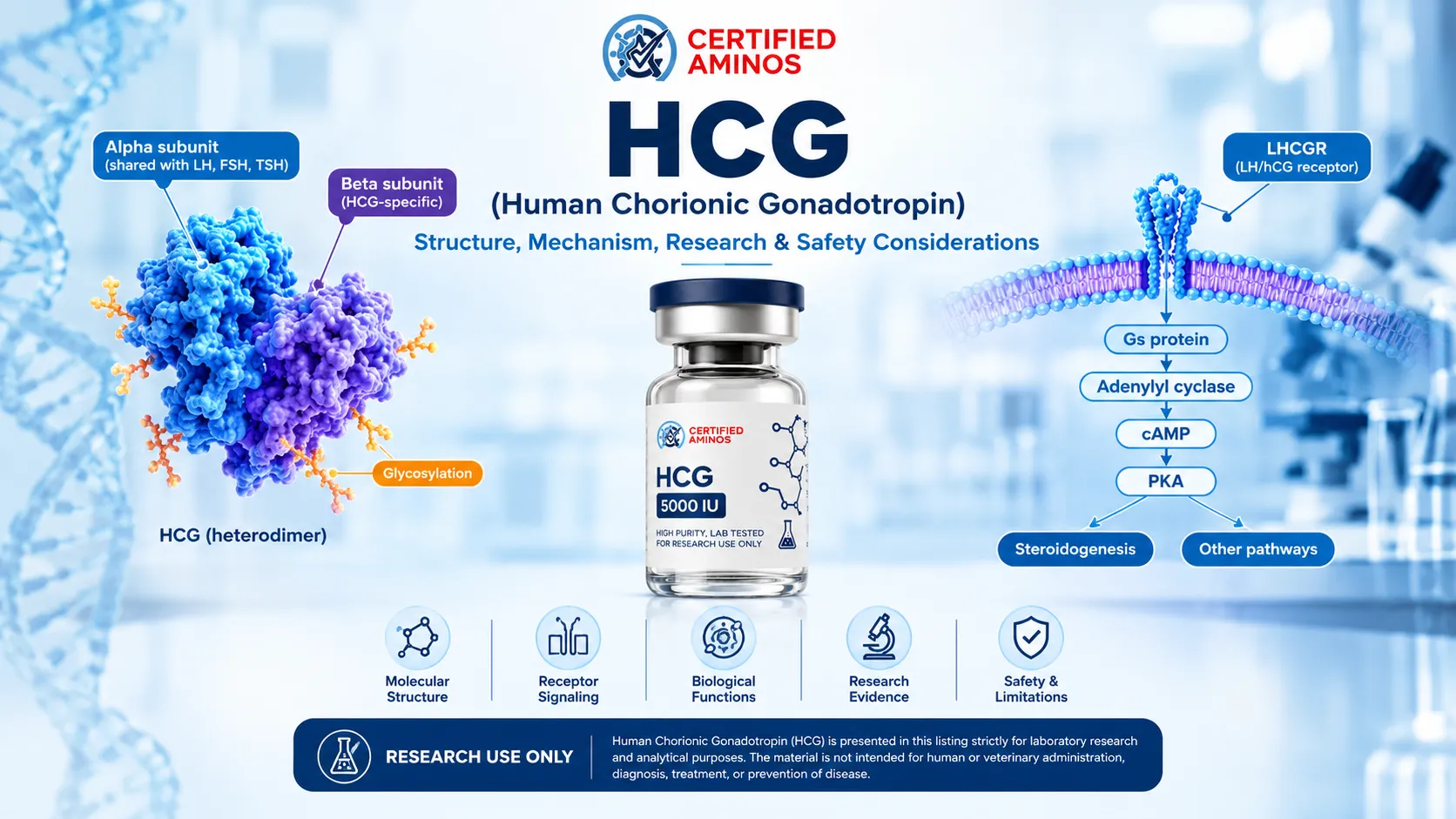
Human chorionic gonadotropin, abbreviated HCG, is the full name of the hormone discussed throughout this article. Unlike short-chain research peptides, HCG is classified as a glycoprotein hormone: a heterodimer built from two separate polypeptide chains that associate non-covalently and carry branched sugar (glycan) chains attached at several points (Fares, 2006). This structural complexity is why HCG behaves differently than small linear peptides in research contexts, and why describing it simply as "the HCG peptide" oversimplifies its biology — even though that phrasing is common in casual search queries.
HCG is naturally synthesized by syncytiotrophoblast cells of the placenta. Its biological significance lies in its capacity to activate the same receptor used by LH, extending LH-like signaling into early pregnancy at a point when pituitary LH output alone would not sustain the corpus luteum (Duncan, 2021).
What Is HCG's Molecular Structure?
HCG's two subunits differ in origin and function:
- Alpha subunit — structurally identical to the alpha subunit found in LH, FSH, and thyroid-stimulating hormone (TSH). It is encoded by a shared gene and does not, on its own, distinguish HCG from its relatives (Fares, 2006; Pigny et al., 1992).
- Beta subunit — unique to HCG, and responsible for the hormone's receptor specificity and immunological identity. It is also the subunit that pregnancy-test immunoassays are built to detect (Berger et al., 1996; Berger et al., 2002).
A further structural distinction is the beta subunit's carboxy-terminal peptide (CTP) — a stretch of amino acids bearing four O-linked glycan chains that LH's beta subunit lacks. Research indicates the CTP and its glycans are not required for receptor binding itself, but substantially extend the hormone's circulating half-life, which is part of why HCG persists in blood and urine longer than LH (Fares, 2006). Both subunits also carry N-linked glycans that, while not essential for receptor binding, are necessary for full signaling competence once the hormone is bound (Fares, 2006; Pigny et al., 1992).
Each subunit is stabilized by a cystine-knot motif — three disulfide bonds that lock the backbone into a compact fold characteristic of a broader family of growth-factor-like proteins (Berger et al., 1996). Reported molecular weight for the intact heterodimer falls in roughly the mid-30-kilodalton range, though exact figures vary across glycoform preparations and analytical methods — single-point molecular-weight claims should be read as approximate, not absolute.
Because HCG, LH, FSH, and TSH all share the same alpha subunit, their biological distinctiveness comes entirely from their respective beta subunits and from how those beta subunits shape receptor engagement and downstream signaling (Pigny et al., 1992).
The mature alpha subunit is approximately 92 amino acids long; the beta subunit is larger and carries the carbohydrate-rich CTP described above. "HCG" is also not a single uniform molecule in the body: the literature describes several naturally occurring variants — regular (fully assembled) HCG, hyperglycosylated HCG produced by invasive cytotrophoblast cells, and a free beta-subunit form — each with somewhat different glycosylation and biological roles across pregnancy (Cole, 2009). This article refers to regular, fully assembled HCG unless otherwise noted, and does not treat all HCG-related molecular forms as chemically identical.
How Does HCG Work? Mechanism of Action
HCG's primary mechanism of action is receptor-mediated: it binds the luteinizing hormone/choriogonadotropin receptor, LHCGR, a class A G protein-coupled receptor (GPCR) expressed on ovarian theca- and granulosa-lineage cells and on testicular Leydig cells (Lee et al., 2021; Perri et al., 2026).
Receptor engagement follows a well-characterized sequence. The hormone's beta subunit, supported by the shared alpha subunit, docks onto the large extracellular domain of LHCGR. This triggers a conformational change transmitted across the membrane to the receptor's intracellular face, activating heterotrimeric G proteins, predominantly of the Gs class (Ayoub et al., 2016). Active Gs stimulates adenylyl cyclase, raising intracellular cyclic AMP (cAMP); cAMP activates protein kinase A (PKA), which phosphorylates downstream targets that initiate steroidogenesis (Ayoub et al., 2016; Lee et al., 2021).
Downstream of PKA activation, one documented target is the steroidogenic acute regulatory protein (StAR), which shuttles cholesterol across the mitochondrial membrane — the rate-limiting step for steroid hormone synthesis. The Gs/cAMP/PKA cascade described above is the dominant, best-characterized route by which HCG and LH drive StAR-dependent steroidogenesis in Leydig and luteal cells.
The Gs/cAMP/PKA route is not the only pathway reported at LHCGR. Older structural and pharmacological work also describes a secondary, generally weaker coupling of LHCGR to Gq/11 proteins, which can activate phospholipase C to generate inositol trisphosphate and mobilize intracellular calcium; this pathway has been reported mainly at higher ligand concentrations or in specific cellular contexts and is considered secondary to the dominant Gs/cAMP route rather than an equally weighted parallel pathway (Ascoli et al., 2002). LHCGR activation can additionally engage mitogen-activated protein kinase (MAPK/ERK) signaling, and here the distinction between LH and HCG becomes scientifically interesting: research comparing the two hormones at the identical receptor reports that LH preferentially drives ERK1/2 and AKT activity — associated with proliferative and anti-apoptotic signaling — while HCG more strongly drives cAMP/PKA-mediated steroidogenic signaling, with LH and HCG beta subunits sharing only around 85% sequence identity despite acting on the same receptor (Casarini et al., 2018). The same research also reports LH and HCG have different circulating half-lives — roughly 90 minutes for LH versus several hours for HCG — which the authors tie to their distinct physiological jobs rather than to any difference in potency alone.
Growing pharmacology research complicates a simple "HCG equals LH" assumption. Although HCG and LH converge on the identical LHCGR, structural and functional studies show the two hormones produce distinguishable signaling output through that one receptor, likely reflecting differences in binding kinetics and in how each hormone stabilizes particular receptor conformations (Perri et al., 2026). LHCGR signaling also is not limited to the canonical cAMP/PKA pathway: receptor activation can additionally recruit beta-arrestin pathways, and research into biased ligands and modulators has shown these pathways can be pharmacologically separated from classical cAMP output, with different downstream consequences for progesterone versus testosterone production in Leydig-cell models (Ayoub et al., 2016).
It is important to separate what is well established from what remains investigational. The existence of LHCGR, its coupling to Gs/cAMP/PKA, and its role in triggering steroidogenic enzyme activity are grounded in decades of receptor pharmacology (Ayoub et al., 2016; Lee et al., 2021). Finer-grained claims — exact binding affinities for a specific HCG preparation, precise potency ratios versus LH, or the clinical significance of biased signaling in humans — remain active research questions rather than settled facts; this article does not assign specific numeric values to them beyond what the cited literature reports.
What Are HCG's Biological Functions?
HCG's best-documented physiological role is in early pregnancy. After implantation, placental syncytiotrophoblast cells begin producing HCG, which travels to the ovary and activates LHCGR on the corpus luteum — the structure left behind after ovulation (Duncan, 2021). Under LH's cyclical influence, the corpus luteum would normally regress after about two weeks; HCG rescues it from that regression and sustains its production of progesterone, the hormone responsible for maintaining the uterine lining pregnancy depends on. The literature describes HCG performing this corpus-luteum-rescue function for roughly six to eight weeks, after which the placenta itself takes over progesterone production and the corpus luteum involutes (Duncan, 2021).
This is natural pregnancy physiology, driven by a woman's own placental tissue — a distinct subject from laboratory research that studies isolated HCG protein in cell or animal models. This article does not offer guidance on pregnancy symptoms, personal fertility decisions, or interpretation of an individual's hormone levels; those questions belong with a qualified clinician.
Beyond pregnancy maintenance, HCG's shared activation of LHCGR gives it a documented role as a research tool in male reproductive-endocrinology research (below) and underlies the immunoassays used in clinical pregnancy and oncology testing.
HCG vs. LH, FSH and TSH
All four hormones share the identical alpha-subunit gene product, but distinct beta subunits confer receptor specificity — so despite their structural kinship, none of the four is interchangeable with another (Pigny et al., 1992; Fares, 2006).
How Is HCG Used in Male Reproductive-Endocrinology Research?
Because HCG and LH converge on LHCGR, HCG is used in research settings as an experimental activator of testicular Leydig cells — the LHCGR-expressing cells responsible for testosterone synthesis in men (Ayoub et al., 2016). In cell and animal models, HCG-driven LHCGR activation triggers the same cAMP/PKA cascade described above, upregulating the steroidogenic machinery that converts cholesterol into testosterone. Research using HCG as a Leydig-cell stimulus has also examined how steroidogenic capacity changes with aging, since aged Leydig cells show reduced receptor numbers and blunted cAMP responses to the same hormonal stimulus (Zirkin & Chen, 2000).
This research context is distinct from testosterone-replacement or fertility-protocol use in people, which this article does not address. No dosing, injection, cycling, or TRT-combination information is provided here, and none of the findings summarized above establish that any specific research-use HCG product is safe or effective for human administration.
How Does HCG Relate to Female Reproductive Biology?
In female reproductive physiology, HCG's receptor target overlaps with structures already primed by the LH surge that triggers ovulation. Granulosa and theca cells of the dominant follicle — and later the corpus luteum they form — express LHCGR, giving HCG access to the same signaling apparatus LH uses during the natural cycle (Lee et al., 2021). Research has used this overlap to characterize corpus luteum insufficiency and the hormonal support some fertility protocols study during assisted reproduction, where exogenous HCG or HCG-like signaling is examined for its capacity to support luteal progesterone output (Duncan, 2021).
This section summarizes general reproductive-endocrinology research and does not provide infertility treatment instructions, medication recommendations, or guidance on personal reproductive decisions.
How Strong Is the Scientific Evidence on HCG?
Evidence about HCG spans a wide range of study types, and conflating them is one of the most common sources of confusion about this hormone. Established pharmacology — the existence of LHCGR, its Gs/cAMP/PKA coupling, and HCG's capacity to activate it — rests on decades of biochemical and cell-based research (Ayoub et al., 2016; Lee et al., 2021). More specific claims, such as how HCG's signaling output differs quantitatively from LH's at the same receptor, come from a smaller and more recent body of structural and pharmacological work that is still being refined (Perri et al., 2026). Separately, FDA-approved HCG pharmaceuticals (for specific infertility and male hormonal indications) have undergone formal human clinical evaluation as regulated drug products — but that evaluation applies to those specific, regulated formulations, not to HCG as a generic research material, and not to any research-use-only listing sold without that regulatory history.
No research-use-only HCG listing, including the Certified Aminos listing, sits in the two bottom rows of this table.
No human clinical trial of the Certified Aminos HCG listing specifically has been identified, and none should be assumed. Readers evaluating HCG research claims should ask, for any given statement, whether it traces to animal data, in vitro/cell-based data, human data from an approved pharmaceutical formulation, or a research-use material with no published human data of its own.
What's the Difference Between HCG and Beta-HCG Testing?
A frequent point of confusion is the relationship between HCG as a research subject and "beta-HCG" as a clinical test result. Quantitative and qualitative pregnancy tests use antibodies that target the hormone's unique beta subunit — this is why the test is often called a "beta-HCG" test, and why immunoassay design depends heavily on the epitope-mapping research summarized earlier (Berger et al., 1996; Berger et al., 2002). A positive or elevated beta-HCG result reflects the immunoassay's detection of circulating or urinary HCG (or related variants such as nicked HCG or HCG beta-core fragment); it says nothing about the purity, identity, or research-grade quality of a separate HCG research material purchased for laboratory use.
This article does not provide pregnancy-level interpretation charts, week-by-week reference ranges, or guidance for interpreting an individual's test result — those questions belong with a clinician or laboratory, since quantitative HCG reference ranges are assay- and lab-specific.
What Are HCG's Safety Considerations and Research Limitations?
Safety information about HCG exists almost entirely in the context of regulated pharmaceutical products, not research-use materials. The FDA-approved prescribing information for pharmaceutical HCG injections documents warnings associated with that specific product in its approved clinical use, including hypersensitivity reactions and, in ovulation-induction protocols, the risk of ovarian hyperstimulation syndrome — a condition documented in regulated fertility treatment, not demonstrated for any research-use-only (RUO) listing (FDA, Pregnyl prescribing information). Because receptor activation drives real downstream endocrine signaling — steroidogenesis, progesterone and testosterone output — any material capable of engaging LHCGR has inherent biological activity, which is a reason for caution in handling, not a safety endorsement.
None of this safety information transfers to the Certified Aminos HCG listing specifically. That listing's purity and identity have not been independently confirmed, no batch-specific certificate of analysis (COA) is currently published for it, and no human safety or efficacy data exist for this particular research material. It should never be treated as safe for human use on the basis of pharmaceutical labeling for a different, regulated product.
HCG and Weight Loss: What Does the Scientific Evidence Say?
HCG has been associated with weight-loss marketing for decades, almost entirely through unapproved over-the-counter "HCG diet" products. The FDA states plainly that there are no FDA-approved HCG products for weight loss (FDA, Questions and Answers on HCG Products for Weight Loss). The agency has specifically addressed homeopathic and over-the-counter HCG drops, pellets, and sprays marketed for weight loss, and in a joint action with the Federal Trade Commission issued warning letters to multiple companies selling such products — describing them as unapproved new drugs and misbranded, and stating that all products advertised as "homeopathic HCG" are illegally marketed (FDA, Questions and Answers on HCG Products for Weight Loss).
The core scientific problem with HCG weight-loss claims is a confound with the diets these products are sold alongside. FDA's consumer guidance states that any weight loss seen with HCG diet plans comes from severe caloric restriction — commonly around 500 calories a day — not from HCG itself, and that approved HCG drug labeling states there is no substantial evidence HCG increases weight loss beyond what caloric restriction alone produces (FDA, Avoid Dangerous HCG Diet Products). Very-low-calorie diets of that kind carry real risks — including gallstones, electrolyte imbalances, and cardiac arrhythmia — and are only used clinically under direct medical supervision (FDA, Avoid Dangerous HCG Diet Products).
This article does not promote HCG diets, weight-loss protocols, or any product as a weight-loss aid. The Certified Aminos HCG listing is explicitly not marketed or intended for that use.
How Should You Evaluate HCG Product Documentation?
Evaluating a research hormone listing requires distinguishing several things often bundled under a single "purity" claim: molecular identity, batch purity, biological potency, glycosylation pattern, sterility, endotoxin status, and lot-to-lot consistency. No single test establishes all of these at once. High-performance liquid chromatography (HPLC) is commonly used to assess purity by separating a sample's components, but HPLC purity alone does not confirm molecular identity, confirm the correct glycosylation profile, or demonstrate biological potency — those require complementary methods such as mass spectrometry (identity) and cell-based or receptor-binding bioassays (potency), given how sensitive glycoprotein hormone bioactivity is to glycosylation state (Fares, 2006). A certificate of analysis (COA) is only as meaningful as the specific batch and tests it documents; a COA for one lot does not verify a different lot. Our 12-point COA red-flag checklist walks through how to read one of these documents line by line.
As of this review, the live Certified Aminos HCG product page states directly that purity and identity are not independently verified, that no batch-specific COA is currently published for this listing, and that identity has not been confirmed by mass spectrometry or an equivalent method. At the same time, the page displays trust badges referencing "Verified Purity ≥99%," "HPLC certified," third-party analysis, and "Documented… COA… Full traceability." Readers should treat those badge claims as supplier-level marketing language rather than independently verified results until a batch-specific COA is actually published and linked. This discrepancy is disclosed here for accuracy, not as a criticism of any specific batch — it reflects a limitation that the listing's visual badging and its own detailed specification text do not currently agree.
What Does Research Use Only Mean for HCG?
Research Use Only (RUO) is a labeling category for materials intended for laboratory and analytical research rather than human or animal administration. An RUO designation does not mean a material has been evaluated for human safety or efficacy, and it does not imply FDA approval of any kind — RUO materials specifically fall outside that regulatory pathway. Separately, some pharmaceutical products containing HCG do carry FDA approval for narrow, specific indications (described above); that approval belongs to those regulated formulations alone and does not transfer to, or validate, an RUO listing sold under a different label, through a different process, without the same manufacturing and clinical oversight. For a fuller breakdown of what the RUO label does and doesn't establish, see what Research Use Only actually means.
The Certified Aminos HCG listing is explicitly not intended for human or veterinary administration, diagnosis, treatment, or disease prevention, and should be handled only within a legitimate laboratory research context.
Common Research Misunderstandings About HCG
"Isn't HCG just another research peptide?"
HCG is frequently grouped with short-chain research peptides in casual search queries, but it is a glycoprotein hormone — a two-subunit, glycosylated heterodimer with a cystine-knot fold, structurally closer to LH, FSH, and TSH than to a linear peptide chain (Fares, 2006). The term "HCG peptide" is used naturally in search behavior, but the scientific classification remains glycoprotein hormone.
"Aren't the alpha and beta subunits basically interchangeable?"
No. The alpha subunit is identical across LH, FSH, TSH, and HCG, so it cannot be what makes HCG unique. Receptor specificity and immunological identity come entirely from the beta subunit, which differs between all four hormones (Pigny et al., 1992).
"Is HCG the same as LH since they use the same receptor?"
Sharing a receptor is not the same as being identical hormones. HCG and LH both activate LHCGR, but current structural and functional research shows they produce distinguishable signaling patterns through that single receptor, consistent with their separate physiological roles (Perri et al., 2026).
"If LH, FSH, TSH, and HCG share an alpha subunit, are they interchangeable?"
No. The shared alpha subunit explains their family resemblance, but each hormone's distinct beta subunit determines which receptor it binds and what physiological effect it produces (Pigny et al., 1992; Fares, 2006).
"Why is LHCGR signaling described as complicated rather than a simple on/off switch?"
Because it isn't just an on/off switch. Beyond the canonical Gs/cAMP/PKA pathway, LHCGR can engage beta-arrestin-mediated signaling, and research on biased ligands shows these pathways can be pharmacologically separated, with different consequences for progesterone versus testosterone output in Leydig-cell models (Ayoub et al., 2016).
"Does HCG cause pregnancy, or does pregnancy cause HCG?"
Placental tissue begins producing HCG after implantation has already occurred — HCG is a consequence of early pregnancy, not its cause. Its job at that point is to rescue the corpus luteum so it keeps producing progesterone (Duncan, 2021).
"Does research on HCG and testosterone mean HCG is a testosterone booster?"
Research using HCG to activate Leydig-cell LHCGR and study steroidogenesis is laboratory and animal-model science, not a human performance or supplementation claim (Zirkin & Chen, 2000; Ayoub et al., 2016). This article provides no dosing, cycling, or TRT-combination guidance.
"Is a research-use HCG listing the same as the prescription HCG a doctor might prescribe?"
No. FDA-approved HCG pharmaceuticals went through a formal, regulated clinical-evaluation and manufacturing pathway for specific indications. A research-use-only listing has not gone through that same pathway, and its safety and efficacy for human use have not been established.
"If my pregnancy test is positive, does that say anything about a research HCG product's quality?"
No. A beta-HCG immunoassay detects a person's own circulating or urinary HCG; it has no relationship to the purity, identity, or manufacturing quality of a separate research-use HCG material (Berger et al., 1996).
"Didn't the FDA approve an HCG weight-loss diet?"
No. The FDA states explicitly that there are no FDA-approved HCG products for weight loss, and has taken joint enforcement action with the FTC against companies selling unapproved, misbranded OTC "homeopathic HCG" weight-loss products (FDA, Questions and Answers on HCG Products for Weight Loss).
"If a product says '≥99% HPLC-certified purity,' doesn't that prove it's pure and safe?"
HPLC purity measures only one property — the relative abundance of components separated under specific conditions. It does not by itself confirm molecular identity, glycosylation pattern, biological potency, sterility, or endotoxin status, all of which require separate testing. A purity badge is not a substitute for a batch-specific, independently issued COA.
"Does 'Research Use Only' just mean 'approval is pending' but the product is still fine to use?"
No. RUO means the material is intended for laboratory and analytical research and has not been evaluated by the FDA for human safety or efficacy — it is not a pending or provisional approval status, and RUO materials are not intended for human or veterinary administration.
Conclusion
HCG's molecular identity as a glycoprotein heterodimer, its activation of LHCGR, and its well-documented role in sustaining the corpus luteum during early pregnancy are established physiology, supported by decades of endocrinology research (Duncan, 2021; Ayoub et al., 2016). More granular questions — exactly how HCG's signaling at LHCGR differs from LH's, the fine detail of biased signaling pathways, and the comparative pharmacology of specific preparations — remain active areas of investigation (Perri et al., 2026).
What research does not establish is the safety, purity, or efficacy of any specific research-use-only HCG listing for human use; that determination depends on independently verified identity and purity data that, for the Certified Aminos listing, is not currently published. Readers who want to review HCG's documented specifications for laboratory and analytical research purposes can view the HCG research listing from Certified Aminos for available product specifications and current research-use information.
Research Use Only Reminder: Human Chorionic Gonadotropin (HCG) is presented in this article, and in the associated Certified Aminos listing, strictly for laboratory research and analytical purposes. It is not intended for human or veterinary administration, diagnosis, treatment, or prevention of disease. This research listing is not an FDA-approved pharmaceutical product. References to approved HCG medications relate to separate, regulated pharmaceutical products and must not be interpreted as an approval, safety determination, or efficacy claim for this research material.