12 Peptide Red Flags: How to Check COAs, Testing, and Supplier Claims
Research methodsOctober 22, 202619 min read
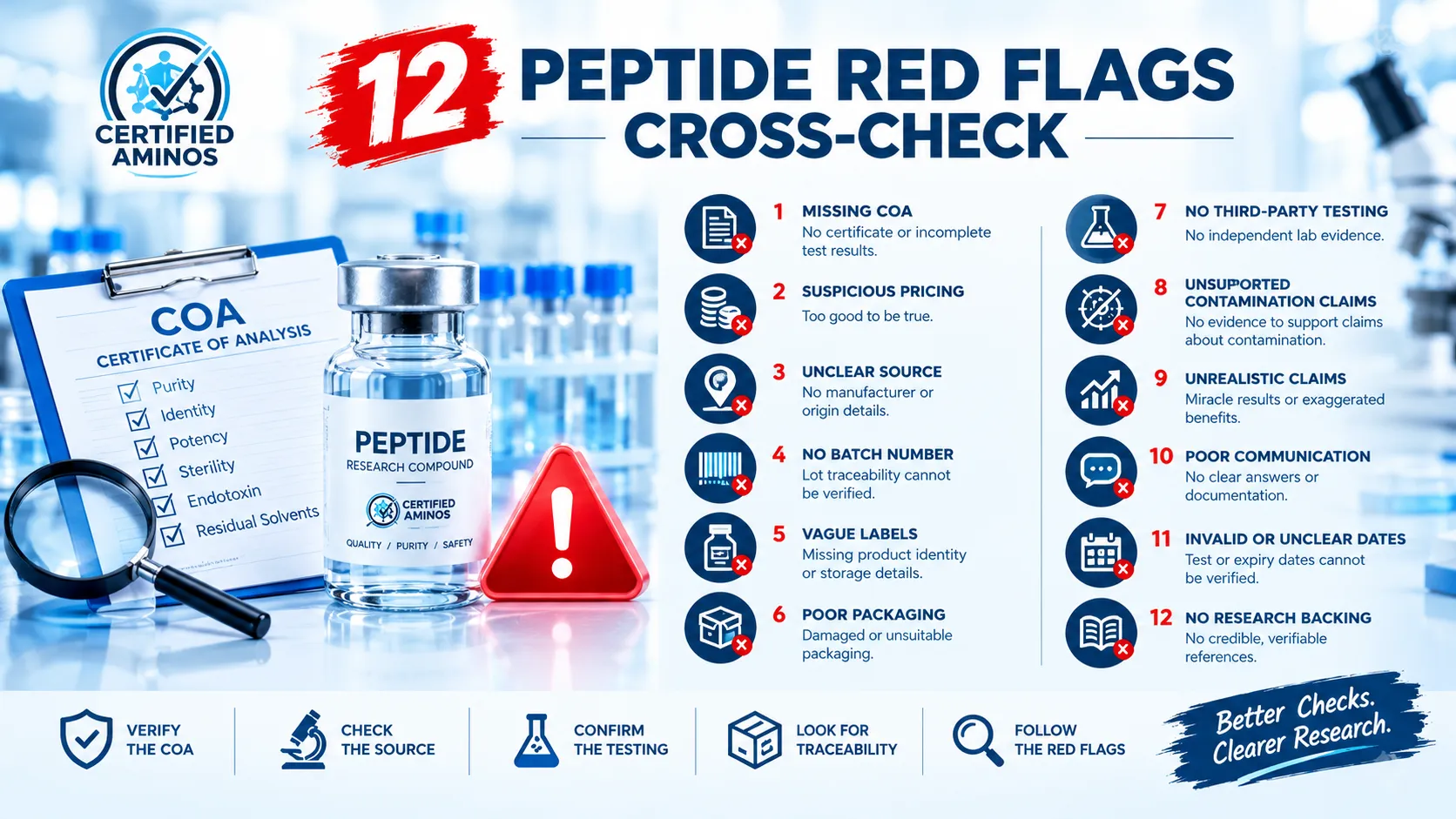
A peptide COA red flag is a gap between what a supplier claims and what the documentation shows. Twelve checks, what each one can settle, and where the evidence runs out.
A COA is evidence only for the sample it names. Its usefulness depends on compound identity, lot linkage, stated methods, the issuing laboratory, and dated results — all five, not just a percentage.
A red flag is a prompt to verify, not an accusation. Missing information, an inconsistency, and an unverifiable claim are three different situations with three different responses.
Purity, identity, sterility, and endotoxin status are separate questions. Each needs its own test and its own result; no single number covers them all.
Research Use Only labelling does not settle regulatory status. FDA assesses intended use from the whole of a product's marketing, not from a disclaimer alone.
A peptide COA red flag is a gap or mismatch between what a supplier claims and what its documentation actually shows. It signals that a claim needs verifying. It does not, by itself, establish that a compound is mislabelled, impure, or poorly made.
That distinction matters more than it sounds. Laboratory procurement runs on documents, and documents can be incomplete for ordinary reasons — a report still in transit, a lot tested after a page went live, a clerical slip. Marketing copy, however, is not a document in this sense. A purity figure printed on a product page is a statement of intent; an analytical result on a dated report for a named lot is evidence. Treating the two as equivalent is the single most common sourcing error in this market.
The concern is not hypothetical. In a peer-reviewed quality evaluation, researchers at Ghent University ordered synthetic quorum-sensing peptides at a requested purity of at least 95.0%, each supplied with a certificate stating that level. In the team's own quality-control analysis, only 44.0% of the peptides met the requested purity, and one sample's main compound turned out to have a different structure from the peptide ordered. That study examined one set of research peptides a decade ago, so it does not describe today's market. Nevertheless, it demonstrates the principle cleanly: an authentic certificate and an accurate result are two different things.
What follows is a verification procedure rather than a warning list. Each red flag covers the problem, a realistic example, how to check it, what to ask for, and what the check still cannot settle.
What Makes a Peptide COA Useful Evidence?
A certificate of analysis reports what a laboratory found when it examined a particular sample on a particular date. Consequently, it is useful only to the extent that five things can be checked.
Identity of the material. The report should name the compound, its salt or counterion form, and the physical form examined.
Linkage to a batch. A lot or batch number ties the report to specific material. Without it, a report describes some sample, not necessarily yours.
Analytical methods. A figure without a method is uninterpretable, because purity means different things under different techniques.
The issuing laboratory. An identifiable laboratory, with a report reference, makes the result traceable to a source that can confirm it.
Dated, reported results. Analysis and issue dates place the result in time; the actual values make it a result rather than a statement.
When all five hold, a reader can interpret the document. When any is absent, interpretation narrows accordingly — which is exactly what the twelve checks below map out.
Red Flag 1: No COA Is Available for the Specific Batch
The problem. A supplier states a testing policy — every batch is tested, all products are HPLC verified — but cannot produce a report for the lot in hand. A policy describes a process. A certificate documents an outcome for one batch.
What it looks like. A product page carries a purity badge and a line about independent laboratories, while the certificates section holds no downloadable report for the lot shipped.
How to verify. First, look for a documentation library and check whether it contains reports at all, or only a statement that reports are forthcoming. Then ask directly for the report covering your lot number.
What to ask. "Was this lot tested, by which laboratory, and may I have the report?" The answer is informative either way.
The limitation. Absence of a document is not evidence of absence of testing, and it is certainly not proof of fraud. It leaves the batch undocumented, which means its analytical status is unknown rather than poor. Treat it as unverified and decide accordingly.
Red Flag 2: The Lot Number on the COA Does Not Match the Vial
The problem. The lot number is the only thing connecting a physical vial to a test result. When the two disagree, the report describes different material.
What it looks like. A vial reads LOT CA-2411-07 while the supplied certificate names CA-2309-02 — or the label carries no lot at all, so no comparison is possible.
How to verify. Photograph the label on arrival, before anything is opened or relabelled. Then compare the lot character by character against every report provided, including any batch reference inside the report body rather than only in its header.
What to ask. "Does a report exist for the lot I received, and if not, which lot does this certificate cover?"
The limitation. A matching lot number shows that two documents name the same batch. It does not confirm that your vial was filled from the material the laboratory received, since that link rests on the manufacturer's own internal records rather than on anything printed on the report.
Red Flag 3: Purity Is Advertised Without a Supporting Result
The problem. A number on a product page and a number on a dated report are not the same category of evidence. One is a claim about a standard; the other is a measurement of a sample.
What it looks like. A badge reads "≥99% purity" sitewide, appearing identically on every listing regardless of compound, lot, or format. Sitewide badges are a strong signal that the figure is a specification rather than a per-batch result.
How to verify. Check whether the same figure appears on unrelated products. Then look for the corresponding report: a method, a sample identifier, an analysis date, and a reported value.
What to ask. "Is the ≥99% figure a specification you set, or a measured result for this lot? May I see the chromatogram?"
The limitation. A specification can be entirely legitimate and routinely met. Still, a specification states a target, whereas a result states what was found. Only the second tells a researcher anything about the vial on the bench.
Red Flag 4: HPLC and Mass Spectrometry Are Treated as Interchangeable
The problem. The two techniques answer different questions, and a report that blurs them obscures what was actually established.
High-performance liquid chromatography separates components in a mixture and quantifies them by detector response, which supports an assessment of chromatographic purity — how much of what the detector saw corresponds to the main peak. Mass spectrometry measures mass-to-charge ratios, which supports an assessment of molecular mass, and therefore contributes evidence about identity. Neither technique, used alone, establishes everything about a sample.
What it looks like. A page states "HPLC/MS verified" with one percentage attached, leaving unclear which instrument produced which conclusion.
How to verify. Read the report for two distinct sections: a chromatographic purity result with its method, and a mass result with observed versus theoretical mass.
What to ask. "Which method produced the purity figure, and what observed mass did MS return?"
The limitation. An HPLC purity figure is detector-dependent, so impurities that respond weakly at the chosen wavelength may be under-represented — the mechanism the Ghent authors linked to part of the gap they measured. A matching mass, meanwhile, is consistent with the target compound without excluding every isobaric alternative.
Red Flag 5: "Third-Party Tested" With No Verifiable Laboratory Report
The problem. Independence is the entire value of third-party testing. An unnamed laboratory cannot be shown to be independent, or to exist.
What it looks like. A site says independent US laboratories perform the testing, yet no report names one, and a search for the laboratory returns only the supplier's own pages.
How to verify. Look on the report for the laboratory's full name, address, report reference, sample identifier, and analysis date. Then confirm the laboratory exists independently, and check whether its published contact details match the report.
What to ask. "Which laboratory issued this report, and what is its report reference?"
The limitation. Laboratories differ widely in capability, and third-party status alone does not make a result accurate. Conversely, a small laboratory with little public presence may produce sound data. The point of this check is traceability to a named issuer, not a verdict on competence.
Red Flag 6: The COA Has No Clear Test Date or Sample Identification
The problem. A result belongs to a sample at a point in time. Strip out the date or the sample identifier, and the report stops describing anything specific.
What it looks like. A certificate shows a purity value and a method but no analysis date; or dates appear in an impossible order, with analysis preceding the manufacture of the batch.
How to verify. List every date on the label and report — manufacture, sample receipt, analysis, issue — and check the sequence runs forward. Then confirm the sample description matches the product sold.
What to ask. "What was the manufacture date for this lot, and when did the laboratory receive and analyse the sample?"
The limitation. An older report is not invalid because of its age. However, it describes the material as it was then. Storage, handling, and shipping since that date are separate questions that no analytical report answers retroactively.
Red Flag 7: Purity Is Confused With Identity
The problem. A high purity percentage says that one component dominates what the detector measured. It does not say that the dominant component is the compound ordered.
What it looks like. A listing presents 99.4% as proof that the vial contains, for example, a particular growth-hormone fragment — while the report contains no mass or sequence data at all.
How to verify. Look for identity evidence as a separate line item: observed versus theoretical molecular mass, and for more complex or disulfide-containing peptides, peptide mapping or sequence confirmation. USP's informational general chapter 1503, Quality Attributes of Synthetic Peptide Drug Substances, is the reference point for the attribute set used in a pharmaceutical context.
What to ask. "Which result on this report establishes identity, as distinct from purity?"
The limitation. Identity methods have their own limits. A matching mass supports identity; it does not by itself exclude every structurally related variant, which is precisely why identity and purity are reported as separate attributes rather than merged into one number.
Red Flag 8: "99% Pure" Is Presented as Proof of Safety or Efficacy
The problem. Purity is an analytical measurement. Safety and efficacy are regulatory and clinical conclusions reached through entirely different evidence.
What it looks like. Copy that moves from a purity figure to a reassurance about quality, suitability, or outcomes — sometimes in the same sentence.
How to verify. Read the report and list what it actually measured. Then compare that list against the claim being made.
What to ask. "Which of these results speaks to sterility, endotoxin content, or residual solvents?" Usually, none of them do.
The limitation. A purity percentage does not establish sterility, endotoxin status, absence of residual solvents or trace metals, stability, clinical efficacy, regulatory approval, or suitability for administration to humans or animals. A standard purity-and-identity COA is not designed to assess those properties, so its silence on them is expected rather than suspicious. The error lies in the inference, not in the report.
Red Flag 9: Unsupported Claims About Sterility, Endotoxins, or Contaminants
The problem. Different questions require different tests. Chemical purity, microbial content, bacterial endotoxin, residual solvents, and elemental impurities are five separate assessments with five separate methods.
What it looks like. A page describes a product as sterile or endotoxin-free while the only available report lists purity and mass.
How to verify. Match every quality claim on the page to a named test, method, and result. Bacterial endotoxin testing, for instance, is performed under USP chapter 85, the chapter FDA addresses in its Pyrogen and Endotoxins Testing: Questions and Answers guidance, revised in March 2026. Under US GMP rules for finished pharmaceuticals, each batch purporting to be sterile or pyrogen-free requires appropriate laboratory testing to determine conformance.
What to ask. "Which report contains the sterility or endotoxin result, and what method was used?"
The limitation. Not every research material requires every panel; the appropriate testing set depends on the compound and the intended laboratory application. A missing test is therefore only a problem when a claim depends on it.
Red Flag 10: No Information About the Analytical Method or Its Limits
The problem. A result without a method cannot be interpreted, compared across suppliers, or reproduced.
What it looks like. A report lists "Purity: 99.1%" with no column, mobile phase, gradient, detection wavelength, or system suitability information — and no reference standard named.
How to verify. Look for the method identifier and enough parameters to understand what was measured. For quantified impurities, look for the reporting threshold or limit of quantitation, since values below it simply are not reported. ICH Q2(R2), the current international guideline on validation of analytical procedures, sets out the characteristics a validated method addresses, including specificity and the lower range limit.
What to ask. "Was this method validated, against what reference standard, and what is its reporting threshold?"
The limitation. Method detail is useful without being decisive. A fully documented method tells a reader what the laboratory looked for; it cannot rule out impurities the method was never designed to detect.
Red Flag 11: Manufacturing, Accreditation, or Quality Claims Cannot Be Verified
The problem. Promotional wording and verifiable credentials look similar on a web page and behave very differently under checking.
What it looks like. Phrases such as "ISO certified laboratory" or "GMP facility" appear with no certificate number, no accrediting body, and no scope document.
How to verify. Separate three things. A supplier's statement is unverified until documented. An accreditation, such as ISO/IEC 17025 for testing laboratories, is granted by an accreditation body — ANAB, A2LA and other ILAC signatories publish searchable directories — and always covers a defined scope of methods. A quality-management certification such as ISO 9001 concerns a management system, not the technical competence of a specific test. None of the three is evidence that a particular batch underwent a particular analysis.
What to ask. "Which body issued the accreditation, what is the certificate number, and does its scope cover the method on my report?"
The limitation. Many laboratories serving the research-chemical market hold no accreditation, and that alone does not invalidate their data. Equally, accreditation attests to assessed competence within a scope; it does not certify any individual result.
Red Flag 12: RUO Labelling Is Treated as Proof of Legitimacy
The problem. A Research Use Only statement describes an intended use. It does not independently establish identity, purity, safety, or lawful marketing status.
What it looks like. A site treats an RUO disclaimer as a complete compliance answer, while the surrounding pages supply benefit language, reconstitution guidance, or injection supplies.
How to verify. Read the whole page, not just the footer. FDA's RUO guidance is written for in vitro diagnostic products, so it does not map directly onto research chemicals — a distinction worth holding onto when the phrase is used loosely. For drug products, intended use is determined under 21 CFR 201.128 from the objective evidence of how a product is presented. Throughout 2026, FDA issued warning letters to peptide sellers concluding that, despite "research use only" and "not for human or veterinary use" statements on their labelling, website evidence established the products were intended as drugs for human use. Our walkthrough of FDA's 2026 peptide actions covers what those letters did and did not change. Separately, registration carries no approval weight: under 21 CFR 207.77, registering an establishment or listing a drug does not denote approval, and representing otherwise constitutes misbranding.
What to ask. "What does this compliance statement cover, and what does it not?"
The limitation. This is not legal advice, and the analysis differs by product, jurisdiction, and business model. A document review cannot settle legal status.
Peptide COA Verification Checklist: What to Check Before Accepting a Report
Work through this with the vial, the report, and the product page open together.
Compound identification — name, salt or counterion form, and physical form match the product sold.
Batch or lot number — present on both the vial and the report, matching character for character.
Sample identifier — the report names the sample the laboratory received, not just the product line.
Issuing laboratory — full name and a report reference, identifiable independently of the supplier.
Test and issue dates — present, and in a sequence that runs forward from manufacture.
Analytical methods — named, with enough parameters to interpret the result.
Purity result — a measured value tied to a stated method, not a sitewide badge.
Identity result — observed versus theoretical mass, or equivalent, reported separately from purity.
Chromatograms or spectra — included where available, rather than summarised into a single figure.
Impurity or contaminant testing — present for any claim that depends on it.
Method limits — reporting threshold or limit of quantitation stated where impurities are quantified.
Batch relevance — the report covers the batch under consideration, not a predecessor.
Claim coverage — no claim on the product page goes beyond what the report shows.
This is an educational review checklist for evaluating documentation. It is not a legal or regulatory specification, and the appropriate attribute set varies by compound and application.
Supplier Claims and What They Actually Establish
Supplier claim
What it establishes
What it does not establish
Recommended verification
"99% purity"
That a figure has been stated — and, with a report, a chromatographic purity value for one sample under one method
Identity, sterility, endotoxin status, residual solvents, stability, safety, or content per vial
Request the dated report, the method, and the chromatogram for your lot
"Third-party tested"
That testing is claimed to be external to the supplier
Who tested it, when, under what method, or whether this lot was included
Ask for the laboratory's name, report reference, and analysis date
"HPLC verified"
That a separation-based purity assessment is claimed
Molecular identity, or impurities that respond poorly to the chosen detector
Check the method, wavelength, and system suitability data on the report
"Mass spectrometry confirmed"
That mass data support the expected molecular mass
Chromatographic purity, quantity, or the absence of co-eluting species
Compare observed against theoretical mass on the report
"COA available"
That a document exists somewhere in the supplier's catalogue
That a report exists for your lot, or that it is current
Request the report naming your specific lot number
"Sterile"
A claim requiring its own test under its own method
Anything, absent a sterility result; purity data do not address it
Ask for the sterility report, method, and date
"Made in the USA"
A country-of-origin statement about some stage of production
Which stage occurred where, or any quality, testing, or regulatory outcome
Ask which operations — synthesis, fill, testing — occurred in the US
"Research Use Only"
The supplier's stated intended use
Identity, purity, safety, approval, or lawful marketing status
Read the full page for claims that conflict with the stated use
What to Ask a Research Peptide Supplier
A short, written, specific request works better than a general enquiry. These questions are deliberately answerable.
Do you hold a certificate of analysis for this lot, and may I have the complete report as the laboratory issued it?
Which laboratory performed the analysis, and what is the report reference number?
Which analytical methods were used, and which result corresponds to purity versus identity?
Is the purity figure shown on the product page a specification or a measured result for this lot?
What reporting threshold or limit of quantitation applies to the impurity results?
Were any tests performed beyond purity and identity — for example, residual solvents, water content, or elemental impurities?
Was the finished product tested, or only the incoming raw material?
If the product is a blend, is each component reported separately? Our Semax / Selank blend guide shows why per-component evidence matters.
Where the product page states a quality or testing claim, which document supports it?
If no report exists for this lot, when was the most recent lot tested, and what distinguishes the two?
Note what a reply does not say as carefully as what it does. A clear "this lot has not been tested" is genuinely useful information, because it defines the gap precisely.
A Red Flag Is Not Proof of Fraud
Verification works best when a reader sorts findings into four buckets rather than two.
Supported by evidence. A claim matches a named document with a method, a date, and a result.
Unverified. A claim may well be true, but no accessible document demonstrates it. Most documentation gaps land here.
Contradicted by evidence. A claim conflicts with the available records — a lot mismatch, or a test that the report shows was never run.
Not assessable. The available documentation cannot answer the question at all, which is common for sterility, stability, and content claims on a purity-only report.
These distinctions matter practically. An honest supplier with a young catalogue can have a thin file; a polished file can describe the wrong batch. Keeping requests factual and private, rather than public and accusatory, also tends to produce better documentation faster.
Where This Leaves a Buyer
A COA review answers four narrow questions well: does a report exist, does it name your batch, which methods produced which results, and has the marketing outrun the evidence. It cannot tell you whether a vial is safe, sterile, stable, or fit for any form of administration. No certificate does that.
Consequently, the most useful stance is neither trust nor suspicion. It is accounting: for each claim, name the document that supports it, and mark the ones with no document behind them. That record is what makes a procurement decision defensible.
Certified Aminos products are supplied strictly for in-vitro laboratory research and analytical applications. Researchers can request batch-specific documentation through the Certificates of Analysis page or by contacting the team directly with a lot number.
Research Use Only disclaimer. All products offered by Certified Aminos are strictly intended for in-vitro laboratory research and analytical applications only. They are not approved for human consumption, therapeutic use, or medical application, and no dosing, reconstitution-for-administration, or treatment guidance is provided or implied. This article is educational content about evaluating analytical documentation. It is not medical, veterinary, or legal advice, and nothing in it establishes FDA approval, clearance, or authorisation of any product. Regulatory information was checked against authoritative sources on October 22, 2026 and may change.
Got Questions?
Frequently Asked Questions
A certificate of analysis is a laboratory document reporting the tests performed on a specific sample, the methods used, and the results obtained. It describes that sample on that date, not a product line in general.