KPV consists of three amino acids: lysine, proline, and valine. It corresponds to the C-terminal portion of α-MSH and is often referred to in scientific literature as α-MSH(11–13).
Laboratory studies and animal experiments have reported effects involving inflammatory pathways, including nuclear factor kappa B (NF-κB). However, findings in cells and animals do not establish that KPV is safe or effective for treating a condition in humans.
This guide covers what researchers have studied, what the evidence suggests, and what remains uncertain — including why Research Use Only (RUO) labeling matters when evaluating research materials, and why a compounding-eligibility vote is a different kind of claim than a scientific one.
What Is KPV Peptide?
KPV is a three-amino-acid peptide composed of:
- K — Lysine
- P — Proline
- V — Valine
The sequence is associated with residues 11–13 at the C-terminus of α-MSH. The parent peptide is derived from proopiomelanocortin (POMC), a larger precursor protein from which several biologically active peptides are produced.
Researchers have studied α-MSH for its roles in pigmentation, immune signaling, and inflammatory responses. Earlier research explored whether shorter fragments of α-MSH could retain certain biological activities without reproducing every function of the full-length peptide. That line of work — tracing the "minimal message sequence" of α-MSH — is what identified KPV (and the closely related four-residue fragment GKPV) as the smallest sequence reported to retain anti-inflammatory signaling in cell models.
KPV became a subject of investigation because preclinical research suggested that this small fragment could influence inflammatory signaling under specific experimental conditions. A foundational review in *Endocrine Reviews* discusses the development of this research area and the proposed anti-inflammatory properties of α-MSH-related peptides.
Importantly, a biological effect observed in a research model does not automatically translate into a clinical benefit.
How Is KPV Studied?
KPV research can be grouped into two broad categories.
1. In vitro research
In vitro studies examine biological processes in isolated cells or other controlled laboratory systems. Researchers can expose cells to a compound and measure changes in signaling pathways, inflammatory mediators, or cellular responses.
Published work has examined KPV in experimental settings involving human bronchial epithelial cells, cartilage-forming chondrocytes, and skin keratinocytes, among other cell types, generally measuring changes in NF-κB activity and the cytokines it controls. These studies can help researchers investigate possible mechanisms and identify questions for further testing.
However, isolated cells do not reproduce the full complexity of a living organism. They cannot independently establish clinical effectiveness, long-term safety, or how a compound behaves throughout the human body.
2. In vivo animal research
Animal studies investigate biological responses in living organisms. KPV has been examined in experimental models involving intestinal inflammation (chemically induced colitis in mice and rats) and corneal epithelial injury (a rabbit abrasion model), among other research contexts.
These models may help scientists explore biological activity under more complex conditions than cell culture alone. Nevertheless, differences between species, experimental methods, formulations, and routes of exposure can substantially affect the interpretation of results.
The key distinction: Cell and animal studies provide preclinical evidence. They do not, by themselves, demonstrate that KPV is an effective or safe treatment for people. No study identified for this article tested standalone KPV in human clinical trial participants.
How Might KPV Work?
One of the principal research interests surrounding KPV is its reported relationship with NF-κB signaling.
NF-κB is a family of transcription factors involved in regulating genes associated with immune responses and inflammation. Its activity varies according to the cell type, stimulus, and biological context.
Several independent cell-based studies have reported that KPV exposure reduces NF-κB activity and the downstream pro-inflammatory cytokines it controls — including TNF-α, IL-1, and IL-6 — with some work also reporting an increase in the anti-inflammatory cytokine IL-10. These findings make the pathway relevant to further investigation, but they do not establish that KPV produces a predictable anti-inflammatory effect in humans.
Why the mechanism remains an open question
The signaling activity of α-MSH is associated with melanocortin receptors, including MC1R. Classical MC1R signaling can involve changes in intracellular cyclic adenosine monophosphate (cAMP).
A 2004 study examining α-MSH-related peptides in human keratinocyte models did not detect a cAMP increase in response to KPV under the reported experimental conditions. The study also investigated intracellular calcium responses, illustrating that the signaling picture is more complex than a single pathway.
This does not establish one definitive alternative mechanism. Instead, it highlights the need for further research into how KPV interacts with cellular signaling systems. It is also why KPV cannot simply be assumed to act "like α-MSH, just smaller" — its receptor pathway has not been confirmed to be the same one.
Researchers should therefore distinguish between a proposed mechanism, an observed laboratory result, and a demonstrated clinical outcome.
What Does the Research Actually Show?
The findings above should be interpreted within the limitations of the individual studies. Experimental models, delivery systems, concentrations, and endpoints can differ, making direct comparisons difficult.
For example, a study using KPV in a specialized nanoparticle or hydrogel delivery system does not necessarily establish how unformulated KPV behaves. Similarly, findings involving related peptide derivatives — such as the cysteine-linked dimer (CKPV)₂ — should not automatically be attributed to KPV itself.
KPV Peptide Benefits: What Is Supported and What Remains Uncertain?
The phrase "KPV peptide benefits" is common in online searches, but it can make early-stage findings sound more conclusive than they are.
The more accurate question is: Which effects have researchers observed, and what can those observations legitimately establish?
What preclinical research suggests
Published research provides a scientific basis for investigating KPV in relation to inflammatory signaling and selected cellular responses. Some studies have reported changes in inflammatory markers in experimental systems, while animal studies have examined outcomes in specific models.
These observations may help guide future research questions.
What has not been established
The available evidence does not establish KPV as a proven treatment for inflammatory bowel disease, skin disorders, joint conditions, or other human diseases. It also does not establish a validated human dosage, a complete human safety profile, or reliable long-term outcomes.
Online summaries that present these possibilities as confirmed human benefits — including summaries that cite the 2026 FDA advisory-committee vote discussed below as if it were a safety or efficacy finding — go beyond what the evidence can demonstrate.
For readers evaluating scientific claims, the study design matters as much as the headline. A result from an isolated cell model should not be described as though it were a clinical trial, and a regulatory committee vote should not be described as though it were a scientific finding.
What Does Inflammation Research Say About KPV?
Inflammatory signaling is an important focus of KPV research because of the relationship between KPV and α-MSH-related biological activity.
Inflammation involves multiple interacting systems, including immune cells, signaling proteins, tissue-specific responses, and feedback mechanisms. NF-κB is one component of this wider network.
When a laboratory experiment reports a change in NF-κB activity or cytokine production, it provides information about that experimental setting. It does not establish that the same change will occur in a person, that the change will improve a disease, or that altering the pathway will necessarily be beneficial.
This distinction is particularly important when interpreting research involving animal models of intestinal inflammation. Such models can help scientists investigate biological processes, but they are not equivalent to clinical studies in people with diagnosed gastrointestinal conditions.
The responsible conclusion is that KPV remains a subject of preclinical investigation, with important questions about clinical relevance still unresolved.
What Are KPV's Safety and Research Limitations?
A limited evidence base creates uncertainty about safety as well as effectiveness.
The research reviewed for this article does not establish a comprehensive human safety profile for standalone KPV. The absence of such evidence should not be interpreted as proof that the compound is safe or unsafe in every possible context.
Important unanswered questions include:
- How KPV behaves in the human body.
- Whether its behavior differs by formulation or route of exposure.
- What dose-response relationships, if any, are relevant to human use.
- Whether repeated or prolonged exposure presents additional risks.
- How the identity, salt form, purity, and other material characteristics affect experimental results.
These questions cannot be resolved by relying on anecdotal reports, supplier marketing language, dosing information circulated online, or a compounding-related regulatory vote (see below).
This article does not provide human dosing, administration, or self-experimentation instructions. KPV's preclinical research status does not establish a human-use protocol.
How Does KPV Compare to Related Peptides?
KPV versus full-length α-MSH
α-MSH is a 13-amino-acid peptide with several biological functions. KPV is a three-amino-acid fragment corresponding to its C-terminal sequence.
The two molecules are not interchangeable. A finding involving α-MSH cannot automatically be applied to KPV, and a finding involving KPV cannot establish that the full-length peptide will behave in the same way.
KPV versus GKPV
GKPV contains four amino acids, including an additional glycine relative to KPV. Although these related sequences appear in discussions of α-MSH-derived peptides, they are chemically distinct.
Evidence should be attributed to the exact molecule investigated in a study.
KPV versus (CKPV)₂
(CKPV)₂ is a structurally distinct, cysteine-linked dimer containing two KPV-related sequences. It has been investigated separately in experimental research, including studies of endotoxin-induced inflammatory responses, and in older literature in connection with antimicrobial applications.
Findings involving this dimer should not be treated as direct evidence about standalone KPV. Researchers evaluating publications should check the exact sequence and formulation rather than relying solely on a shared name, and should verify the current status of any clinical-development claims independently rather than relying on older literature.
How to Evaluate KPV Research Materials
For laboratory work, documentation and material identification are important parts of experimental planning.
1. Verify material identity
Look for appropriate analytical documentation that identifies the material being supplied. Mass spectrometry is one method commonly used to assess molecular identity, although interpretation depends on the material and analytical method.
2. Review purity information carefully
High-performance liquid chromatography (HPLC) is commonly used to assess chromatographic purity. A reported purity percentage should be interpreted alongside the method, report, and specific batch to which it applies.
A purity figure alone does not prove identity, sterility, endotoxin status, or suitability for a particular experiment.
3. Check batch-specific documentation
A Certificate of Analysis (COA), when available, should be linked to the relevant batch or lot. Confirm that the document identifies the material and reports the tests actually performed.
A generic specification sheet is not the same as a batch-specific analytical report.
4. Review handling and storage information
Peptide stability can depend on the material's characteristics, formulation, packaging, and storage conditions. Follow appropriate laboratory documentation rather than assuming that instructions for another peptide apply to KPV.
5. Evaluate supplier transparency
Look for clear product identification, accessible documentation, consistent labeling, and an explicit statement of intended use.
This article does not independently certify the identity, purity, testing status, or batch documentation of any particular KPV product. Verify the current documentation for the exact material being considered.
What Does Research Use Only Mean for KPV?
Research Use Only (RUO) indicates that a material is designated for research purposes rather than intended for human or veterinary consumption. It does not itself demonstrate that the material has been approved, evaluated as safe, or validated for a particular experimental application. For a fuller breakdown of what the RUO label does and doesn't establish, see what Research Use Only actually means.
In the United States, FDA approval of a drug is a separate regulatory matter from the question of whether a bulk substance may legally be used by a compounding pharmacy. Compounding eligibility and new-drug approval are two different legal pathways, and neither one establishes scientific proof of safety or effectiveness.
A 2026 regulatory development worth knowing about: On July 23, 2026, the FDA's Pharmacy Compounding Advisory Committee (PCAC) met to evaluate seven peptide bulk drug substances — including KPV (free base) and KPV acetate — for potential addition to the Section 503A Bulk Drug Substances List, which governs what compounding pharmacies may legally prepare. FDA's own briefing materials for that meeting recommended against including KPV. The committee did not follow that recommendation: multiple independent reports describe PCAC voting 8–6, with one abstention, to recommend KPV (in both free-base and acetate form) for inclusion, alongside five of the other six peptides reviewed.
That vote is an advisory recommendation only. It is not FDA approval, it does not by itself place KPV on the 503A Bulks List, and the FDA may accept, reject, or take no immediate action on it; further formal rulemaking would be required before compounding pharmacies could rely on it. The vote also has no bearing on KPV's status as a laboratory research compound — it does not establish clinical safety, efficacy, purity, or identity for any specific product, including this one. Readers should check current, official FDA sources for the latest status before relying on any claim about KPV's regulatory standing.
For laboratory researchers, RUO labeling is a boundary around intended use, not a substitute for evaluating material documentation or the scientific evidence.
Certified Aminos lists KPV on its product page. Readers should review the current listing and applicable research-use notices for product-specific information: view the KPV product listing.
Conclusion
KPV is a short peptide derived from the C-terminal sequence of α-MSH and has attracted research interest because of its reported effects in experimental models of inflammatory signaling.
Preclinical studies provide a basis for further investigation, but important limitations remain. Findings from cells and animals do not establish that KPV is an effective treatment, demonstrate a validated human dosage, or provide a complete account of human safety. A 2026 advisory-committee vote on compounding eligibility is a regulatory development, not a scientific one, and does not change any of those conclusions.
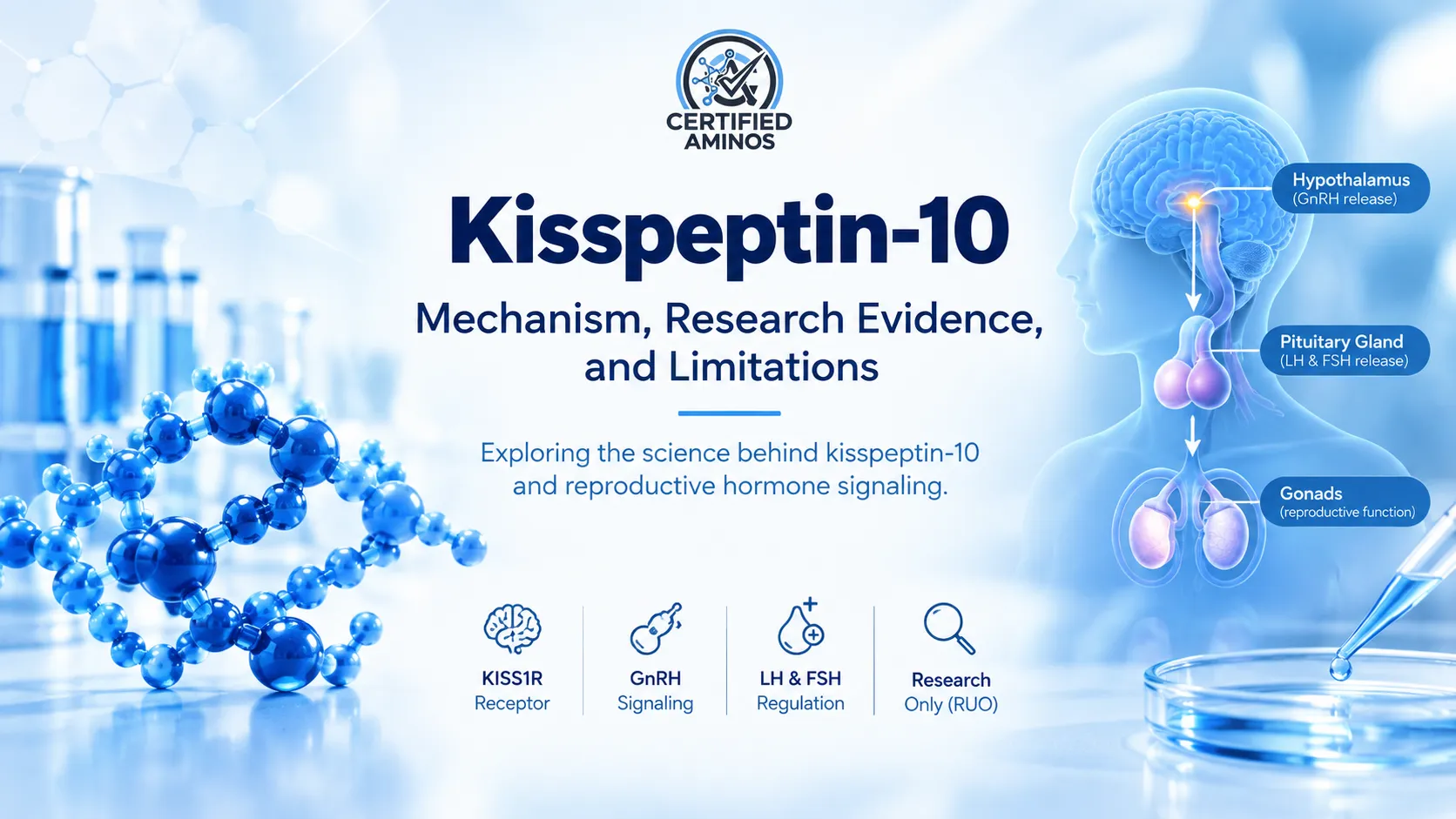
The most useful way to assess KPV is to examine the exact compound studied, the experimental model, the measured outcome, and the limits of the conclusion. For research materials, documentation and accurate RUO labeling are also essential. If you're evaluating other short fragment peptides with the same kind of evidence gap, our Kisspeptin-10 research guide walks through a comparable case.
KPV should therefore be discussed as a subject of scientific investigation, not as a peptide with established human therapeutic benefits.