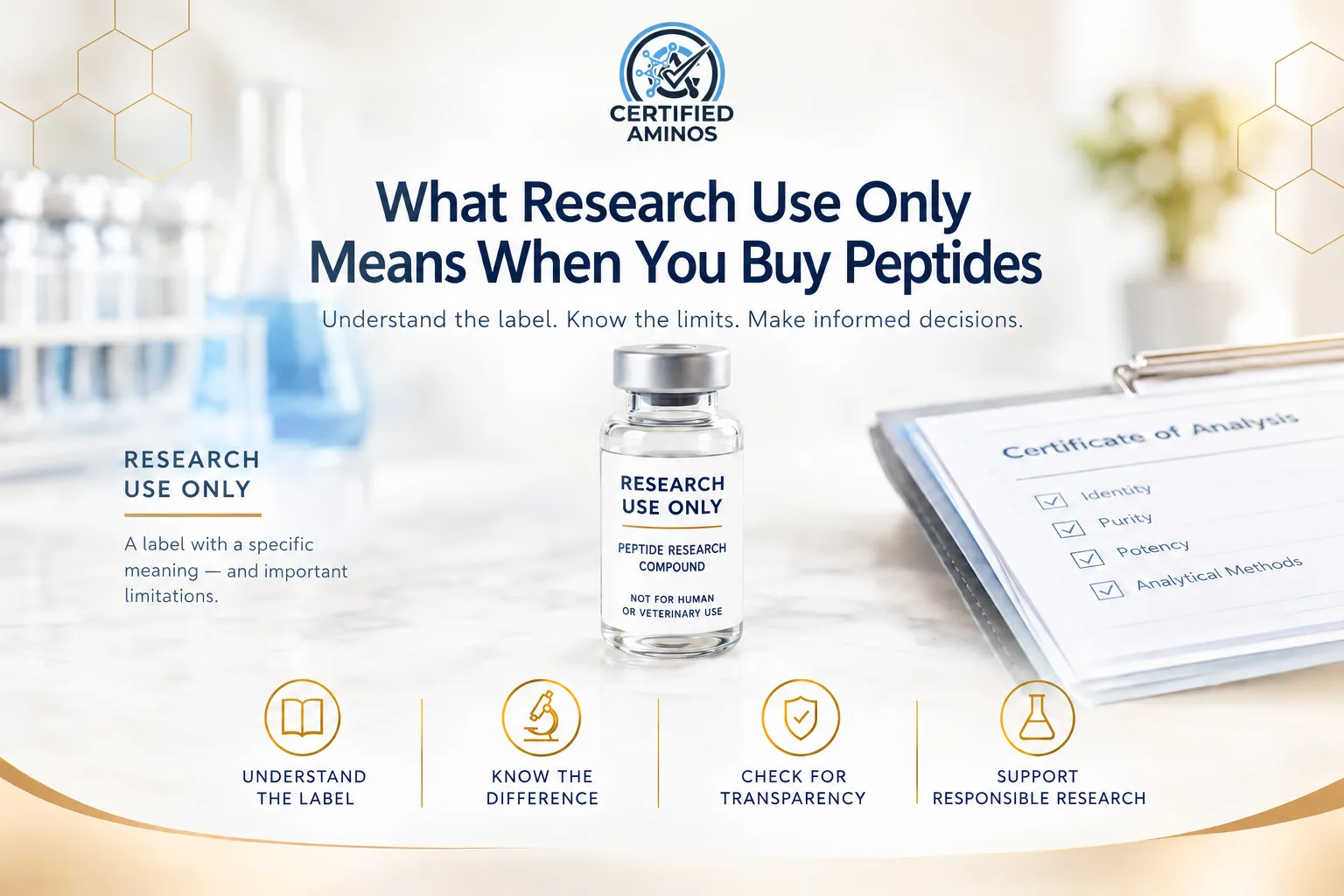
That distinction matters more than it sounds like it should, because RUO wording shows up everywhere in the research-peptide market, attached to products with very different levels of documentation behind them. This article walks through what the label does and doesn't establish, what FDA has actually said about RUO disclaimers in recent enforcement actions, and how to read a certificate of analysis (COA) that's actually worth something. By the end, you'll have a short list of questions worth asking before you treat any single research-peptide listing as more than it claims to be.
What Does the RUO Label Actually Mean?
Research Use Only (RUO) is a labeling term that originates in FDA's regulatory framework for products — originally formalized for in vitro diagnostic (IVD) devices — that a manufacturer intends exclusively for laboratory and scientific research rather than for use in diagnosing, treating, or preventing disease in a human or animal. FDA's 2013 guidance on RUO and investigational-use-only (IUO) labeling is explicit that it applies to IVD products specifically, and the agency has been clear that labeling has to match a manufacturer's actual, demonstrated intended use, not just the words printed on a product page. The research-peptide market has adopted the same RUO language by convention, even though most peptide listings aren't IVD devices, which is part of why the exact legal weight of an RUO label varies by product and context rather than following one uniform rule.
In plain terms: RUO tells you what the seller says the product is for. It's a starting point for understanding a listing, not a conclusion about its legal status, purity, or safety.
What Doesn't RUO Cover?
- It does not mean FDA-approved. Approval is a formal process tied to a specific drug product, a specific manufacturer, and a specific intended use — it isn't inherited by every compound that shares a name with an approved drug's active ingredient.
- It does not mean the product is legal to sell or buy for any purpose. Regulatory status depends on the product's actual formulation, how it's marketed, how it's distributed, and the applicable law.
- It does not mean the product is safe for human use. RUO is a statement about intended use, not a safety or toxicology finding.
- It does not mean the product has been tested to any particular standard, unless separate, verifiable documentation actually backs that up.
Why Are Peptides Labeled Research Use Only?
Legitimate research-peptide suppliers sell compounds for laboratory work: cell-based assays, animal studies, analytical chemistry, and early-stage investigation into a compound's mechanism or structure. Some peptides sold as RUO research materials are structurally related to active ingredients in FDA-approved drugs; others are earlier-stage investigational compounds still in clinical trials, with no approved product at all; others have little to no published human data. RUO labeling doesn't distinguish between these categories — a buyer has to look at the specific compound, not assume the label implies a consistent regulatory story across the catalog.
Does RUO Mean a Peptide Is FDA-Approved?
No. FDA approval and RUO labeling describe two different things entirely. A drug is approved when FDA has reviewed a specific formulation, from a specific manufacturer, supported by clinical trial data, for a specific indication, and that approval doesn't transfer to other products containing a chemically similar or identical compound sold under a different label. Semaglutide and tirzepatide are useful examples: FDA-approved versions exist on the market with full prescribing information, but that approval doesn't extend to an unapproved RUO-labeled product listed under the same generic name — those are, legally, different products.
Can Research Use Only Peptides Be Used in Humans?
An RUO label is, by definition, a statement that the product isn't intended for human or animal use. That's the boundary the label itself draws. Whether a given seller's actual marketing is consistent with that boundary is a separate, fact-specific question, and it's exactly the question FDA has focused on in recent enforcement. This article doesn't provide guidance on using RUO products in humans, and a label alone doesn't change what the underlying evidence does or doesn't support about a compound's safety.
What Do FDA Warning Letters Say About RUO Disclaimers?
This is where the "RUO means whatever the seller says it means" assumption runs into actual precedent. Between late 2024 and mid-2026, FDA's Center for Drug Evaluation and Research issued a string of warning letters to online peptide sellers, and a consistent theme runs through them: an RUO or "not for human consumption" disclaimer doesn't, by itself, override other evidence on a seller's own website pointing to human use.
- Gram Peptides (MARCS-CMS 721806, March 31, 2026). FDA reviewed the seller's website and found it offered retatrutide, tirzepatide, and bacteriostatic water for injection, treating them as unapproved new drugs. Local news coverage reported FDA found evidence the products were intended for human use despite the site's research-only claims, and that the seller removed the cited products after receiving the letter.
- USApeptide.com (MARCS-CMS 696885, February 26, 2025). FDA found the site was offering unapproved, misbranded semaglutide and tirzepatide, sold without a prescription requirement and packaged for injection, which the agency treated as an aggravating factor given the boxed warnings carried by the FDA-approved versions of those drugs.
- Peptide Partners LLC (MARCS-CMS 735063, August 24, 2026). One of five warning letters FDA issued the same week to online peptide sellers, citing products including semaglutide, tirzepatide, retatrutide, and tesamorelin as unapproved new drugs marketed over the internet.
- Summit Research Peptides (MARCS-CMS 695607, December 10, 2024). An earlier example in the same pattern, involving semaglutide sold through the seller's site.
None of this means every RUO-labeled peptide seller is operating unlawfully — a warning letter is FDA's statement of concern about a specific website at a specific point in time, not a universal ruling about an entire product category, and recipients can and do respond with corrective action. What it does show is that FDA's own compliance approach treats an RUO disclaimer as one fact among several, not an automatic shield — language elsewhere on a site can outweigh it in the agency's intended-use analysis.
Does an RUO Label Guarantee Quality or Purity?
No. Labeling a product RUO says nothing about what's actually in the vial. Identity, purity, potency, sterility, and batch-to-batch consistency are separate, testable properties that have to be established through actual analytical work, not inferred from a disclaimer. A page that pairs an RUO statement with purity claims is making two different assertions, and only one of them (the research-use statement) is established by the label itself. The other needs its own documentation.
What Should You Look for in a Peptide Certificate of Analysis?
A certificate of analysis (COA) is a lab's report on a specific test, run on a specific sample. A COA that's actually useful to you should show:
- Product and compound identification — the specific peptide name/sequence being tested, not a generic category.
- Batch or lot number — and critically, this number has to match what's printed on your vial.
- Testing laboratory and date — ideally an independent third-party lab, recent enough to be relevant to the batch you received.
- Analytical method — typically HPLC and/or mass spectrometry, described clearly enough that you know what was actually measured.
- Reported results with stated scope — a purity percentage or identity confirmation clearly tied to what the method can actually detect.
HPLC and mass spectrometry answer different questions. HPLC separates a sample into its components and is well-suited to quantifying purity. Mass spectrometry measures molecular weight and is well-suited to confirming identity. A complete picture typically needs both; either one alone leaves part of the question unanswered. Neither method, alone or together, establishes that a compound is safe for human use or clinically effective. For a closer look at what a weak or incomplete COA actually looks like, see our 12-point COA red-flag checklist. You can also see how we document testing on our own listings on the certificates page.
Does Third-Party Testing Prove a Peptide Is Safe?
"Third-party tested" is a claim worth asking follow-up questions about, not accepting at face value. A useful version of that claim names the lab, the method, the specific lot tested, and the date, and that documentation should be something you can actually see, not just a badge on the page. What third-party testing of this kind can establish is identity and purity for the tested sample. What it generally can't establish, on its own, is sterility, long-term stability, or, most importantly, clinical safety or efficacy in humans.
RUO vs. FDA-Approved, Prescription, and IUO Products
Note: FDA's commonly cited RUO/IUO guidance is written specifically for in vitro diagnostic products; it does not create a single, uniform RUO regulatory category covering every type of product sold under that label, peptides included.
How Should You Read a Supplier's RUO Claims?
- What exactly is the intended-use statement? Is "research use only" the only use claim on the page, or does other language point toward human use?
- Is the product identity specific? A generic name without a defined sequence, source, or formulation is harder to verify.
- Is purity/testing language backed by an actual, accessible document, not just a percentage printed in the product copy?
- Does the disclaimer match the rest of the site? A page combining strict RUO wording with injection-ready formulations or suggested dosing is sending a mixed signal.
How to Evaluate a Research Peptide Supplier
- Clear, specific product identification (not just a trade name)
- A COA that's actually accessible, lot-matched, and from a named lab
- Transparent explanation of what analytical methods were used and what they establish
- An intended-use statement that's consistent with the rest of the site's marketing
- Real, findable business information, not just a contact form
- No unsupported medical, safety, or efficacy claims
None of these checks, individually or together, guarantees that a supplier is fully compliant with applicable law — they're signals of transparency, not a certification. If you want a longer, product-level version of this checklist, our 12 Peptide Red Flags guide walks through how to read a COA line by line.
What Are the Most Common Misunderstandings About RUO Peptides?
- "RUO means FDA-approved." It's the opposite of approval — RUO signals the product hasn't gone through that process for the stated use.
- "RUO means legal everywhere." Legal status depends on the specific product, its marketing, and the jurisdiction.
- "RUO means safe to take." The label addresses intended use, not safety evidence.
- "Research-grade is a standardized, regulated certification." It's a descriptive term different suppliers may define differently.
- "A high purity percentage proves the product is safe." Purity and safety are separate questions.
- "An HPLC chromatogram confirms everything about a product." HPLC is strong on purity; it's not a complete identity, sterility, or safety profile.
- "A COA automatically belongs to the batch I'm buying." Only if the lot number on the document matches the lot number on your vial.
- "Third-party testing proves clinical effectiveness." Analytical testing checks identity and purity, not whether a compound works in humans.
- "A disclaimer overrides whatever else the marketing says." FDA's own enforcement pattern says otherwise.
- "An approved medicine and a separately sold research product with a similar name are the same thing." They're legally distinct products.
- "All peptides have the same regulatory status." The category spans very different positions.
- "A seller's claims remove the need for independent verification." A seller's marketing copy isn't a substitute for your own documentation review.
What Are the Regulatory Considerations for RUO Products?
FDA's clearest formal statement on RUO/IUO labeling is its November 2013 guidance, Distribution of In Vitro Diagnostic Products Labeled for Research Use Only or Investigational Use Only. That document is explicit about its own scope: it governs in vitro diagnostic (IVD) products specifically, and it states that RUO/IUO labeling must be consistent with how a manufacturer actually intends and markets the product. It isn't a general RUO statute covering every category of research chemical, peptides included.
For products outside that specific IVD framework, including most research peptides, FDA's enforcement activity gives the clearest practical signal of how the agency evaluates intended use: by looking at the totality of a seller's marketing, not a single disclaimer in isolation. A warning letter is not a court ruling, doesn't freeze a company's operations, and doesn't by itself establish that every recipient broke the law. But the pattern across multiple 2024-2026 letters is consistent enough to be useful: RUO wording, by itself, has not been treated by FDA as sufficient to establish lawful research-only distribution when other site evidence points toward human use.
Regulatory frameworks outside the U.S. differ, sometimes substantially, and nothing here should be read as legal advice for a specific jurisdiction or a specific product.
What Should Responsible Research Buyers Understand?
For institutional or lab-based research use, that typically means working within your organization's own procurement, documentation, and oversight procedures, not relying on a supplier's marketing copy as a substitute for them. Appropriate institutional review, qualified personnel, and documented chain-of-custody from supplier to lab are the pieces that actually support legitimate research use; an RUO label on a product page is the starting point for that process, not the end of it.
Conclusion
A Research Use Only label is a starting point, not a conclusion. It tells you how a seller intends a product to be used — it doesn't, on its own, tell you whether that product is pure, safe, legal to sell in every context, or backed by real documentation. Reading a listing well means separating those claims out: what does the RUO statement actually establish, what does the COA actually show, and where is the page making a claim that isn't backed by either one. That habit, checking documentation against what's actually being claimed, is the single most useful thing a buyer evaluating research-use-only peptides can do.
*This article is informational and is not legal, medical, or regulatory advice.*