Research Use Only. This material is provided for scientific and educational purposes only. The product discussed is designated for Research Use Only (RUO) and is not intended for human or veterinary consumption, diagnosis, treatment, or prevention of disease. Nothing on this page constitutes medical advice or a recommendation for human use.
What Is the Semax / Selank Blend, and How Does It Differ From Either Compound Alone?
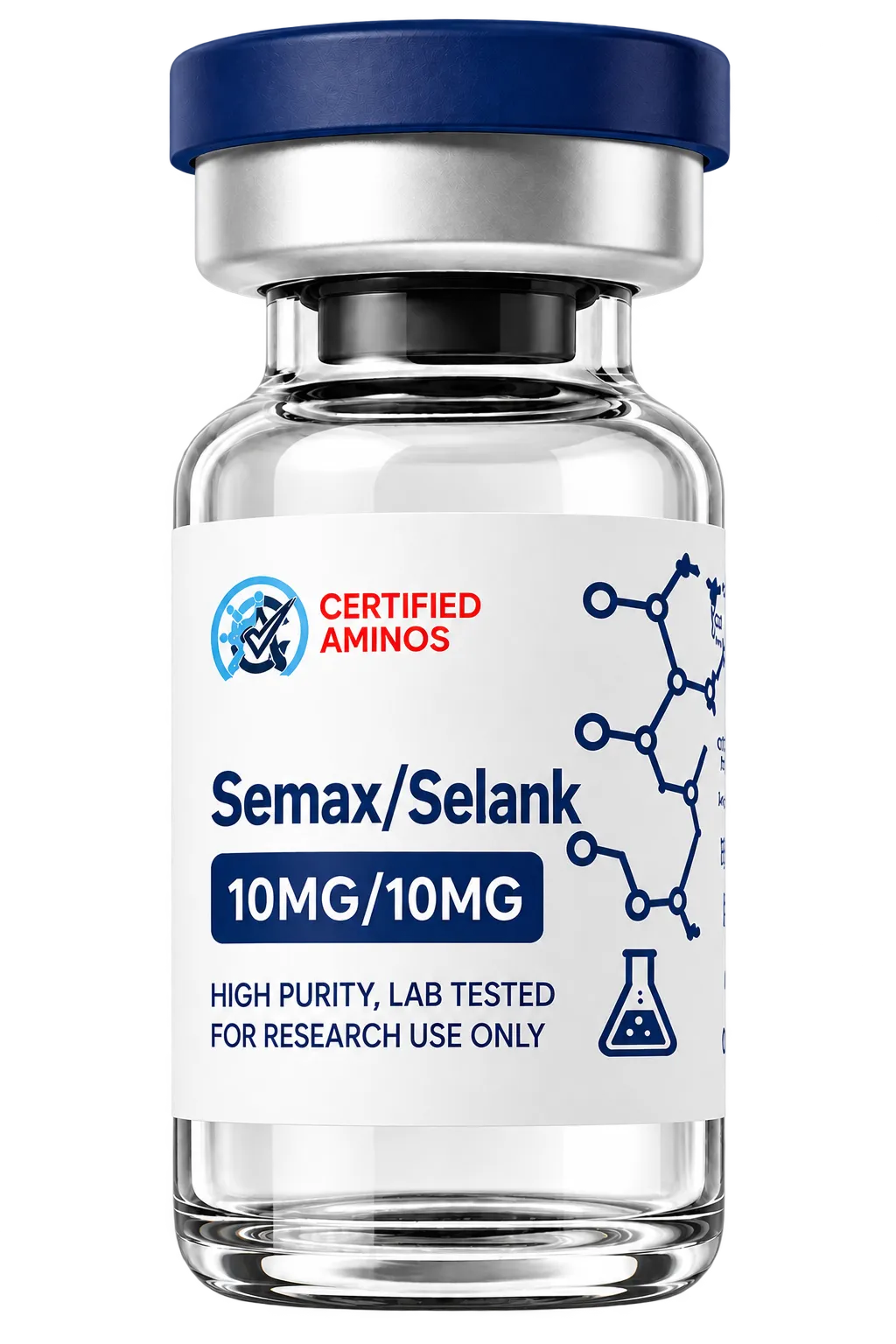
The Semax / Selank Blend is a single vial combining two separately-developed, separately-studied peptides — 10mg of Semax and 10mg of Selank, lyophilized together — rather than a new, independently characterized molecule. Semax contributes a proposed effect on neurotrophic signaling; Selank contributes a proposed anxiolytic and immune-modulating effect. Putting the two in one vial is a packaging decision, not evidence that combining them changes, improves, or even preserves either compound's individual effects.
What Is Semax, and How Is It Proposed to Work?
Semax is a synthetic heptapeptide corresponding to amino acids 4–10 of adrenocorticotropic hormone (ACTH), with the native sequence's hormonal (corticotropic) activity removed and a synthetic Pro-Gly-Pro tripeptide added to extend its stability. It was developed in Russia in the 1980s, primarily studied as a nasally-administered nootropic and neuroprotective agent.
The most consistently reported mechanism involves the brain-derived neurotrophic factor (BDNF) system. Dolotov et al. reported that Semax binds specifically and reversibly to membrane sites in rat basal forebrain and raises BDNF protein levels there after intranasal dosing, with no comparable rise in cerebellum — a region-specific effect, not a general one [1]. This is rodent mechanistic data; it describes a plausible pathway, not a demonstrated human cognitive or neuroprotective outcome.
What Does the Human Research on Semax Actually Show?
The clinical literature on Semax is real but narrow. The most-cited human study is a 1997 Gusev et al. trial in 30 patients with acute hemispheric ischemic stroke, comparing Semax added to standard therapy against patients receiving conventional therapy alone [2]. This was not a placebo-controlled trial — it compared Semax-plus-standard-care to standard-care-alone, which is a meaningfully different and weaker design than a blinded, placebo-controlled study. The authors reported that adding Semax was associated with better recovery of disturbed neurologic function, particularly motor function, but the published abstracts available for this article did not include detailed effect sizes or statistical significance values.
Beyond that trial, the broader Semax literature is dominated by Russian-language publications and preclinical work, with no large Western randomized controlled trial located for this article. A single historical, non-placebo-controlled stroke study and a body of rodent mechanistic data are a real evidence base — they are not the same thing as modern, independently-replicated proof of effect in humans.
What Is Selank, and How Is It Proposed to Work?
Selank is a synthetic heptapeptide analog of tuftsin, an endogenous immunomodulatory peptide, developed at Russia's Institute of Molecular Genetics and the V.V. Zakusov Institute of Pharmacology. It has reportedly been registered in Russia since approximately 2009 as a prescription anxiolytic nasal spray for generalized anxiety disorder and related conditions, under local regulatory review — this article could not locate the primary Russian State Register entry to confirm the exact registration details, so treat the specific year and scope as reported rather than independently verified here.
Proposed mechanisms include GABAergic modulation, effects on serotonin metabolism, and modulation of pro-inflammatory cytokines — particularly interleukin-6 (IL-6) — under stress conditions in animal models [3]. Whether the cytokine effect is clinically meaningful in humans, and whether reported BDNF changes reach a clinically significant magnitude, has not been established in controlled human trials.
What Does the Human Research on Selank Actually Show?
Selank's anxiolytic evidence base rests on Russian clinical trials, reportedly including comparisons against benzodiazepine anxiolytics, that supported its domestic registration. No Western-standard, independently-replicated randomized controlled trial was located for this article, and Selank has no clinical trial registration or regulatory recognition outside Russia and some post-Soviet states. As with Semax, a real evidence base exists — it is simply a different, less internationally scrutinized kind of evidence than a reader might assume from how the compound is sometimes described in English-language secondary sources.
Has the Semax + Selank Combination Itself Been Studied?
No independently verifiable study was located. A direct search for any trial, human or animal, administering both Semax and Selank to the same subjects — combined into a single dose or given in separate sessions — did not surface one. The closest adjacent work located was a rodent study of Selank's anxiolytic activity compared against diazepam under chronic stress conditions, which did not involve Semax at all.
This matters because Certified Aminos' own product page for this blend states that "the one study that administered both peptides to the same subjects gave them as separate sessions against placebo, not as a combined dose" [4]. This article's independent literature search could not locate or confirm that specific study. It is possible the reference is to a Russian-language publication not indexed in the sources searched for this article — but until that citation can be directly verified, this specific claim should be treated as unconfirmed rather than repeated as established fact. Either way, no source located for this article, including the product page itself, claims the two compounds have been tested together as a combined dose.
Semax vs. Selank vs. the Blend
Sharing a loose goal — supporting cognitive or stress-related research outcomes — does not make these two peptides, or their combination, a single evidenced intervention.
Is Semax or Selank FDA-Approved?
Neither compound has any FDA-approved product, for any indication. The regulatory picture is more specific for Semax: it was one of six peptide groups FDA's Pharmacy Compounding Advisory Committee reportedly recommended in July 2026 for inclusion on the 503A Bulks List — the formal list that would let state-licensed pharmacies compound it under specific conditions [5]. That recommendation is non-binding advisory input FDA is free to accept, reject, or modify, and as of this writing no rule has been finalized adding Semax to that list. For the full regulatory timeline and what each 2026 FDA action does and doesn't mean, see FDA Peptide Update 2026: PCAC Votes, Compounding Status, and What Hasn't Changed. Selank was not identified in that same review and carries no comparable compounding-eligibility recommendation.
Research Use Only labeling, which is how this blend is sold, describes an intended laboratory use. It is not an FDA finding of any kind and does not establish legality for human use.
What Does Certified Aminos' Own Product Page Say About This Listing?
Checked directly on certified-aminos.com/product/semax-selank-blend [4] and certified-aminos.com/certificates [6], 2026-10-21.
What Should a Researcher Check on a Certificate of Analysis (COA)?
For this product, no batch-specific COA is currently published, so none of the above can yet be checked against a document [4][6].
What This Page Does Not Establish
This page does not establish that Semax or Selank is safe or effective for any use; that combining them produces an effect different from, or superior to, either compound alone; that the specific combined-dosing study referenced on Certified Aminos' product page for this blend exists as described; or that this product's purity, identity, or composition meets any particular standard. It also does not provide dosing, reconstitution, or administration guidance, and none should be inferred from it.
For Researchers
Featured in This Article: Semax / Selank Blend — view the current listing on Certified Aminos to review live specifications, stock status, and documentation. Only features actually stated on that page are referenced in this article; no purity, identity, or testing claim is implied beyond what the page itself states [4].
Related reading: FDA Peptide Update 2026: PCAC Votes, Compounding Status, and What Hasn't Changed for the regulatory status behind Semax's PCAC recommendation, and Are Peptides Safe? What Research Shows for the broader RUO/evidence framework this article applies.
This material is Research Use Only. It is not medical advice, and it is not a recommendation for human use.