The Short Answer
The direct answer: peptides are not uniformly safe or unsafe as a group. Evaluating any individual peptide means looking at its specific identity, the dose and route it's used at, how it was manufactured, whether it has been reviewed by a regulator like the FDA, and how much human clinical evidence actually exists for it. A peptide hormone with decades of approved clinical use and a peptide sold under a research-use-only label sit in very different places on that spectrum, even though both are technically "peptides."
This matters because search results, forum threads, and vendor marketing often collapse that spectrum into a single claim — "peptides are safe" or "peptides are dangerous" — when neither statement is accurate or useful. The rest of this article walks through the variables that actually determine safety, so you can evaluate a specific peptide rather than relying on a category-wide assumption.
What Is a Peptide?
A peptide is a short chain of amino acids linked together — shorter than a full protein, but built from the same molecular building blocks. Some peptides occur naturally in the human body and function as hormones or signaling molecules; insulin and glucagon are well-known examples. Others are manufactured synthetically, either to replicate a natural peptide or to create a novel sequence being studied for a specific biological effect.
This single definition spans several very different real-world categories:
- Naturally occurring peptide hormones your body already produces and uses for signaling.
- FDA-approved peptide medicines, where a specific formulation of a specific peptide has gone through clinical trials and regulatory review for a specific indication.
- Nutritional or collagen peptides, sold as food ingredients or dietary supplements under a different regulatory framework entirely.
- Cosmetic peptides, used topically in skincare formulations.
- Investigational peptides, still being studied in preclinical or clinical research and not yet approved for routine treatment.
- Research Use Only (RUO) compounds, labeled and sold for laboratory research rather than human use, with human safety data that is often limited or absent.
A finding about one of these categories does not automatically transfer to another. Evidence that a dietary collagen peptide is well tolerated as a food ingredient says nothing about the safety of an injectable investigational peptide, and vice versa.
Why There Is No Single Answer to "Are Peptides Safe"
"Peptide" is a structural description — a molecule built from amino acids — not a regulatory or safety classification. Two compounds can both be accurately called peptides while sitting in completely different places on the evidence-and-regulation spectrum. The question "are peptides safe" is a bit like asking "are chemicals safe" or "are pills safe": the category is too broad to answer in one word.
What actually determines whether a specific peptide is reasonably safe for a specific use includes:
- Which peptide, specifically. Different peptides act on different biological targets.
- How much human evidence exists. Human clinical data is a stronger basis for judgment than cell-culture or animal-only findings.
- Dose and exposure. Risk is frequently dose-dependent; this article does not provide dosing guidance.
- Route of administration. Oral, topical, and injectable routes carry different risk considerations.
- Formulation. Concentration, excipients, delivery method, and storage can all affect risk.
- Manufacturing quality. Contamination or an incorrect compound are manufacturing failures, not peptide-class failures — but they're common real-world risks.
- Purity and identity testing. This confirms what's actually in a sample; it is not the same as proving clinical safety.
- Drug interactions. Risk can change depending on other medications or substances a person is using.
- Individual health factors. These affect risk in ways a general article can't account for — a question for a healthcare provider, not a blog post.
- Regulatory status. Approved, investigational, compounded, cosmetic, nutritional, and research-use-only products are distinct categories, not interchangeable labels.
The sections below apply this framework to the specific questions people searching "are peptides safe" are actually asking.
Illustrative comparison across peptide categories (not an exhaustive or product-specific list)
This table illustrates category-level differences only. It does not imply that every product within a category shares identical safety data, and it does not evaluate any specific Certified Aminos product.
Are Peptides FDA Approved?
Some are, and some are not — and the distinction is narrower than it sounds. FDA approval is not granted to "peptides" as a class. It is granted to a specific drug product: a specific active ingredient, at a specific formulation and dose, for a specific indication, backed by a specific set of clinical trial data submitted in a specific application.
Several peptide-based medicines have gone through that process. GLP-1 receptor agonist medicines such as semaglutide (marketed as Ozempic and Wegovy) and the dual GIP/GLP-1 agonist tirzepatide (marketed as Mounjaro and Zepbound) are FDA-approved for specific indications, including type 2 diabetes and chronic weight management, at FDA-reviewed doses and formulations. Insulin itself is a peptide hormone, and multiple insulin analog products are long-approved prescription medicines.
That approval status does not transfer automatically to every related compound. A newer peptide in the same general drug class — for example, one still in clinical trials, or one sold outside the approved product's manufacturing and labeling — is not "FDA approved" simply because it resembles an approved medicine chemically. The FDA evaluates specific products, not general molecular families, and approval for one indication does not mean a compound is appropriate or safe for an unrelated use.
It's also worth being direct about what FDA approval does not mean. An approved peptide medicine still carries documented risks and side effects specific to its label; approval reflects a regulatory judgment that the benefits outweigh the risks for a defined population and use, not an assurance of zero risk, and it says nothing about the safety of an unrelated, unapproved peptide.
In August 2026, the FDA’s Center for Drug Evaluation and Research issued warning letters to several online peptide vendors, citing products including semaglutide, tirzepatide, retatrutide, tesamorelin, and PT-141 marketed with a “research use only” label (Arnall Golden Gregory LLP, 2026). The agency’s position, as summarized by legal counsel tracking the letters, was that a research-use-only label does not change a product’s legal status if the surrounding marketing — dosing guidance, health claims, or accessories like reconstitution supplies — shows it is actually intended for human use. That action is a useful current illustration of a general principle covered in the next section: labeling is not the same as regulatory approval.
What Does Research Use Only Mean?
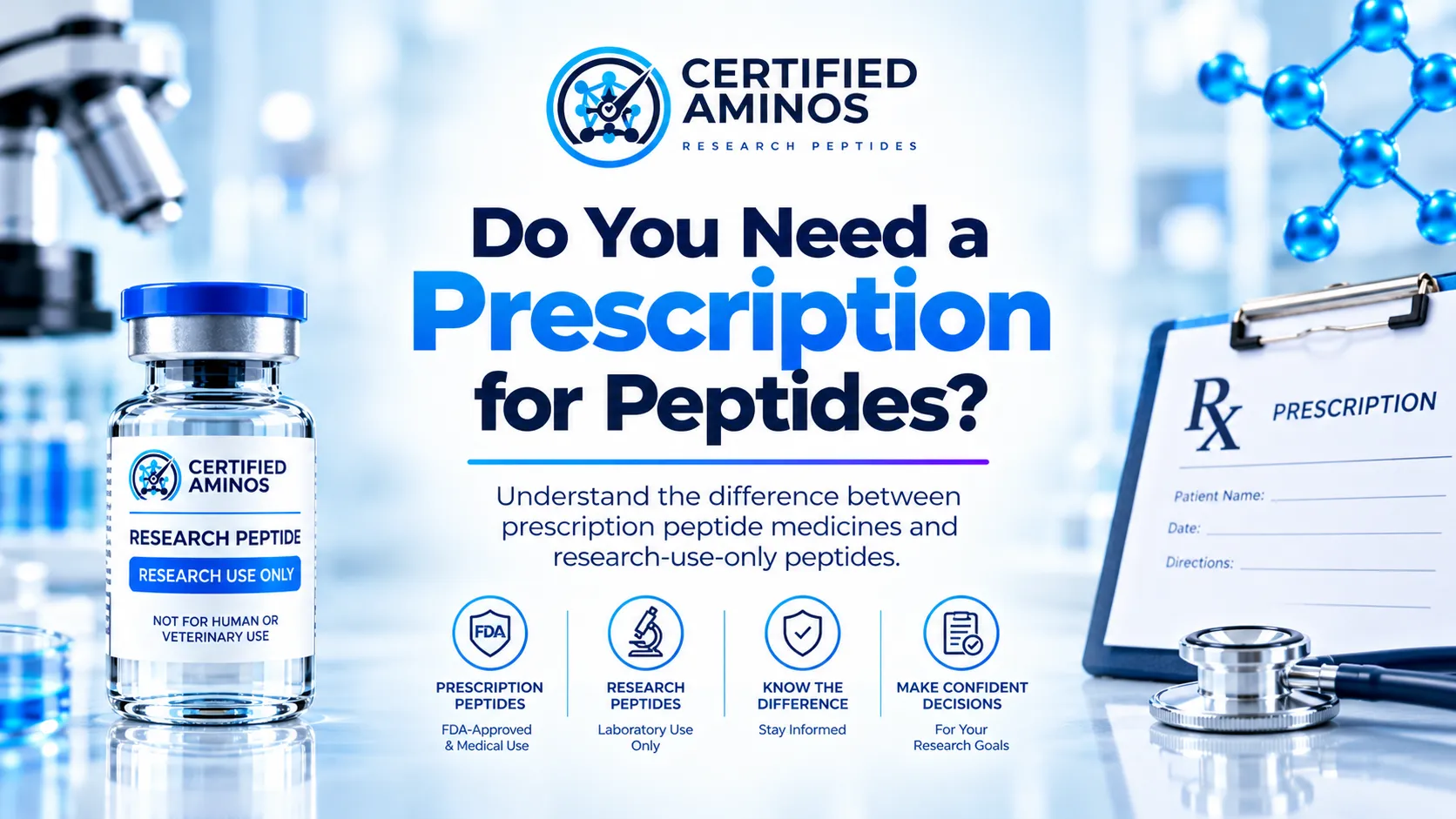
Research Use Only (RUO) is a labeling and marketing designation, not a safety certification, and not a substitute for FDA approval. A compound labeled RUO is being sold for laboratory or research purposes, not for human or animal consumption, diagnosis, treatment, cure, or prevention of any condition. It has not necessarily been evaluated by the FDA at all, in either direction — "not evaluated" is different from "evaluated and approved" or "evaluated and found safe."
For more on how Certified Aminos applies RUO labeling across its catalog, see the Research Use Only FAQ.
Because RUO labeling frameworks were originally built around laboratory reagents and in vitro research materials, the exact regulatory meaning can depend on the specific product category and the applicable FDA guidance for that context — this is a case where the general public and manufacturers alike sometimes over-generalize a narrower regulatory concept. What RUO labeling does not do, regardless of context, is establish that a compound is safe for human use, effective for any purpose, or legally cleared for self-administration outside a genuine research setting.
Certified-Aminos states on its own site that its products are intended strictly for laboratory or scientific research, are not drugs, medicines, dietary supplements, or food, are not intended for human or veterinary use, and have not been evaluated by the FDA, as stated on its Medical Disclaimer page. That framing is consistent with how RUO labeling works generally: it defines the stated intended use of the product, not a judgment about whether the underlying compound would be safe if used differently.
Are Peptides Dangerous? Common Risks and Side Effects
There is no universal "peptide side effect list," because there is no universal peptide. Risk depends on the specific compound's biological target, the dose and duration of exposure, the route of administration, the quality of the specific product, potential interactions with other substances, and individual health factors.
That said, several risk categories recur across different peptides:
- Injection-site and local reactions. Injectable peptides can cause local irritation, redness, or discomfort at the injection site.
- Immunogenicity. Some peptides can trigger an immune response, particularly with repeated exposure or low-purity products — a recognized consideration in peptide drug development generally, not specific to any one compound named here.
- Manufacturing-related contamination or misidentification. A product that's contaminated, mis-dosed, or simply not the compound it claims to be is a quality-control failure, and a common real-world risk with less-regulated research compounds.
- Drug interactions. Combining a peptide with other medications or substances can change its effects.
- Unknown long-term effects for less-studied compounds. For investigational or research-use compounds, long-term safety often hasn't been established either way — an evidence gap, not a specific risk finding.
Specific side effects reported for one approved peptide medicine (documented on that medicine's FDA label) should not be assumed to apply to a different peptide, even one in a related class. Generalizing a side-effect profile from one compound to "peptides" as a category is one of the most common inaccuracies in consumer content on this topic.
Are Peptides Natural? Are They Steroids?
Are peptides natural? Some are. Your body produces peptide hormones and signaling molecules on its own — insulin and oxytocin are two examples. Many peptide products sold commercially, however, are synthesized in a lab, either to replicate a naturally occurring sequence or to create a new one. A natural origin doesn't automatically make a compound safe at a given dose or in a given formulation, and a synthetic origin doesn't automatically make a compound unsafe. Origin and safety are separate questions.
Are peptides steroids? No. Peptides and anabolic steroids are chemically and mechanistically distinct classes of molecules. Peptides are chains of amino acids that typically act on specific cell-surface receptors or signaling pathways. Anabolic steroids are a different chemical class (steroid hormones, derived from a cholesterol-based structure) that act through different receptors and mechanisms. The two categories are sometimes discussed together in a muscle-growth or performance context, which has likely contributed to the two terms getting conflated in casual use, but they are not the same thing structurally, legally, or pharmacologically.
How Peptide Quality, Purity, and COAs Affect Safety
Analytical testing is a meaningful part of evaluating any research compound, but it answers a narrower question than people sometimes assume. Here's the distinction that matters:
A purity or identity test — commonly run by high-performance liquid chromatography (HPLC) and mass spectrometry (MS) — tells you about the chemical composition of a specific sample: whether the material is actually the intended compound, and at what concentration and purity. It does not, by itself, establish that the compound is clinically safe or effective for any particular use. A sample can be 99%+ pure and still be an investigational or research-use compound with limited human safety data. Purity and clinical safety are different questions answered by different kinds of evidence.
A Certificate of Analysis (COA) is documentation of that testing — again, evidence about what's in the vial, not a safety guarantee. A COA from a credible, independent third-party laboratory is a meaningfully stronger signal than an in-house or unverifiable test result, because it removes the manufacturer's own incentive from the verification step. When you're evaluating a specific product, it's reasonable to look for: which laboratory performed the testing and whether it's independent of the seller, whether the documentation is batch- or lot-specific rather than a generic specification sheet, and whether the seller can produce that documentation on request.
By way of example, Certified Aminos describes a two-stage testing process on its site — raw materials checked by HPLC before compounding, and finished batches checked again by HPLC and mass spectrometry at independent third-party U.S. laboratories, against what it describes as a 99% purity baseline, as described on its Certificates of Analysis page. That's a description of a testing process; as with any supplier, it's still worth confirming that batch-specific documentation is actually available for the specific product and lot you're looking at, since a described methodology and a posted, lot-matched COA are two different things.
Are Collagen Peptides Safe?
Collagen peptides are a different category from the injectable research and investigational peptides discussed elsewhere in this article, and they deserve to be evaluated on their own terms. Sold primarily as a food ingredient or dietary supplement, collagen peptides (sometimes called hydrolyzed collagen) are typically derived from animal connective tissue and broken down into smaller peptide fragments for oral consumption or topical use.
As a food and supplement ingredient, collagen peptides are regulated under a different framework than injectable drugs or investigational compounds, and they carry a correspondingly different — and generally more established — safety track record in that context. That track record applies to collagen peptides as a dietary ingredient; it does not transfer to injectable, investigational, or research-use peptides, which are chemically and functionally different products evaluated under a different regulatory and evidentiary framework entirely. Worth noting in the other direction too: "natural" or "food-based" is not automatically synonymous with "risk-free" — any ingredient, including a food ingredient, can carry considerations like allergy potential or product-specific quality issues.
What Are Peptides Used For?
Peptides show up across several distinct use categories, and the safety and evidence picture is different for each one:
- Metabolic and weight-related medicine. This is where the clearest FDA-approved peptide drugs exist today (GLP-1 and GIP/GLP-1 receptor agonist medicines), alongside related compounds still in earlier stages of investigation.
- Hormone and growth-hormone-axis research. A number of peptides studied in this space (growth hormone secretagogues, for example) remain investigational or research-use compounds rather than approved treatments.
- Tissue repair and recovery research. Several peptides marketed in this category are sold specifically as research-use-only compounds, with human clinical evidence that ranges from limited to largely absent, depending on the specific compound.
- Cosmetic and skin applications. Topical cosmetic peptides are formulated and regulated differently from injectable compounds, and claims made for one shouldn't be assumed to apply to the other.
- Nutritional use. Collagen peptides, covered above, fall here.
Across every one of these categories, the same rule applies: evidence strength and regulatory status vary by the specific compound and the specific product, not by the use-case label attached to it. This article does not recommend specific peptides for any of these purposes, and intentionally does not provide dosing or treatment protocols for any of them.
Are Peptides Legal?
This is a question that depends on the specific substance, the jurisdiction, the intended use, how the product is classified and manufactured, and how it is marketed — it is not a single yes/no answer, and this section is general information rather than legal advice for your specific situation.
In the United States, FDA-approved peptide medicines are legal prescription drugs when used as labeled, under a prescriber's care. Compounds sold as Research Use Only are, by definition and by label, restricted to laboratory and research settings — not to self-administration or human treatment use outside that context — and sellers and users are expected to follow applicable local, state, and federal law regardless of how a product is labeled. As the 2026 FDA warning letters referenced earlier illustrate, a "research use only" label does not override how regulators evaluate a product's actual marketed and intended use; it is a labeling choice, not a legal exemption.
If you have a specific question about whether a specific product or use is lawful in your jurisdiction, that is a question for a qualified attorney or the relevant regulatory agency directly, not something a general article can answer for your situation.
How to Evaluate a Peptide Product or Research Compound
Rather than asking "are peptides safe" as a single question, a more useful frame is a short checklist you can apply to any specific product:
- Do you know exactly which compound this is — not just a brand or blend name, but the specific peptide or peptides involved?
- What is its regulatory status — an approved medicine, an investigational compound, a research-use-only material, or a nutritional/cosmetic product — and does the evidence available match that status?
- How much human clinical evidence exists, as opposed to cell-culture or animal-only data?
- Is there independent, batch-specific purity and identity documentation available for the exact product and lot in question, from a laboratory that isn't the seller itself?
- Is the product being marketed consistently with its stated intended use — for example, a research-use-only label paired with dosing instructions or disease claims is a mismatch worth noticing?
- Does using this product involve combining it with other medications or substances in a way that hasn't been evaluated?
None of these questions have a universal answer. They're designed to help you evaluate one specific product at a time, which is the only way "is this peptide safe" can actually be answered.
What Should You Look for When Evaluating a Research Peptide Supplier?
Applying that checklist to a supplier specifically: for research-use-only materials, look for a clear statement of intended use (research only, not for human or animal consumption) and a documented path to batch-specific test results rather than a generic claim of "tested" or "pure."
Certified Aminos, for example, states on its site that it's a U.S.-based RUO peptide supplier using a two-checkpoint HPLC and mass spectrometry process through independent third-party laboratories, against a stated 99% purity baseline, according to its About Us and Certificates of Analysis pages. As with any supplier, it's worth confirming that lot-specific documentation is actually available for the exact product you're interested in — a described methodology and a posted, batch-matched certificate are two different things to verify.
None of this is a safety claim. Independent testing is a meaningful quality signal, not evidence that any specific research peptide is safe, effective, or appropriate for human use. A high purity percentage describes what's in the vial; it doesn't describe what happens when that compound is used.
For deeper dives on specific compounds mentioned here, see the Certified Aminos Journal.
For research use only. Not for human or veterinary use.