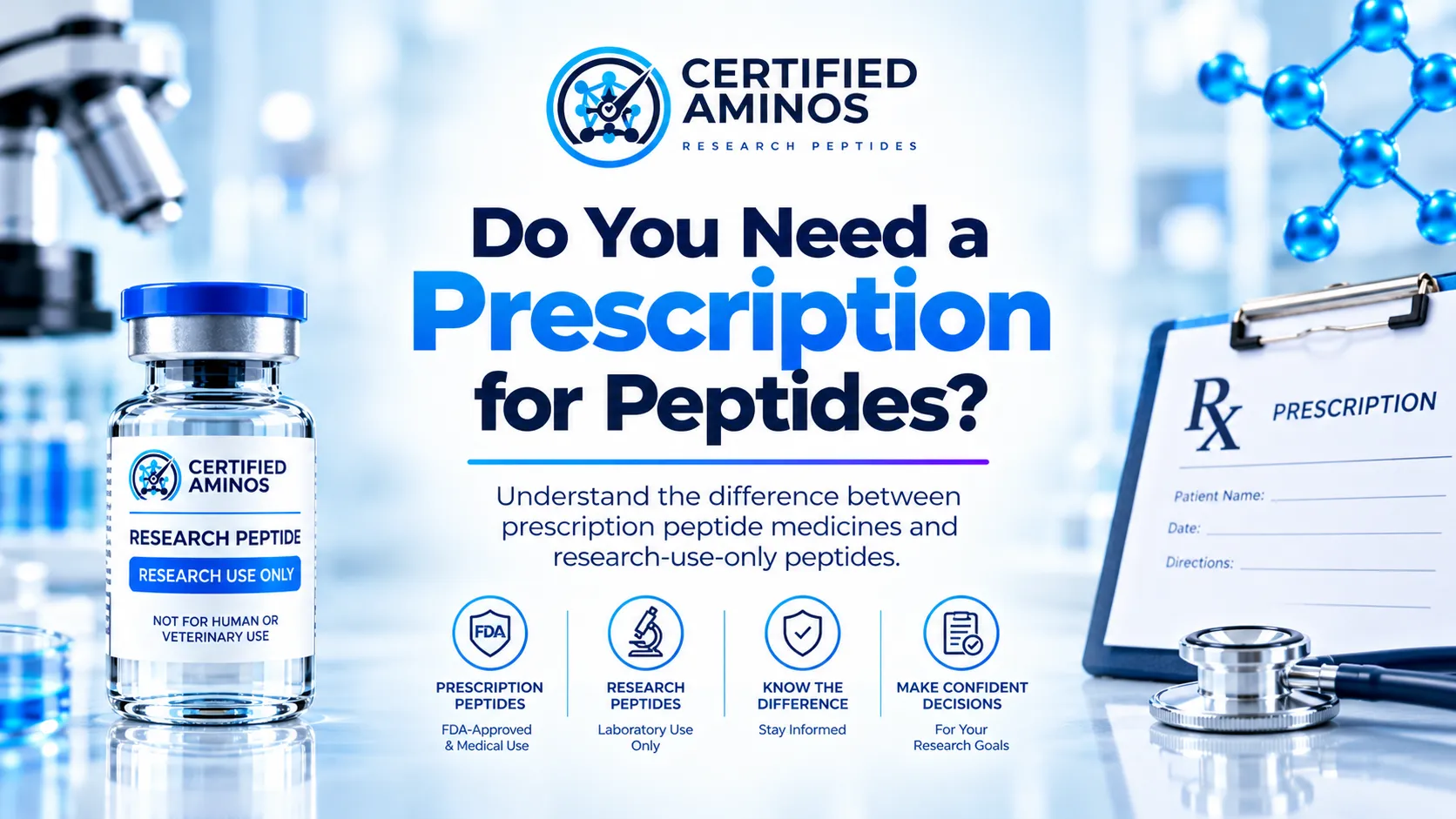
Whether a peptide needs a prescription depends on the specific product, not on peptides as a category. Some peptides, like semaglutide and tesamorelin, are FDA-approved prescription drugs. Others remain investigational and unapproved. Many peptides sold online are labeled Research Use Only and were never evaluated for human use at all. Prescription requirements, and legal treatment generally, can also vary by jurisdiction.
Why “Peptide” Isn't a Legal Category
Peptide describes a chemical structure, a short chain of amino acids, not a regulatory status. That one word covers an FDA-approved weight-management drug, a compound still in clinical trials, a vial labeled strictly for laboratory research, and a cosmetic ingredient in a skincare serum. None of those four things are regulated the same way, even when the underlying molecule is identical or nearly so.
This is also why the same peptide name can show up in very different places: a prescription at a pharmacy, an investigational drug in a clinical trial, and a Research Use Only listing on a supplier's website. The name doesn't settle the regulatory question. The specific product, its approval history, and its labeled intended use do.
Which Peptides Are FDA-Approved Prescription Drugs?
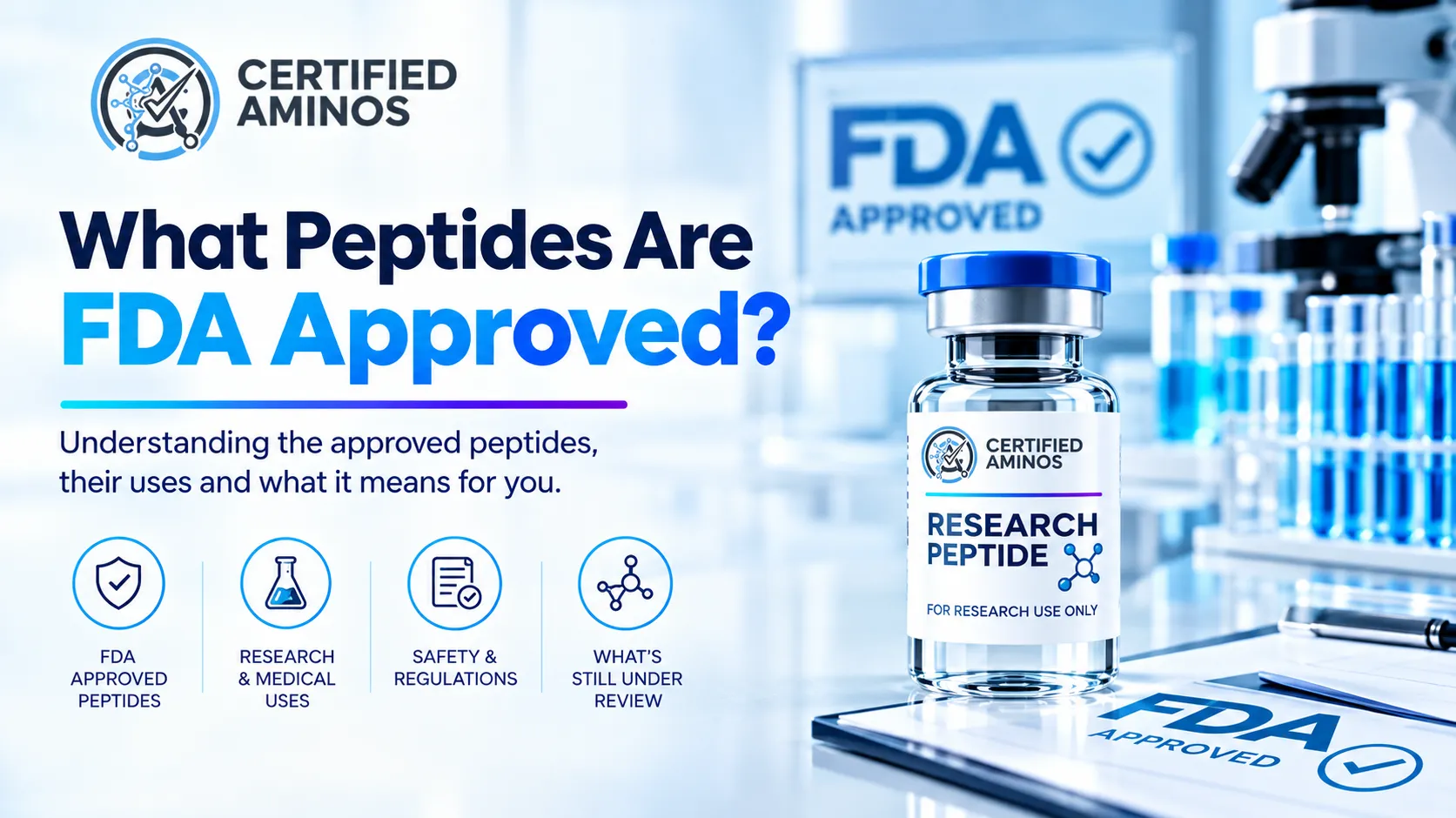
A small number of peptides have completed the FDA's drug approval process and are legally marketed as prescription-only medications for specific indications. The table below lists examples with their approval status; confirm current status against Drugs@FDA before treating any of these as fixed, since approvals, label updates, and formulations change.
Why prescription status applies to the drug product: the FDA doesn't declare “peptides” prescription-only as a class. It evaluates a specific formulation for a specific indication, then decides, separately, whether that approved drug is safe enough for unsupervised use or requires a licensed prescriber's involvement. Both decisions are product-specific, not ingredient-specific.
What Does FDA Approval Actually Mean?
FDA approval means a drug has completed a New Drug Application or Biologics License Application review and can legally be marketed for a defined use. It says nothing, by itself, about whether a prescription is required; some approved drugs are sold over the counter.
FDA approval and prescription status are two separate questions, not one. Approval asks whether a specific drug product can be marketed for a specific use at all. Prescription status asks how that already-approved drug may be dispensed. An investigational or Research Use Only peptide hasn't cleared the first question, so the second one doesn't apply yet.
What Are Investigational or Unapproved Peptide Compounds?
An investigational drug is still working through the FDA's clinical trial pathway. It has not received approval to be marketed, regardless of how widely it's discussed or used off-label elsewhere.
Retatrutide is the clearest current example. As of October 2026, retatrutide remains investigational, in Eli Lilly's Phase 3 TRIUMPH program. The company has indicated plans to submit a Biologics License Application in early 2027, with approval, if granted, projected for late 2027 or 2028. None of that is settled; trial results, submission timing, and FDA review outcomes can all shift, so this status should be re-checked against current sources before being treated as fact later.
Investigational does not mean illegal, and it does not mean approved. It means the compound is still being studied under FDA oversight for a specific use. That's a different question from whether buying, possessing, or using it outside a trial is permitted, which is a separate legal question this article doesn't attempt to resolve for every circumstance.
What Does Research Use Only (RUO) Mean?
Research Use Only is a labeling designation, not an approval pathway. It states that a product is intended for laboratory and research applications and has not been evaluated by the FDA for human consumption.
RUO does not mean approved for human use, and it is not a discount version of an approved drug. A peptide can be chemically identical, or nearly so, to an approved medication's active ingredient and still carry RUO labeling, because RUO describes the product's intended use and regulatory pathway, not its chemistry.
It follows that a product being legally available under RUO labeling is not evidence that it's safe, effective, or authorized for personal use. Those are different claims, and conflating them is one of the most common errors in how this topic gets discussed online.
What About Compounded Peptide Medications?
Compounding pharmacies prepare customized drug formulations for individual patients under separate rules from standard drug manufacturing, specifically Section 503A for traditional pharmacy compounding and Section 503B for larger-scale outsourcing facilities. A compounded drug is not independently FDA-approved the way a manufactured, NDA-holding drug is; it's permitted under the compounding framework instead, when the ingredients and process meet that framework's requirements.
Which bulk substances a compounding pharmacy may legally use is governed by FDA's bulk drug substances lists, and that list can change, sometimes quickly. BPC-157 is a useful, current illustration of exactly how unsettled this can get.
BPC-157's compounding status changed twice within 2026 alone, as of this writing. FDA placed BPC-157 in Category 2, its significant-safety-concern category, in 2023. On April 15, 2026, FDA removed BPC-157 from Category 2 without placing it in Category 1, the category that would make it eligible for 503A compounding, leaving it in a regulatory gap. Then, on July 23 to 24, 2026, FDA's Pharmacy Compounding Advisory Committee voted 8 to 6 to recommend Category 1 placement, tied to a proposed ulcerative colitis indication. That vote is advisory only; rulemaking, including a public comment period, isn't expected to finalize before late 2026 at the earliest. Separately, and without ambiguity, BPC-157 has no FDA approval for any human use, in any category.
The broader point survives even if BPC-157's specific status moves again: a compounded peptide's legal status and an FDA-approved peptide's legal status are different questions, governed by different rules, and neither should be assumed from the other. For more on BPC-157's own research record, see our BPC-157 and TB-500 research guide.
Does Buying a Peptide Online Mean It's Approved?
No. Online availability reflects a seller's labeling and distribution choices, not FDA approval. A peptide can be legally sold as a Research Use Only product, fully compliant with that labeling framework, while remaining entirely unapproved and unevaluated for human use. The ability to add something to a cart says nothing about its regulatory status.
How Can You Check Whether a Peptide Is FDA-Approved?
The authoritative check is always the FDA's own records, not a seller's marketing claims or a product name's similarity to something familiar.
- Search Drugs@FDA for the exact drug product and formulation, not just the active ingredient's generic name.
- Check the product's own labeling for “Rx Only,” “OTC,” or “Research Use Only” language, and verify that claim rather than taking it at face value.
- Confirm the specific approved indication; approval for one use doesn't extend to others.
- Ask a licensed healthcare provider or pharmacist when in doubt, rather than relying on forum or retailer claims.
FDA-Approved vs. Investigational vs. Research-Use-Only: Quick Comparison
This table is an educational framework, not a legal classification chart. Not every RUO-labeled product carries identical legal treatment, and status for any specific compound can change. Confirm current status before relying on any row above.
This article is educational and does not constitute medical or legal advice. It does not address dosing, administration, sourcing, or legal status for any individual's specific circumstances, and regulatory information can change after publication. Products sold by Certified Aminos are intended strictly for laboratory and scientific research and are not for human or animal consumption. Readers with questions about a specific peptide's legal or medical status should consult a licensed healthcare provider, a qualified attorney, or the FDA directly.