Native GLP-1 is a hormone your gut already makes after a meal, and your body clears it almost as fast as it's released — by design, since hormones that regulate blood sugar and appetite need a short leash. Turning a minutes-long signal into a once-a-week medicine required deliberately re-engineering how long the molecule survives in circulation, not just how strongly it binds its receptor.
Why Does Semaglutide Last a Week?
The short answer is that semaglutide was built to resist the two things that clear native GLP-1 almost immediately: enzymatic cleavage and rapid renal filtration. Native GLP-1 is a small, unprotected peptide. As soon as it's released into the blood, the enzyme dipeptidyl peptidase-4 (DPP-4) clips off its first two amino acids, inactivating it, while the kidneys filter out what's left (Vilsbøll et al. 2003). The combined effect is a circulating half-life measured in minutes.
Semaglutide carries two changes that interrupt this. First, a single amino-acid substitution near the enzyme's cutting site makes the backbone resistant to DPP-4 cleavage (Lau et al. 2015). Second, a fatty-acid chain attached elsewhere on the molecule gives it the ability to bind reversibly to serum albumin — and a peptide riding on albumin behaves, for pharmacokinetic purposes, much more like the protein it's attached to than like a small, freely filtered peptide (FDA label). Resisting degradation and slowing filtration are different problems, and semaglutide needed both solved to get from minutes to days.
It's worth being precise about what "lasts a week" means here. A half-life is a pharmacokinetic measurement — the time for the concentration of drug in blood to fall by half. It is not a countdown to zero activity, and it is not interchangeable with how long a clinical effect persists or how often a drug should be dosed.
Natural GLP-1 Half-Life vs. Semaglutide
The Fatty-Acid Trick Behind Semaglutide's Long Half-Life
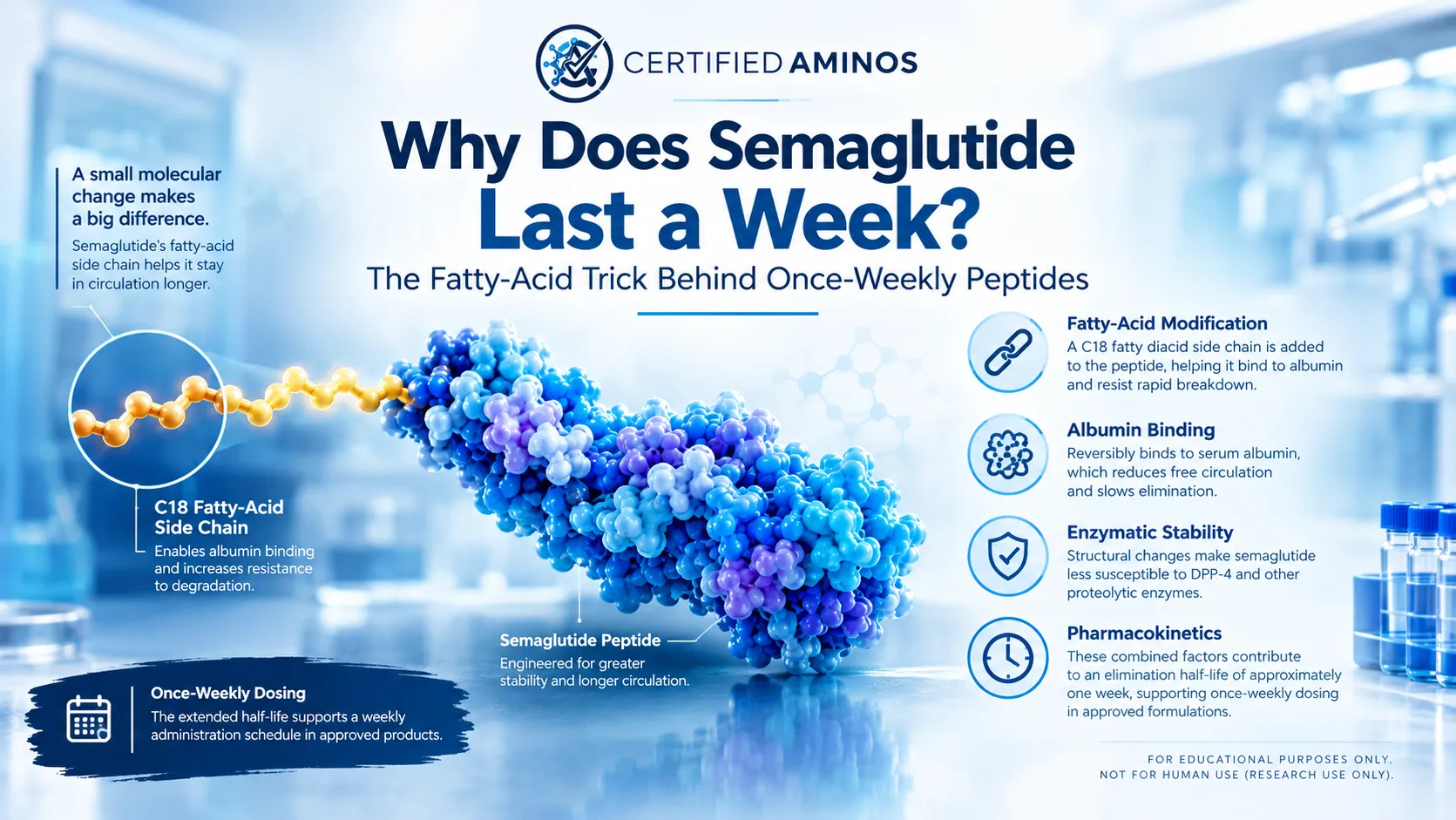
The modification usually associated with semaglutide's duration is its fatty-acid side chain — specifically a C18 fatty diacid (an 18-carbon chain with an acid group at each end) attached through a short linker to a lysine residue on the peptide backbone (Lau et al. 2015). Think of it like a tow cable: the fatty-acid chain doesn't change what the front of the molecule does at its receptor, but it gives the back of the molecule something else to grab onto — albumin — so the whole assembly moves through the body differently. That's an analogy, not a literal description of the chemistry.
The specific chain length wasn't arbitrary. Researchers compared fatty diacid chains of different lengths (C12, C18, C20, C22) for both receptor potency and albumin-binding strength. The C18 diacid used in semaglutide showed the strongest in-vitro receptor potency of the group tested, while albumin-binding affinity continued to rise somewhat with longer chains. C18 was selected as a balance point — strong enough albumin binding to extend circulation, without giving up too much receptor potency.
A short spacer — built from a glutamic acid unit and two polyethylene-glycol-like linker units — connects the fatty diacid to the lysine attachment point. In the same research program, swapping a longer fatty-acid chain onto the backbone without a comparable linker actually reduced receptor potency, which the added spacer chemistry was used to offset. Fatty-acid acylation isn't just "attach a fat molecule and wait" — chain length, attachment position, and linker chemistry all have to be tuned together.
How Does Albumin Binding Extend Semaglutide's Circulation Time?
Albumin is the single most abundant protein in human blood plasma, with a well-characterized role in ferrying fatty acids through the bloodstream. Semaglutide's fatty-acid side chain lets it occupy one of albumin's fatty-acid binding pockets, and the FDA-approved label reports it's extensively — more than 99% — bound to plasma albumin (FDA label).
This binding is dynamic and reversible, not permanent — semaglutide and albumin let go of each other constantly, they just rebind before the kidneys get much of a chance to filter the free molecule out. It doesn't make semaglutide immune to being metabolized, either: the FDA label describes its eventual elimination route as proteolytic cleavage of the backbone together with sequential beta-oxidation of the fatty-acid side chain itself.
The Other Half of the Story: Enzymatic Stability
Native GLP-1's rapid inactivation is driven substantially by DPP-4, which cleaves its two N-terminal amino acids and destroys its activity (Vilsbøll et al. 2003). Semaglutide addresses this with a backbone substitution at the DPP-4 cleavage site, stabilizing it against DPP-4-mediated degradation (FDA label). An experimental analogue that bound albumin just as well as semaglutide, but without this substitution, still cleared noticeably faster — that's the comparison that shows the two changes aren't substitutes for each other (Lau et al. 2015).
Semaglutide Pharmacokinetics: Absorption, Distribution, and Clearance
Using the figures in semaglutide's FDA-approved prescribing information:
- Absorption: Tmax of 1–3 days post-dose; absolute bioavailability of 89%.
- Distribution: Volume of distribution ≈ 12.5 L.
- Metabolism: Proteolytic cleavage of the backbone plus sequential beta-oxidation of the fatty-acid side chain.
- Clearance: ≈ 0.05 L/h.
- Elimination half-life: Approximately one week.
- Detectable presence: ~5 weeks after the final dose (roughly five half-lives).
- Excretion: Primarily urine and feces; ~3% of a dose excreted as intact semaglutide.
A drug can be measurable well after its concentration falls far below any biologically meaningful level — "stays in your system" describes detection limits and elimination kinetics, not constant activity.
Why Is Semaglutide Administered Once a Week?
A roughly week-long half-life makes once-weekly dosing pharmacokinetically plausible, but the approved interval reflects the full clinical evidence package — dose-ranging studies, steady-state exposure data (steady state at 4–5 weeks of weekly dosing), and demonstrated safety/efficacy at that interval (FDA label). This article explains the pharmacokinetic engineering behind an approved medicine's dosing interval; it is not guidance for adjusting any individual's prescribed schedule — that decision belongs with a prescribing clinician.
Do All Once-Weekly Peptides Use the Same Fatty-Acid Strategy?
No. Liraglutide, an earlier once-daily analogue with a shorter fatty-acid modification, has an elimination half-life of about 13 hours (Victoza label). Tirzepatide, a once-weekly dual GIP/GLP-1 agonist with its own distinct attachment chemistry, is reported at approximately 5 days (Lilly Medical Information). Similar dosing intervals do not mean identical molecular structures.
What This Means for Peptide Research
Molecular identity, purity, stability, biological activity, and pharmacokinetic behavior are five separate questions. Mass spectrometry can confirm identity and HPLC can assess purity, but neither establishes sterility, biological activity, or suitability for any particular use — a distinction covered in more depth in Are Peptides Safe? What Research Shows. Research-grade peptides sold for laboratory use — including semaglutide sold in that context — are not interchangeable with FDA-approved prescription medicines, regardless of purity assay results, and carry different regulatory status than prescription or investigational compounds. Certified Aminos' own semaglutide listing positions the product as a laboratory research compound, not a substitute for any approved prescription medicine, with no instructions for human administration.
Final Takeaway
Semaglutide's roughly one-week half-life is the product of engineering, not a single discovery: a fatty-acid side chain tuned for albumin binding, paired with a separate change that blocks rapid enzymatic degradation. The combination — not either mechanism alone — turned a minutes-long native hormone signal into a once-weekly pharmacokinetic profile.
This article is for scientific and educational purposes. It describes the pharmacokinetic and molecular-design properties of approved semaglutide formulations as documented in FDA labeling and peer-reviewed literature. It is not medical advice, is not an instruction to use any research compound in humans, and does not address dosing, treatment, or self-administration. Readers with questions about a prescribed medication should consult their healthcare provider.