GHK-Cu is Certified Aminos' research listing for the copper(II) complex of glycyl-L-histidyl-L-lysine (GHK), a tripeptide that occurs naturally in human plasma and declines in measured concentration with age. It is studied in cell-culture and animal models for extracellular matrix signaling and tissue-remodeling pathways. Available in 30mg, 50mg, and 100mg for laboratory research use only.
HPLC certified
Independent analysis
Highest standard
Full traceability
Each order ships as a GHK-Cu research peptide in your choice of 30, 50, or 100 mg vials, manufactured for laboratory use only.
| Product Name | GHK-Cu (copper tripeptide-1 complex) |
|---|---|
| Alternate Names | Copper peptide GHK-Cu; glycyl-L-histidyl-L-lysine copper(II); copper tripeptide-1 |
| Peptide Sequence | Gly-His-Lys (GHK), complexed with one Cu²⁺ ion |
| CAS Number | 89030-95-5 (free-base copper complex) — general literature reference value, not yet matched to this product's own COA |
| Molecular Formula | Commonly reported as C₁₄H₂₂CuN₆O₄ — general literature reference value, not yet matched to this product's own COA |
| Molecular Weight | ≈401.9 g/mol for the base complex (hydrate/salt forms differ) — general literature reference value, not yet matched to this product's own COA |
| Purity | Not independently verified — no batch-specific COA is currently published |
| Identity | Not independently confirmed by mass spectrometry or an equivalent method |
| Physical Form | Not published on this listing — confirm with supplier |
| Available Sizes | 30 mg / 50 mg / 100 mg |
| Intended Use | Laboratory research only (RUO) |
The CAS number, molecular formula, and molecular weight above describe the GHK-Cu molecule as studied in the general chemical literature — they are not yet matched to this product's own certificate of analysis. When your order arrives, match the lot number on the vial to the lot number on the COA before beginning any work.

AI now proposes peptide candidates before synthesis begins — here's what that changes about the research workflow, and what still has to happen on the bench.
GHK-Cu isn't a stand-in for every copper peptide — it's one specific, well-studied complex. What research supports for skin and hair, and current FDA status.
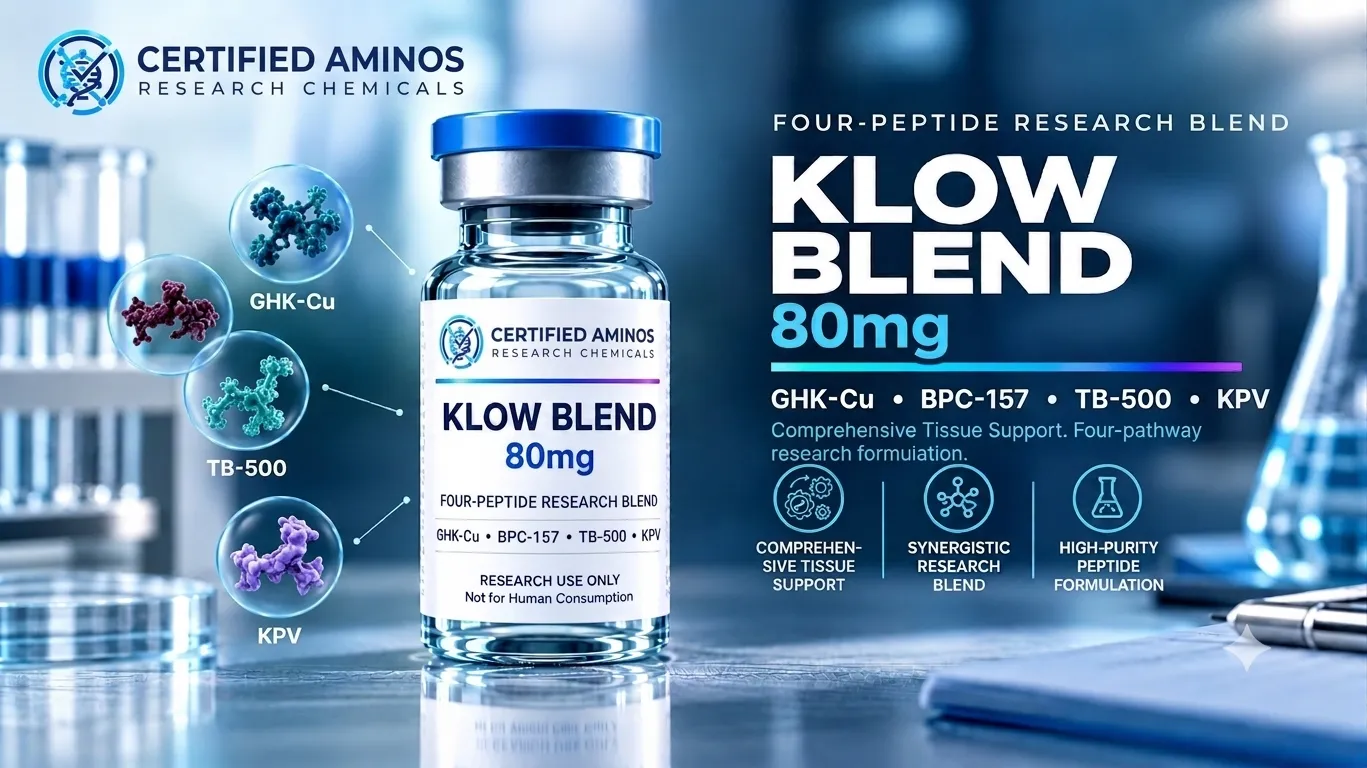
Klow Blend's own label disagrees with itself — Kisspeptin on one page, KPV on another. What's verified, and how each component's research actually stacks up.