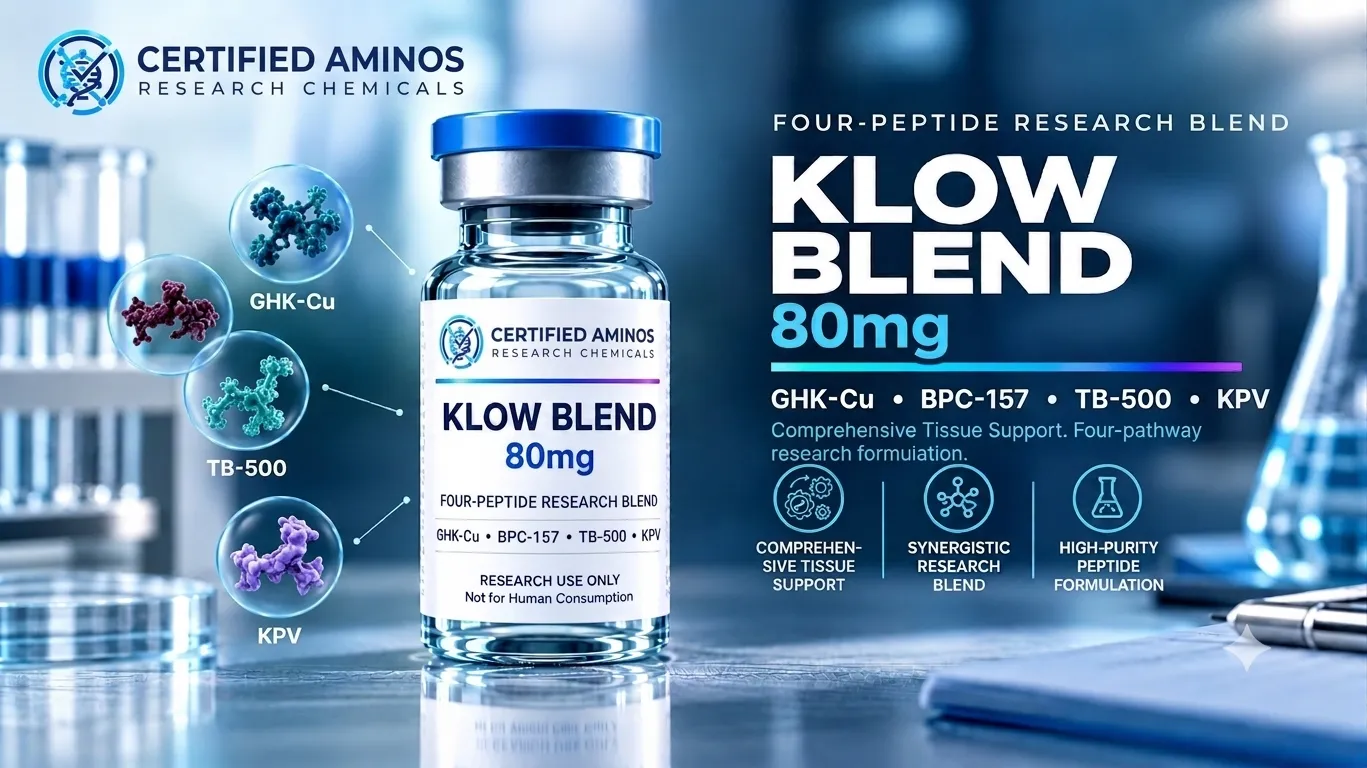
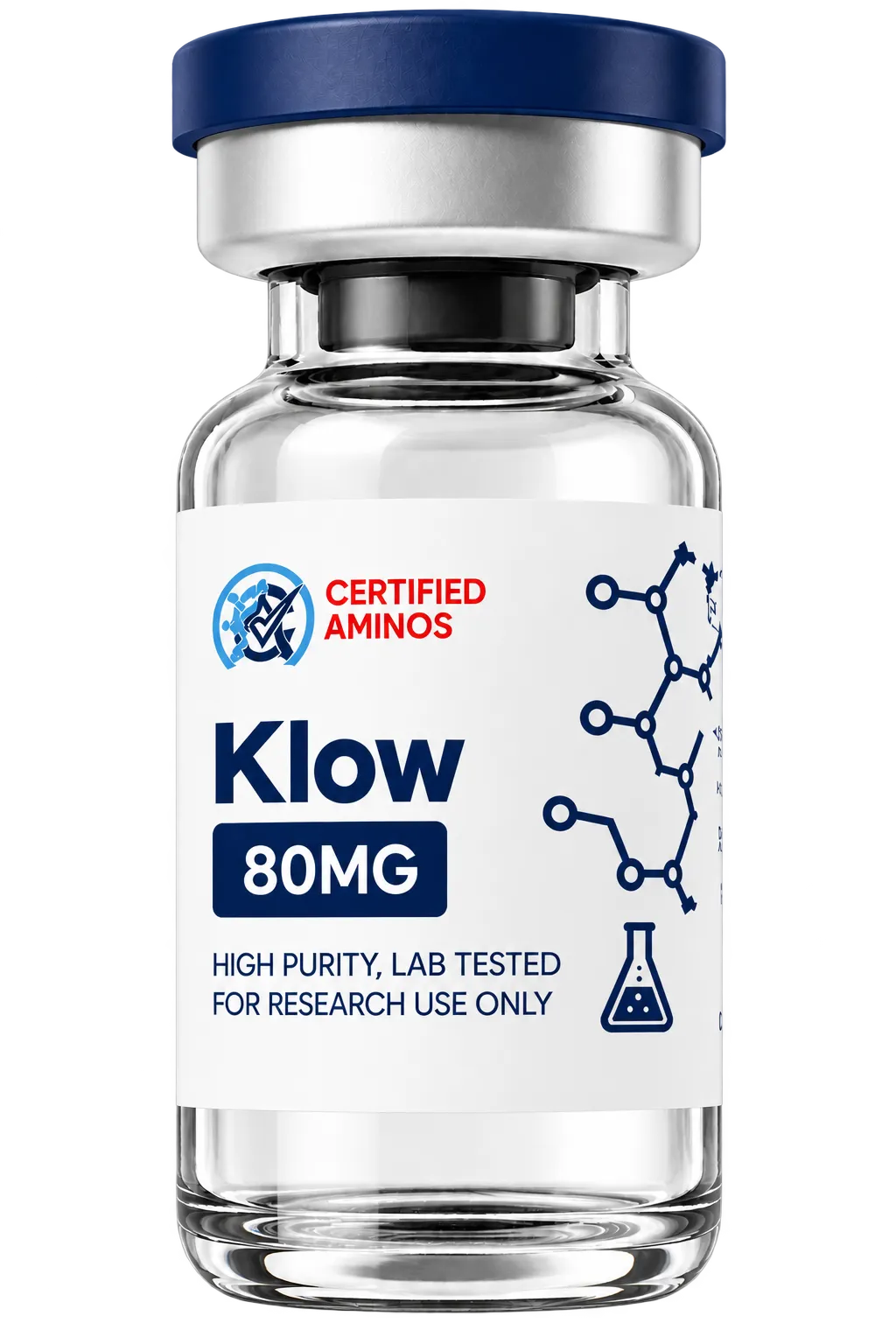
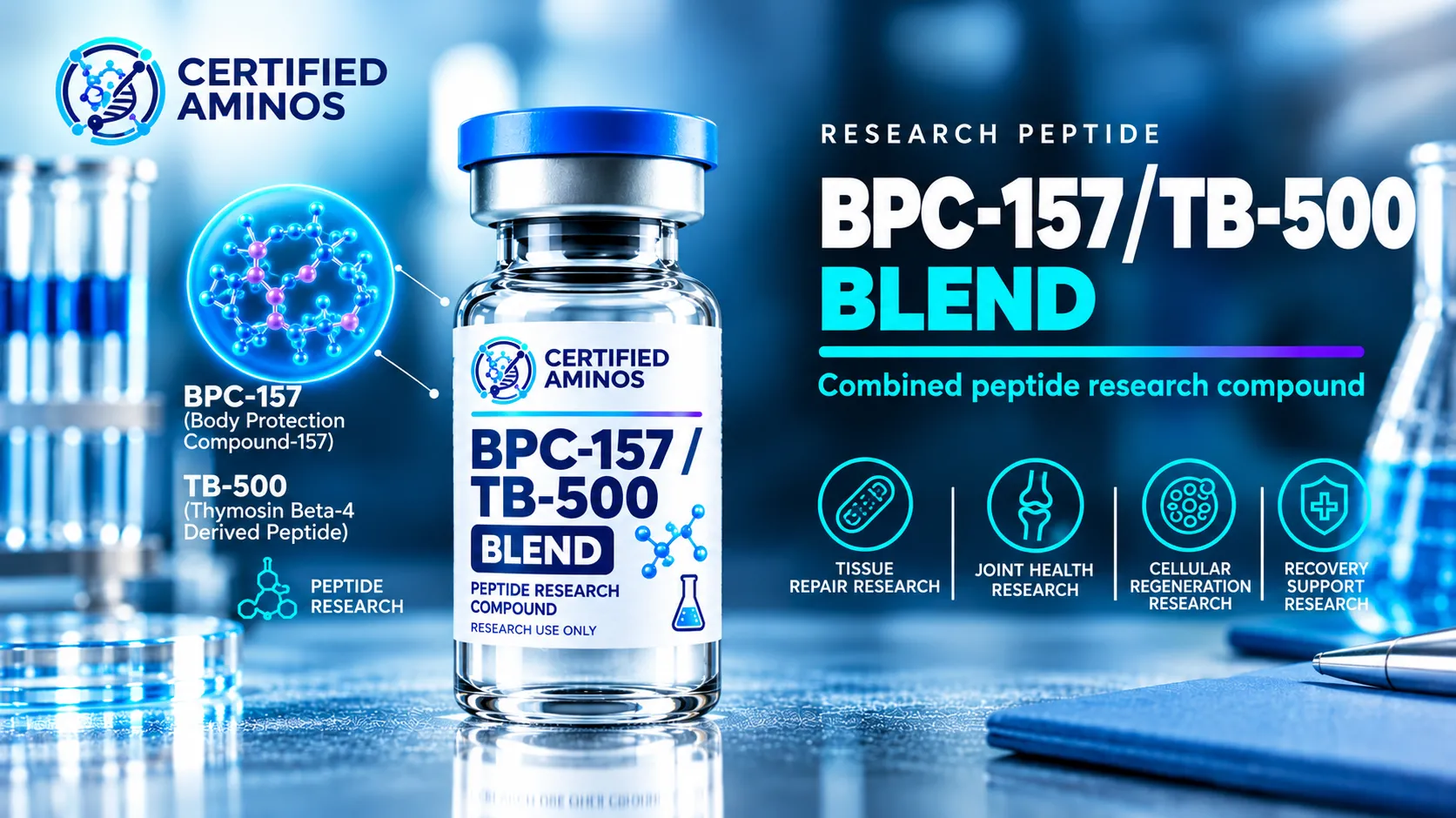
Klow Blend, as sold by Certified Aminos, is a four-peptide research formulation: TB-500, BPC-157, GHK-Cu, and KPV. Every benefit claim attached to it online is extrapolated from four separate research literatures, none of which tested these four compounds together.
This page doesn't cover dosing — that's a question for a laboratory's own validated experimental design, not a product blog post.
Where the name "Klow" comes from
Glow emerged first, as an informal nickname circulating in research-peptide circles for a three-peptide combination: GHK-Cu, BPC-157, and TB-500. KPV was added later by vendors interested in its anti-inflammatory signaling research, and the informal name shifted toward "Klow" — the K from KPV standing in for the fourth ingredient. No formal standard documents this naming logic, and it isn't registered to any single seller.
That matters practically: "Klow" is an informal community nickname, not a standardized formulation. One vendor's Klow Blend and another's share the same four component names; after that, amounts, ratios, and quality controls can differ. This article describes specifically what Certified Aminos lists under that name — not a generic industry average.
A disambiguation worth making directly: Certified Aminos' own site disagrees with itself here. The main product page describes Klow Blend as containing "Kisspeptin"; the Shop → Peptide Bundles listing correctly names the fourth ingredient as KPV. Kisspeptin is an unrelated reproductive-hormone-signaling peptide with no documented role in this formulation — and "kisspeptin" itself shows up as a fast-rising search term in the data around this product, which suggests that wording is actively confusing people. The verified formulation is TB-500, BPC-157, GHK-Cu, and KPV.
What's actually inside a Klow Blend vial
Certified Aminos' Klow Blend listing is a four-peptide lyophilized research formulation priced at $199, with an 80 mg total. The Shop → Peptide Bundles category page gives the per-component breakdown that the product page itself doesn't:
TB-500 identity note: Certified Aminos' documentation doesn't specify whether its TB-500 material is the full-length 43-amino-acid thymosin beta-4 or the shorter synthetic fragment that's standard across most commercial "TB-500" products. These are meaningfully different molecules with different research records, covered below. The product's own Certificate of Analysis and manufacturing specification — not trade convention — are the authoritative source on what's actually in the vial.
Certified Aminos describes a two-stage testing process: HPLC prior to compounding to verify sequence accuracy, then independent third-party HPLC alongside mass spectrometry on finished batches, against a stated 99% purity baseline. At the time this article was researched, the certificates page described that methodology but did not yet have a Klow Blend–specific, lot-numbered certificate loaded — the page itself says COA documents are still being added for the current catalog. Check that page directly for the lot number on the vial you actually receive before treating any purity figure as settled.
What the research actually shows for each of the four ingredients
This is the part most Klow Blend content skips. Rather than describing the research vaguely, here's where the evidence actually stands for each component, individually.
A closer look at each:
GHK-Cu (Evidence level: human RCT for topical use; theoretical-mechanistic for an injectable multi-peptide context). GHK-Cu has a multi-decade research history in skin and tissue-remodeling biology. The strongest human data is a randomized controlled trial in the Archives of Facial Plastic Surgery: blinded, objective evaluation found no statistically significant improvement in wrinkles or erythema from a GHK-Cu regimen on post-laser skin, though patients reported significantly higher satisfaction with skin quality at 12 weeks (Miller et al., 2006; DOI: 10.1001/archfaci.8.4.252). A separate animal study found a topical copper-tripeptide complex accelerated open-wound healing in rabbits versus zinc oxide or no treatment (Cangul et al., 2006; DOI: 10.1111/j.1365-3164.2006.00551.x). Both are topical, skin-route findings — not evidence about an injected four-peptide blend. See Certified Aminos' GHK-Cu product page.
BPC-157 (Evidence level: extensive animal preclinical; no completed human RCT). BPC-157 has one of the larger animal-research literatures of any peptide in commercial research use. A 2019 review in Cell and Tissue Research found consistently positive healing effects across tendon, ligament, and skeletal-muscle models, while stating directly that "the efficacy of BPC 157 is yet to be confirmed in humans" (Gwyer et al., 2019; DOI: 10.1007/s00441-019-03016-8). A broader 2021 review extends this to skin, gastrointestinal, and vascular wound models in rats (Seiwerth et al., 2021; DOI: 10.3389/fphar.2021.627533). Worth noting separately: BPC-157 sits under category S0 (non-approved substances) on WADA's Prohibited List — a regulatory fact about sport eligibility, not a safety verdict. See Certified Aminos' BPC-157 product page.
TB-500 (Evidence level: human clinical for the full-length protein; thin for the commercial fragment). The molecule question here is real and easy to miss. Commercial "TB-500" is generally understood in the research-peptide trade to be a shorter synthetic fragment of thymosin beta-4, not the full 43-amino-acid protein. The human clinical work belongs to the full-length protein: a review by Kleinman and Sosne describes Phase 2 trials in which topical thymosin beta-4 accelerated healing in pressure ulcers, stasis ulcers, and epidermolysis bullosa wounds (Kleinman & Sosne, 2016; DOI: 10.1016/bs.vh.2016.04.005), and a double-blind, placebo-controlled trial tested topical thymosin beta-4 on venous ulcers across ten European sites (Guarnera et al., 2007; DOI: 10.1196/annals.1415.003). Citing that clinical record as proof for the commercial fragment would be citing a different molecule. See Certified Aminos' TB-500 product page.
KPV (Evidence level: human cells + animal in vivo; no human clinical data). KPV is the newest of the four components to this research area and, in one sense, the most straightforward to assess honestly: the evidence that exists is real, and there simply isn't much of it yet. Dalmasso and colleagues found that nanomolar KPV concentrations inhibited NF-κB and MAPK inflammatory signaling in human intestinal epithelial cells, and that oral KPV reduced colitis severity in two mouse models via the PepT1 transporter (Dalmasso et al., 2008; DOI: 10.1053/j.gastro.2007.10.026). That's genuine human-cell and animal in vivo evidence — more than some research peptides in this category can claim. No human clinical trial exists yet, by any route.
Why four studied ingredients don't make a studied blend
Each ingredient above carries its own evidence, and some of it is genuinely solid. None of it was generated on the four-peptide combination sold as Klow Blend. Combining peptides changes the variables that matter: the ratio of each component to the others, the total peptide load in one reconstituted vial, and any interaction between compounds that none of the cited literature addresses. A blend built from four individually-promising peptides is a reasonable hypothesis to investigate — it isn't, on that basis alone, a validated research tool. Treat the combination itself as untested until a study says otherwise.
Klow Blend vs. Glow Blend
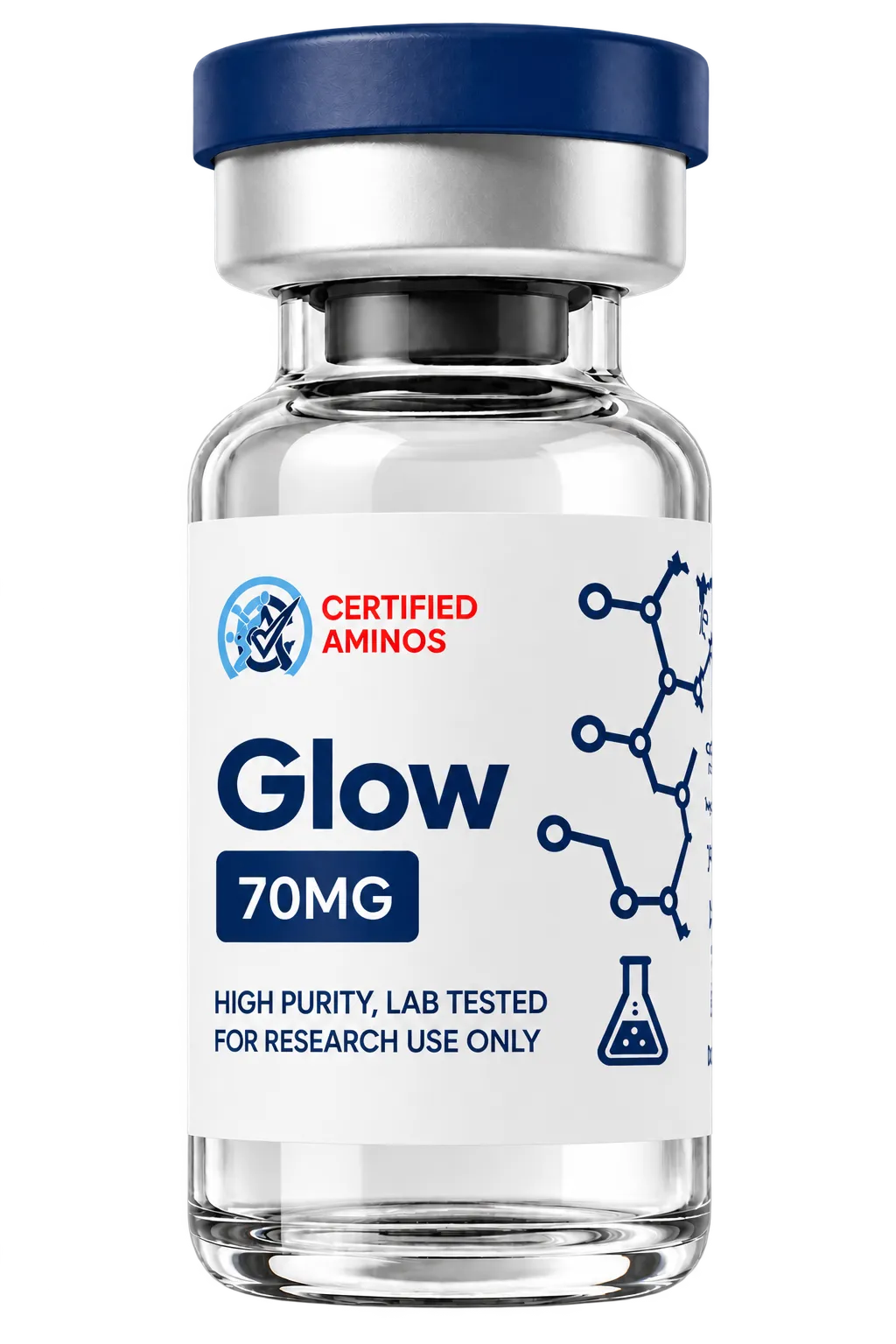
Glow Blend predates Klow Blend and is the three-peptide base it was built on. Certified Aminos lists Glow Blend as TB-500, BPC-157, and GHK-Cu at a 70 mg total ($179) — the same three peptides as Klow Blend, minus KPV, at a lower total weight and price. For a deeper look at that formulation, see our Glow Blend research guide.
If your research interest specifically includes the anti-inflammatory pathway KPV is studied in, Klow Blend adds it; if not, Glow Blend is the same base formulation without that fourth variable.
How to evaluate a research peptide blend
A short, practical checklist — for Klow Blend or any comparable product:
- Does the vendor publish exact per-component amounts, not just a total weight?
- Is there a batch-specific Certificate of Analysis, not just a page describing testing methodology in general terms?
- Does the listed formulation match across every page of the site — product page, category listing, homepage copy? A mismatch, like the Kisspeptin/KPV inconsistency on this product, is worth asking the vendor about directly.
- Is testing performed by a named, independent third-party lab?
- Is the vendor explicit about RUO status, with no human-use claims anywhere on the page?
Why a Certificate of Analysis matters
A Certificate of Analysis (COA) documents the results of laboratory testing — typically HPLC for purity, mass spectrometry for identity confirmation — for one specific manufactured batch. That's a meaningfully different thing from a page describing testing methodology in general: a methodology statement says how a company tests; a COA is the actual result for the vial someone received. Check Certified Aminos' certificates page for the lot number matching your batch before treating any purity figure as confirmed.
Research Use Only: what that means here
Klow Blend is positioned by Certified Aminos as Research Use Only (RUO) — supplied strictly for laboratory and scientific research, not for human or veterinary use, self-administration, diagnosis, treatment, cure, or disease prevention, and not evaluated for any of those uses by a regulatory body. This article doesn't cover dosing, reconstitution, or administration amounts for exactly that reason: those are questions for a laboratory's own validated experimental design, not a product blog post.
Klow Blend and its individual components (TB-500, BPC-157, GHK-Cu, and KPV) are intended for laboratory and scientific research purposes only. They are not intended for human or veterinary use, diagnosis, treatment, cure, or prevention of disease.