Research Use Only. This material is provided for scientific and educational purposes only. The product discussed is designated for Research Use Only (RUO) and is not intended for human or veterinary consumption, diagnosis, treatment, or prevention of disease. Nothing on this page constitutes medical advice or a recommendation for human use.
What Is SS-31, and How Is It Different From Elamipretide and Forzinity?
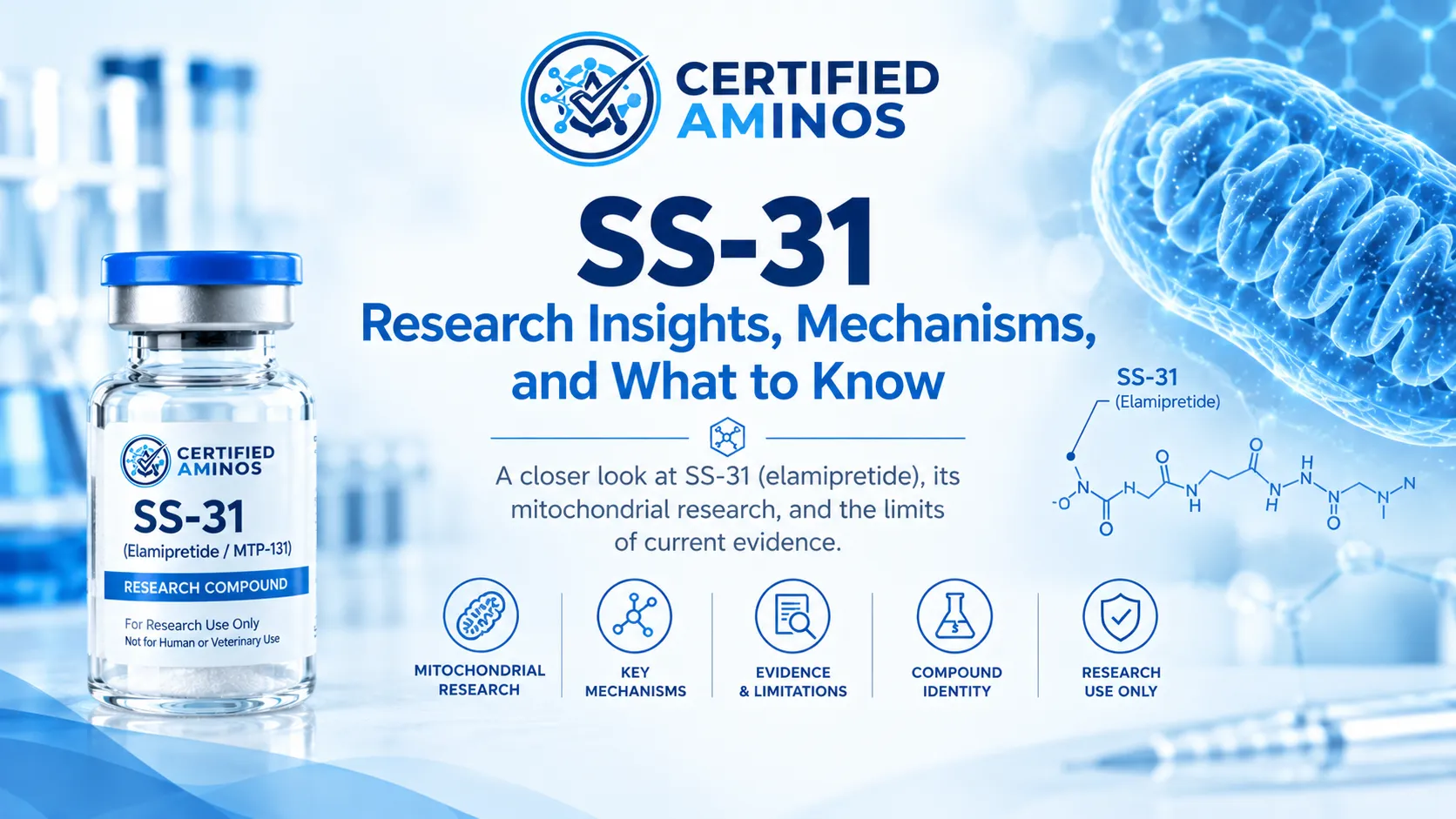
Same molecule, three different contexts. SS-31 and MTP-131 are research/laboratory designations for elamipretide, a synthetic, amphipathic tetrapeptide (sequence D-Arg-Dmt-Lys-Phe-NH2) belonging to the Szeto-Schiller family of mitochondria-targeting peptides. "Elamipretide" is also the generic name for Forzinity, Stealth BioTherapeutics' specifically manufactured, FDA-approved product. Sharing a compound name does not make a research-use material and an approved pharmaceutical product identical in identity, purity, manufacturing, or regulatory status — they are different materials from different sources, reviewed (or not reviewed) separately [1].
How Is SS-31 Proposed to Work?
The most consistently documented mechanism is SS-31's binding affinity for cardiolipin, a phospholipid concentrated in the inner mitochondrial membrane that helps organize the protein complexes responsible for oxidative phosphorylation (the main process cells use to produce ATP). A 2020 cross-linking mass spectrometry study (using a biotinylated form of SS-31 to enrich cross-linked complexes in isolated mitochondria) identified twelve proteins across nine enzymatic complexes as SS-31 interactors — eight involved in ATP-generating oxidative phosphorylation, four in 2-oxoglutarate metabolism — with cross-linked residues often sitting near each protein's own cardiolipin-binding region [2]. A separate biophysical study found SS-31 partitions into membranes in a charge-dependent way, with cardiolipin enrichment increasing binding affinity [3].
These are real, specific molecular-interaction findings. They describe where and how SS-31 associates with mitochondrial membrane proteins — they do not, on their own, establish what that association does to a cell, an organ, or a person.
What Does the Preclinical Research Actually Show?
Animal-model studies have reported elamipretide affecting structural and functional measures in cardiac and skeletal-muscle myopathy models, ischemia-reperfusion injury, and ocular-pathology models, generally framed around preserving mitochondrial cristae structure and reducing markers of oxidative stress [4]. One rat study specifically found elamipretide mitigated fragmentation of mitochondrial cristae networks following cardiac ischemia-reperfusion injury. Cell and animal models isolate a mechanism under controlled conditions; they do not reproduce full human physiology, and preclinical findings in this literature have repeatedly not translated cleanly into the clinical trial results below.
What Does the Human Clinical Research on Elamipretide Actually Show?
Results across the published elamipretide program are mixed, and the headline result is a negative one. Early dose-finding and crossover studies in primary mitochondrial myopathy (PMM) reported six-minute-walk-test (6MWT) signals favoring elamipretide [5][6]. The pivotal phase 3 trial, MMPOWER-3, was a randomized, double-blind, placebo-controlled study in 218 genetically confirmed PMM patients, testing 40mg/day subcutaneous elamipretide against placebo over 24 weeks with co-primary endpoints of 6MWT distance and total fatigue score [7]. Neither endpoint improved: the between-group difference in 6MWT distance was −3.2 meters (95% CI −18.7 to 12.3; p=0.69), and the fatigue result was also null [7]. That negative primary-endpoint result is the trial's headline finding.
The same published trial also reported a prespecified subgroup analysis: participants with nuclear-DNA (nDNA) pathogenic variants showed a 6MWT improvement, while the mitochondrial-DNA (mtDNA)-variant subgroup showed no difference from placebo [7]. The authors characterized this nDNA signal as encouraging but hypothesis-generating, not confirmatory. A separate 2024 publication then conducted additional exploratory post hoc analyses of genotype-specific correlates within that same trial — it did not re-establish the subgroup finding as a new, independent result; it looked for patterns among the nDNA responders [8]. Neither the prespecified subgroup signal nor the 2024 exploratory analysis demonstrates a general benefit in people with mitochondrial dysfunction. Both sit beneath MMPOWER-3's negative overall result, which remains the trial's headline finding.
How Did Forzinity Actually Get FDA-Approved?
This is where the story is more specific than most summaries make it sound — including, until now, this site's own product page for SS-31. Forzinity's approval traces to TAZPOWER, a phase 2/3 trial in genetically confirmed Barth syndrome, which had two parts [9]:
- Part 1 (randomized, placebo-controlled, 12 weeks, n=12 males): No statistically significant difference between elamipretide and placebo on knee-extensor strength by handheld dynamometry (+6.7 newtons; p=0.65), nor on the 6MWT or fatigue endpoints [9].
- Part 2 (open-label extension, unblinded, no placebo arm, 10 of the original 12 patients enrolled): Knee-extensor strength rose substantially from baseline at every subsequent visit — a mean +37.9 newtons (about 30%) at week 12 of the extension (p=0.003, n=10), +56.0 newtons (about 42%) at week 36 (p=0.001, n=8), with gains reported as sustained through week 168 in the 8 participants who reached that visit [9].
FDA's September 19, 2025 accelerated approval rests on that open-label extension finding — knee-extensor strength as a surrogate endpoint the agency considers reasonably likely to predict clinical benefit — not on a result demonstrated in TAZPOWER's randomized, blinded, placebo-controlled phase, which was negative on that same measure. FDA has required a post-approval randomized, double-blind, placebo-controlled confirmatory trial. This is a legitimate, real regulatory pathway for an ultra-rare disease with few other options — but "approved based on knee-extensor strength improvement" and "improvement demonstrated in a randomized controlled trial" are two different claims, and conflating them overstates how the approval was actually earned.
Does Forzinity's Approval Apply to This SS-31 Listing?
No, on two independent grounds. First, FDA accelerated approval evaluates one sponsor's specific manufactured product, formulation, and manufacturing process for one indication (Barth syndrome, patients ≥30kg) — it does not extend to a differently sourced, differently manufactured research material that happens to share a generic compound name. Second, even within elamipretide's own approved use, the approval rests on an unblinded extension study, not a blinded randomized comparison — a narrower evidentiary basis than the headline "FDA-approved" framing alone conveys. The Certified Aminos SS-31 listing is not an FDA-approved drug product, and its Research Use Only label is not FDA authorization of any kind.
SS-31 vs. Elamipretide (Research Literature) vs. Forzinity
What Does Certified Aminos' Own Product Page Say About This Listing?
Checked directly on certified-aminos.com/product/ss-31 [10] and certified-aminos.com/certificates [11], 2026-10-21.
What Should a Researcher Check on a Certificate of Analysis (COA)?
For this product, no batch-specific COA is currently published, so none of the above can yet be checked against a document [10][11].
What This Page Does Not Establish
This page does not establish that SS-31 is safe or effective for any use; that Forzinity's approval reflects on this or any other research-grade elamipretide material; that the cardiolipin-binding mechanism described here produces any specific effect outside the experimental models studied; or that this product's purity, identity, or concentration meets any particular standard. It also does not provide dosing, reconstitution, or administration guidance, and none should be inferred from it.
For Researchers
Featured in This Article: SS-31 — view the current listing on Certified Aminos to review live specifications, stock status, and documentation. Only features actually stated on that page are referenced in this article; no purity, identity, or testing claim is implied beyond what the page itself states [10].
Related reading: Are Peptides Safe? What Research Shows and Do You Need a Prescription for Peptides? for the broader RUO/FDA framework this article applies.
This material is Research Use Only. It is not medical advice, and it is not a recommendation for human use.