What Is PT-141 Peptide? What the Research Actually Shows
Recovery protocolsOctober 8, 20269 min read
PT-141, bremelanotide, and Vyleesi get treated as interchangeable — they aren't. What the trials actually show, by population, and how to verify an RUO batch.
PT-141, bremelanotide, and Vyleesi are one molecule across three contexts, not three interchangeable products.
The human evidence is real but narrow and sex-specific by trial design: a Phase 1 trial in men, a Phase 3 program in women that became the only FDA approval.
A Research Use Only PT-141 material should be judged on its own identity, purity, and lot-matched COA -- not on Vyleesi's approval or safety record.
“PT-141 peptide” and “what is pt-141” are tied for the single highest search-interest score in our keyword research, yet most of what ranks for those terms conflates three different things: a research peptide, a generic drug name, and an FDA-approved injection with one specific approved use. That gap between search demand and accurate information is why this page exists.
Featured In This Article
RESEARCH PEPTIDE
PT-141
Highly purified synthetic peptide prepared for rigorous laboratory research.
$69.00
PT-141 is a single peptide, not a blend. It's a melanocortin-receptor agonist studied for effects on sexual-response pathways that run through the central nervous system rather than the vascular system. Every real claim about it traces back to one of three sources: a rodent study, a small Phase 1 trial in men, or the Phase 3 program that led to one specific FDA approval in women — never all three at once, and never to a general population outside those studies.
What follows grades that evidence honestly, by source and population. We'll also cover how PT-141, bremelanotide, and Vyleesi relate to each other, what to check on a PT-141 certificate of analysis, and why this page won't turn dosage-related search demand into a usage protocol.
Where the Names PT-141, Bremelanotide, and Vyleesi Actually Come From
PT-141 was the development code name used by Palatin Technologies for a cyclic peptide analogue of alpha-melanocyte-stimulating hormone (alpha-MSH). As the compound moved through clinical development, it picked up its generic (INN) name, bremelanotide, which is how it's identified in most of the published literature from 2007 onward.
Vyleesi is narrower than either of those names. It's the FDA-approved brand name for one specific subcutaneous injection formulation of bremelanotide, approved for one specific indication. A research peptide labeled “PT-141” and sold Research Use Only is the same molecule by name, but it is not Vyleesi, has not been through the same review, and carries none of that approval's regulatory status.
That's the one fact worth holding onto before anything else on this page: three names, one molecule, three very different regulatory contexts.
How PT-141 Is Believed to Work
PT-141 acts on melanocortin receptors — a receptor family that includes MC3R and MC4R — rather than on vascular smooth muscle the way PDE5 inhibitors do. Because those receptors sit in brain regions tied to sexual behavior, its effects are described as centrally (CNS) mediated. In the rodent model Pfaus, Giuliano and Gelez used in their 2007 review, administering bremelanotide activated the medial preoptic area along with other hypothalamic and limbic regions associated with sexual behavior.
That's a mechanistically distinct target from anything working through blood flow, and it's the actual reason PT-141 drew sustained research interest across both male and female study populations — not a claim about which approach works better.
What the Research Actually Shows
Rather than describing “the evidence” as one undifferentiated pile, here's where it actually stands, broken out by source.
Evidence tier
Source
Population / model
Key finding
Preclinical
Pfaus, Giuliano & Gelez, 2007 (J Sex Med)
Ovariectomized, hormone-primed female rats
Increased solicitation (appetitive) behavior without changing lordosis; tracked with medial preoptic area activation
Human — Phase 1
Diamond et al., 2004 (Int J Impot Res)
Men with mild-to-moderate ED, intranasal dosing
Statistically significant erectile response above a 7 mg threshold vs. placebo; flushing and nausea most common adverse events
Human — Phase 3 / approval basis
Simon, Kingsberg, Clayton et al., 2019 (Obstet Gynecol)
Premenopausal women with HSDD, subcutaneous injection
Sustained desire-domain improvement through a 52-week open-label extension; nausea, flushing, and headache most common adverse events
Preclinical research (Evidence level: animal data only — informs mechanism, not human outcome)
Pfaus and colleagues tested bremelanotide in female rats able to control the timing of their own sexual encounters. Bremelanotide increased solicitation — a marker of appetitive interest — without changing lordosis, a consummatory reflex. That's a meaningful mechanistic finding, and it's animal data. It doesn't stand in for a human result on its own.
Human evidence in men (Evidence level: Phase 1 safety/pharmacodynamics trial, not an approved indication)
Diamond and colleagues ran a double-blind, placebo-controlled Phase 1 trial of intranasal PT-141 in healthy men and in men with mild-to-moderate erectile dysfunction who had previously responded to sildenafil. Doses above 7 mg produced a statistically significant erectile response versus placebo, with onset around 30 minutes. This trial established safety and pharmacodynamics — it was never carried forward to an approved product for this population.
Human evidence in women (Evidence level: Phase 3, the basis for the only FDA approval that exists for this molecule)
Simon, Kingsberg, Clayton and colleagues reported the 52-week open-label extension of RECONNECT, two Phase 3 trials of subcutaneous bremelanotide in premenopausal women with hypoactive sexual desire disorder (HSDD). Women who'd received bremelanotide in the double-blind core phase maintained improvement in desire-domain and distress scores through the extension, with no new safety signals. This is the data set behind Vyleesi's approval — for this specific population, by this specific route, for this specific indication.
What none of this establishes: a general sexual-performance enhancer claim, a testosterone effect, a broad erectile-dysfunction treatment outside the trial population studied, a fertility benefit, a weight-loss effect, or any anti-aging finding. Each of those runs past what the cited trials actually measured.
Why Clinical-Trial Dosing Data Isn't a Personal Protocol
In the supplied keyword research, “pt-141 peptide dosage” and “pt-141 dosage” score 97 and 95 — the two highest-interest phrases in the entire file after the core entity terms themselves. The demand behind those searches is real.
This page won't answer them as a protocol, but here's what can be said accurately. The “>7 mg” threshold from Diamond et al. (2004) describes a dose tested under medical supervision, in a specific population, by a specific route (intranasal), inside a Phase 1 study designed to establish safety and pharmacodynamics. Simon et al. (2019) used an entirely different formulation, delivered subcutaneously, in a different population, for a different endpoint. Route, population, and study design all change what a number means — which is exactly why a figure from one trial can't be lifted out and applied as a cycle, frequency, or injection schedule.
What this page will never do: no personal dosing figures, no injection volumes, no administration steps, no cycle schedules. A PT-141 research material is sold strictly for laboratory and research use, has not been evaluated by the FDA for human or animal use, and any real dosing question belongs with a licensed physician, not a product explainer.
PT-141, Bremelanotide, and Vyleesi: Where the Regulatory Line Sits
The FDA approved Vyleesi (bremelanotide) on June 21, 2019, under NDA 210557, specifically for acquired, generalized hypoactive sexual desire disorder in premenopausal women — and explicitly excluded cases tied to another medical or psychiatric condition, relationship issues, or medication effects. That approval, and the safety data behind it, belongs to that specific branded formulation.
It does not transfer to a Research Use Only PT-141 product sold as a research chemical. An RUO material has not been reviewed by the FDA for any human or animal use, and an approved drug's safety record says nothing about the purity, identity, or quality of a separate, unreviewed research compound that happens to share its molecule name.
How to Read a PT-141 Certificate of Analysis
A COA for a single-peptide product is simpler to read than a multi-ingredient blend's, but the same checks apply.
1. The lot number matches the vial. A generic certificate that doesn't name your specific batch isn't documentation for your product.
2. Identity and purity are two different questions. Identity (is this actually PT-141, by molecular weight) is typically confirmed by mass spectrometry. Purity (how clean the sample is) is typically estimated by HPLC. A single purity percentage confirms neither identity nor safety on its own.
3. The method and date are stated alongside the number. An undated purity figure with no method attached isn't independently verifiable — it's only meaningful tied to both.
4. The named testing lab must exist and be verifiable. A COA is only as credible as the lab that produced it. If the lab can't be independently verified, treat the certificate as unconfirmed.
One line worth holding onto: a clean COA confirms what's in the vial. It doesn't speak to whether the material should be used for any particular purpose, at what amount, or to what effect.
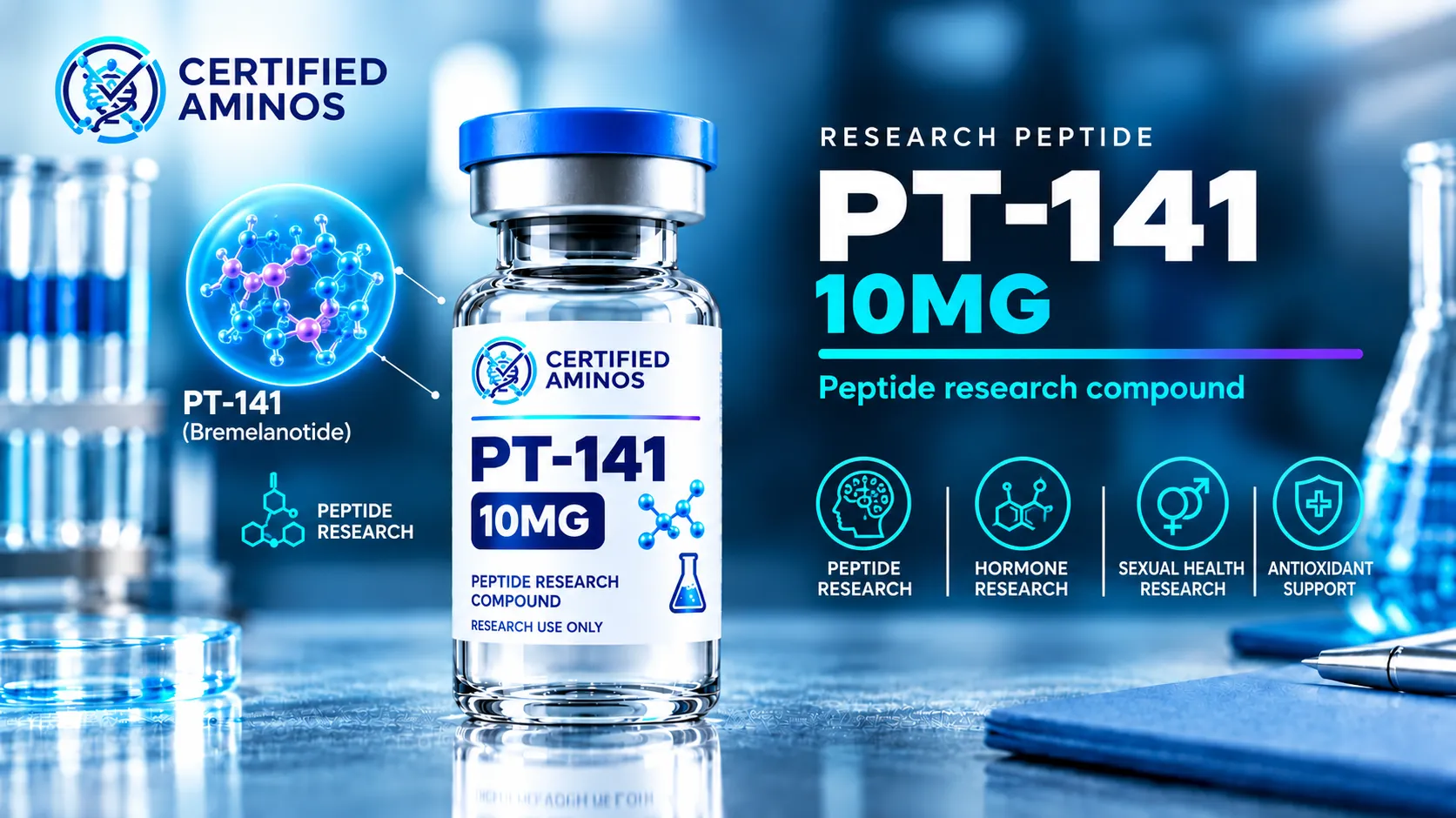
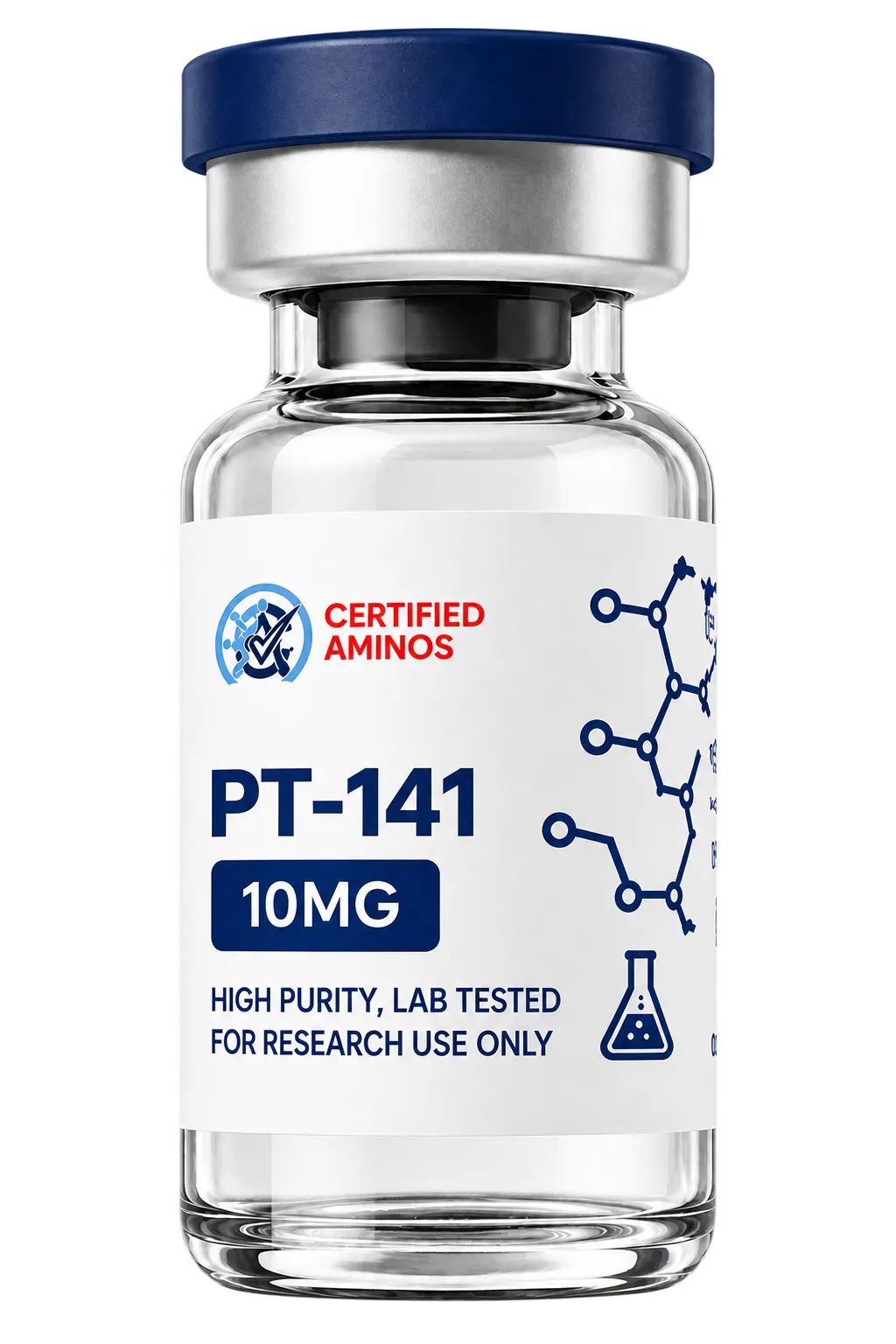
Certified Aminos PT-141 research material
Certified Aminos' PT-141 research listing sits under the Sexual & Hormonal category, titled “PT-141 for Research | COA-Verified,” with on-page copy describing it as a melanocortin-receptor agonist studied for CNS-mediated effects on sexual-response pathways — consistent with the research framing above. The listed option is a 10MG size at $75.
Documentation note: the product page's purity claim is ≥ 99%, described as HPLC-certified, and the site's certificates page separately describes an in-house HPLC check on raw material followed by a second HPLC run and mass spectrometry at outside laboratories on finished batches. At the time of this review, however, the certificates page had not yet posted a batch-specific, lot-matched COA for this product, and the product page does not state the material's physical format (for example, lyophilized vial) or whether sizes exist beyond the single 10MG listing. Those three details are marked verification required rather than assumed, and the current batch's documentation should be requested directly through Certified Aminos' contact page before being stated as settled fact.
On regulatory status, PT-141 is listed and described in research-use terms throughout the product and category pages, consistent with the RUO classification discussed above — it is not positioned anywhere on the site as an approved treatment, and nothing in this guide should be read as suggesting otherwise. Full product details and current pricing are on the PT-141 product page; current lot documentation, once published, will be on the certificates page.
Three Things Worth Holding Onto
PT-141, bremelanotide, and Vyleesi are one molecule across three contexts, not three products with three safety profiles. The mechanism is reasonably well characterized in animal research; the human evidence is real but narrow, and it's sex-specific by trial design, not interchangeable. A Research Use Only PT-141 material stands or falls on its own documentation — identity, purity, a lot-matched COA — not on the reputation of a drug that happens to share its name.
For a deeper look at the regulatory distinction specifically, see the Research Use Only FAQ. To verify current batch documentation, the certificates page is the right stop.
For research use only. Not for human or animal use.
Got Questions?
Frequently Asked Questions
PT-141 is a synthetic cyclic peptide that acts as a melanocortin-receptor agonist, studied for centrally (CNS) mediated effects on sexual-response pathways rather than direct vascular action.