Glow Blend pairs GHK-Cu, BPC-157 and TB-500 — untested as a combination. What's known about each ingredient, and why KLOW Blend isn't the "KLOW" forums mean.
No study has tested GHK-Cu, BPC-157, and TB-500 together as Glow Blend. Each ingredient's research is real; the blend's isn't.
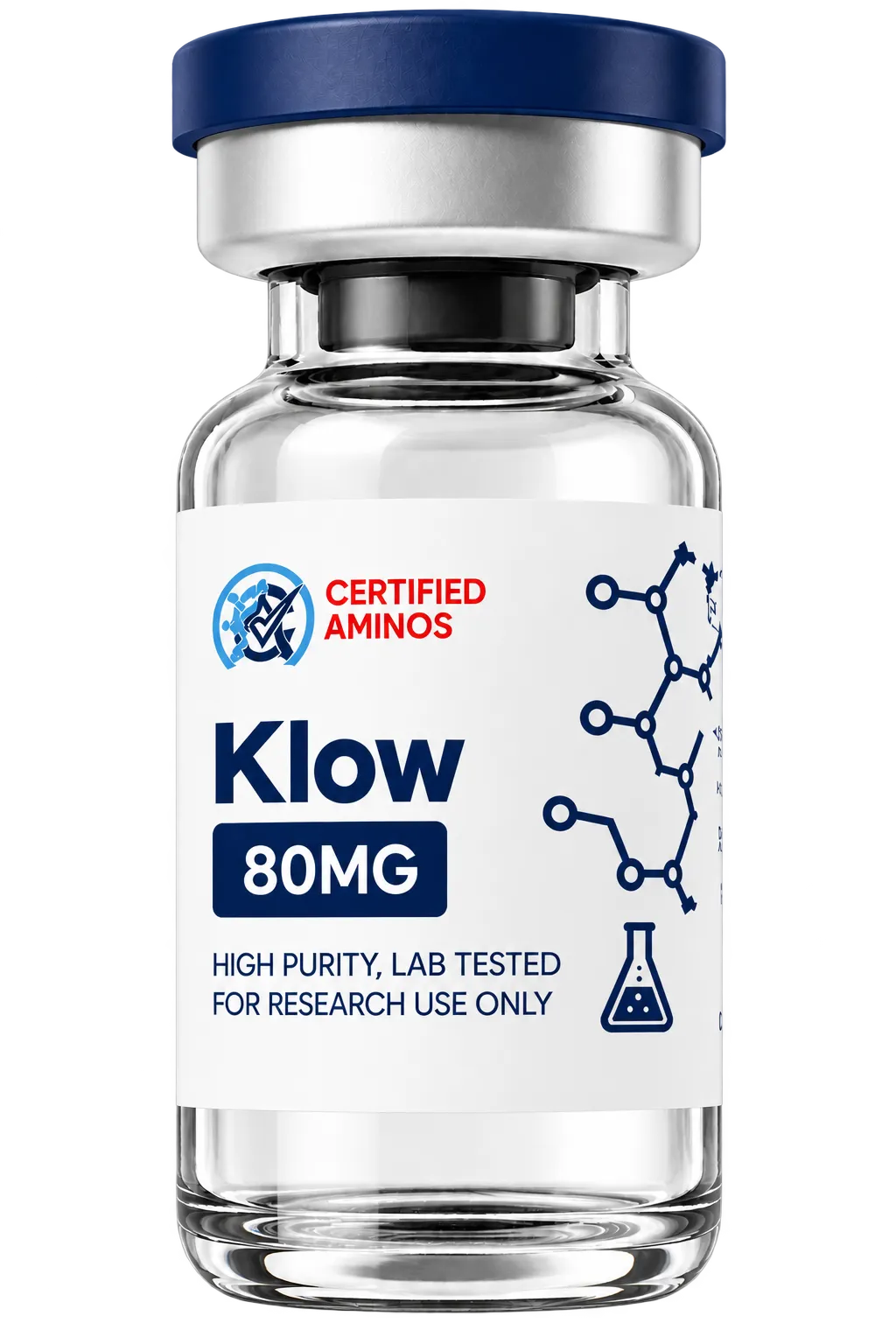
Certified Aminos' KLOW Blend contains Kisspeptin, not KPV — different from the four-ingredient "KLOW" most of the research-peptide community means by that name.
BPC-157 has no published randomized controlled trial in humans. The evidence is animal preclinical plus a handful of small observational reports.
Most commercial "TB-500" is reported to be a 7-amino-acid fragment, not the 43-amino-acid full thymosin beta-4 protein that has the actual human clinical record.
Glow Blend pairs three well-known research peptides in a single vial. Searches for it have been rising, and most of what comes up repeats the same handful of benefit claims without saying where those claims actually come from. This page tries to do that part properly.
Featured In This Article
RESEARCH PEPTIDE
Glow Blend
Highly purified synthetic peptide prepared for rigorous laboratory research.
$129.00
RESEARCH PEPTIDE
Klow Blend
Highly purified synthetic peptide prepared for rigorous laboratory research.
$149.00
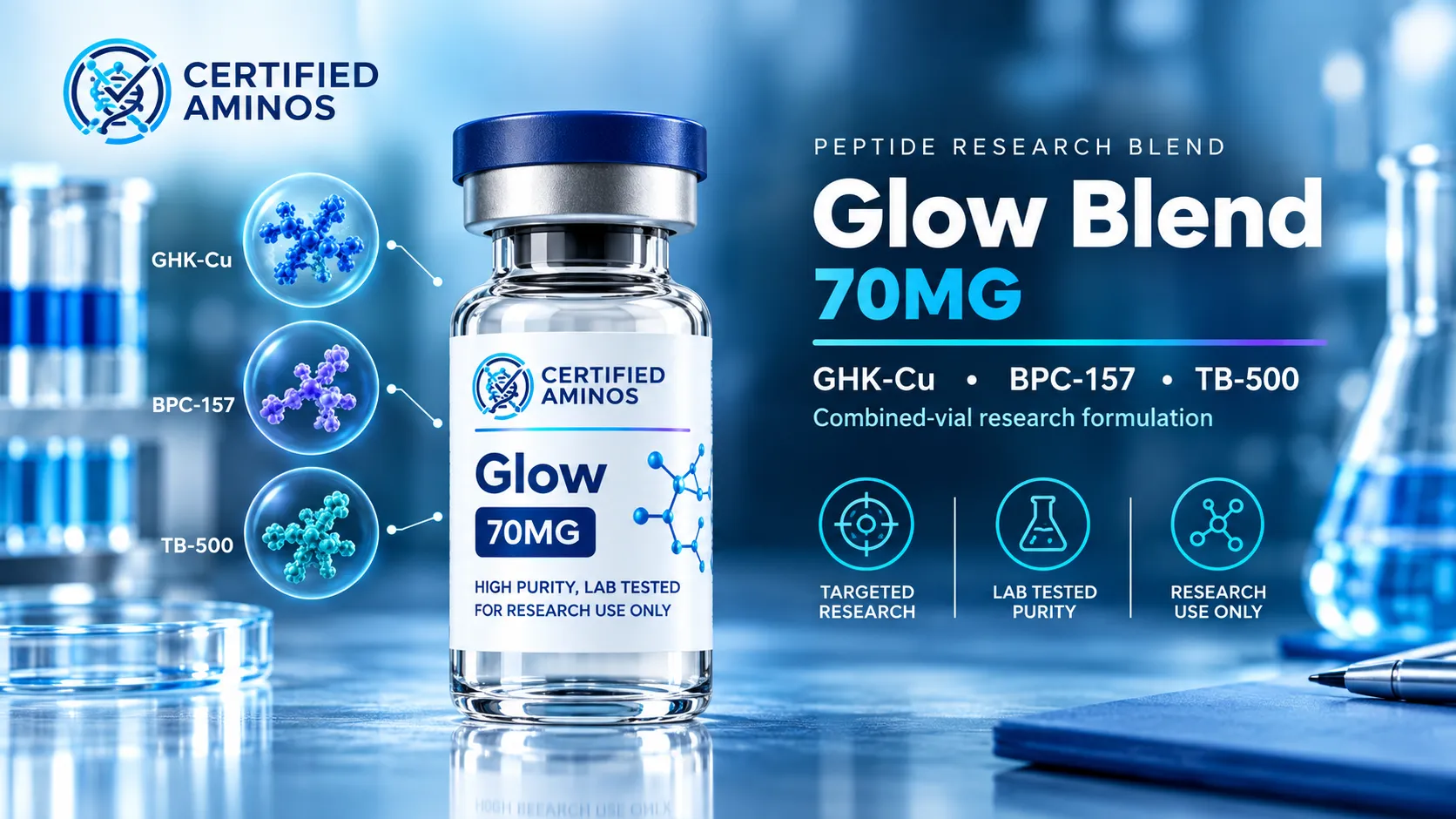
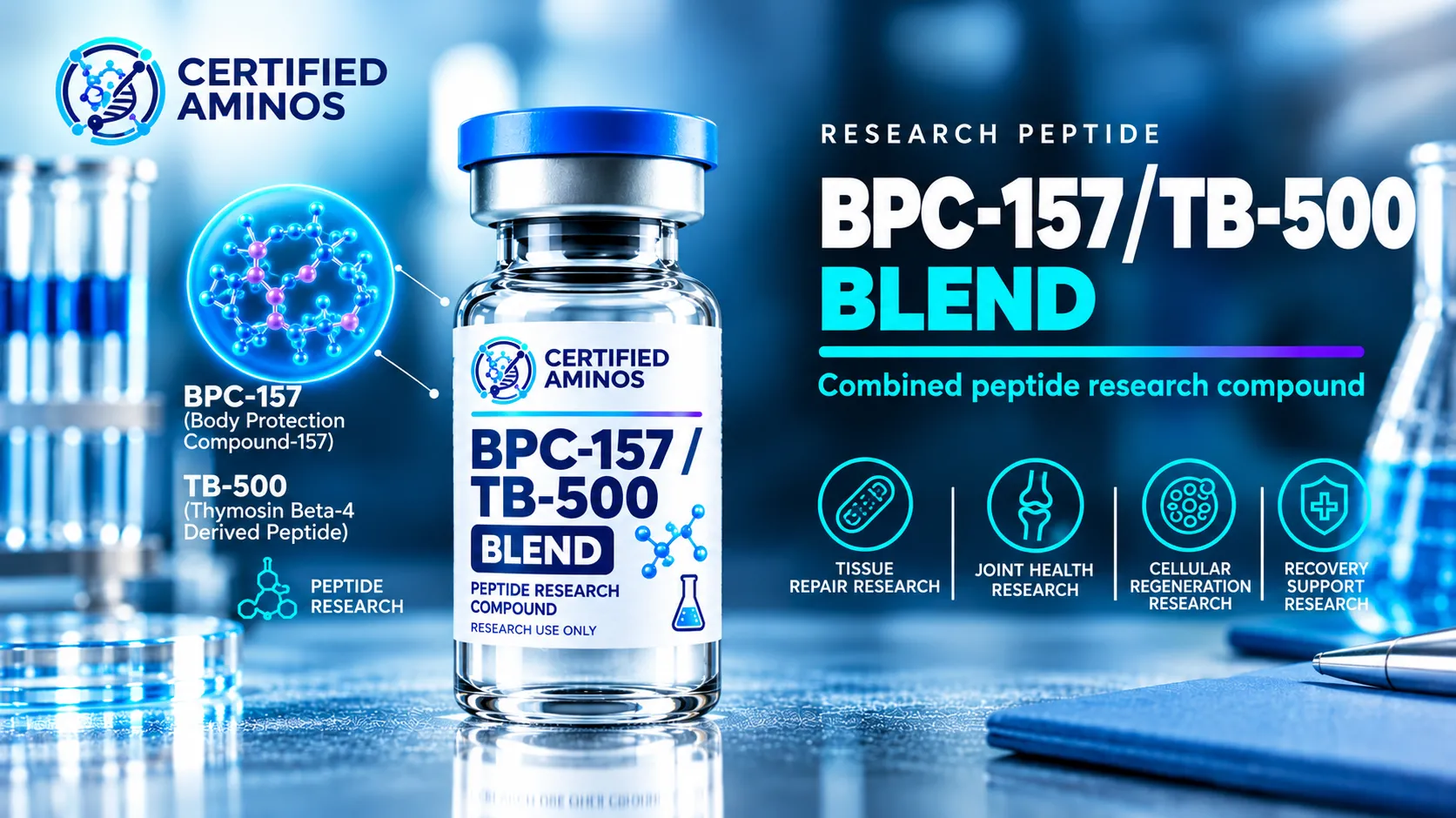
Glow Blend is a three-peptide research formulation: GHK-Cu, BPC-157, and TB-500. Each of those three has its own, separate research literature. None of the sources reviewed for this page describe a study that tested the three of them together, as this specific combination.
What is Glow Blend?
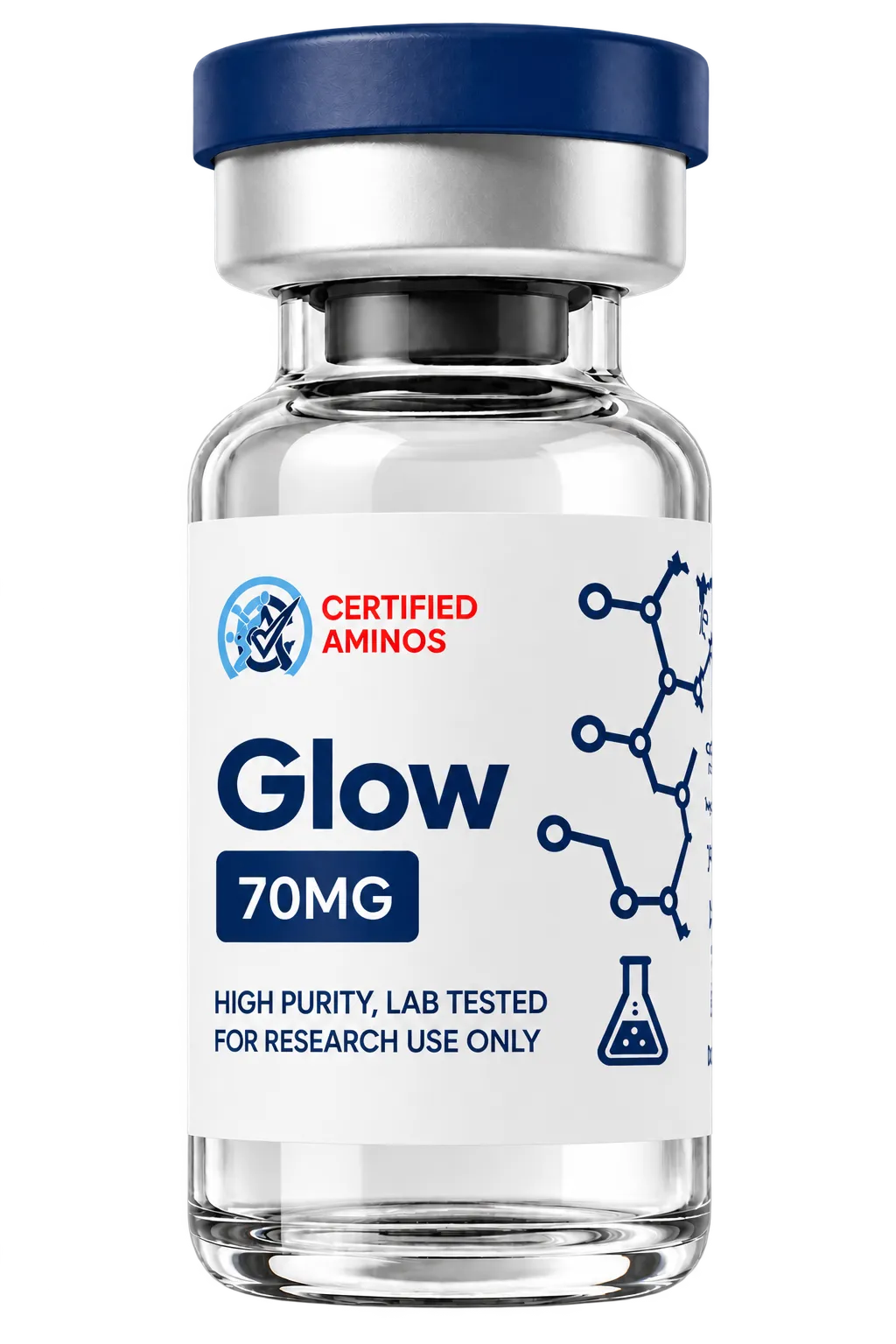
Glow Blend is a combined-vial research peptide product sold by Certified Aminos. The listing describes it as a skin- and repair-focused formulation pairing GHK-Cu with BPC-157 and TB-500, intended for laboratory and research use rather than human administration.
The product listing states the three components and markets the formulation around purity testing and documentation, but it does not clearly and consistently publish an exact milligram breakdown per component. Where this page would otherwise state a specific amount, it says so plainly instead: exact per-component amounts should be confirmed on the current live listing or batch documentation before being treated as fact.
This matters because research-use-only (RUO) material is, by definition, not something to use based on a blog post's description of it. What this page can responsibly do is describe what each ingredient is, summarize what's actually been studied about each one, and explain where the evidence stops — not tell anyone how to use the product.
What's actually in Glow Blend
Three components make up the formulation. Here's what each one is, in plain terms, before any discussion of evidence:
Skin and extracellular-matrix biology; gene-expression modulation studied mostly in topical applications
BPC-157
Synthetic 15-amino-acid peptide
Tissue-repair signaling studied across angiogenesis, tendon, muscle, and gut-injury models, predominantly in animals
TB-500
Marketed as thymosin beta-4-related material (see note below)
Cell migration and actin binding; the full-length protein has a human clinical record, the common commercial fragment does not
A note on exact amounts: Certified Aminos' listing names these three components but amounts have not been confirmed consistently across the live page. Don't rely on a figure repeated elsewhere online — check the current product listing or, better, the batch's certificate of analysis on the certificates page for the specific lot in hand.
TB-500 identity note: Certified Aminos' documentation does not specify, as reviewed for this page, whether its TB-500 material is the full-length 43-amino-acid thymosin beta-4 or the shorter fragment many commercial "TB-500" products actually contain (commonly described as an acetylated 7-amino-acid fragment, residues 17-23). These are meaningfully different molecules with different research records. The COA and manufacturing specification for the specific batch are the authoritative source on what's actually in the vial — a product name on its own isn't.
A note on what Glow Blend is not: some keyword research around this product surfaces terms like KPV and glutathione. Neither appears in Certified Aminos' Glow Blend listing, and this page does not treat them as part of the formulation. They belong to other products and other searches, not this one.
What the research actually shows for each component
Rather than describing the research vaguely, here's a structured summary of where the evidence currently stands for each of the three ingredients.
Ingredient
Strongest evidence type
Key finding
Biggest limitation
GHK-Cu
Human placebo-controlled trials (topical)
Placebo-controlled and pilot studies have reported gains in skin thickness, elasticity, collagen density, and reductions in wrinkle depth with topical application
Topical skin data doesn't transfer to an injectable multi-peptide blend
BPC-157
Animal preclinical
A large preclinical literature spans angiogenesis, tendon, muscle, and gut-injury models
No randomized controlled human trial was identified (confirmed via PubMed search); a retrospective knee-pain series is the closest direct human data found
TB-500
Human clinical (full-length protein only)
Full-length thymosin beta-4 has a human clinical record in several contexts
Most commercial "TB-500" material is reported to be a shorter fragment, not the full protein, and direct human data on that fragment is thin
GHK-Cu (evidence level: human placebo-controlled trials for topical applications; theoretical/mechanistic for multi-peptide injection contexts)
GHK-Cu is one of the better-studied peptides in this formulation, at least for a specific application. Early gene-expression research described broad modulatory effects across wound-healing, anti-inflammatory, and tissue-remodeling pathways. The topical evidence base includes placebo-controlled and pilot trials reporting gains in skin thickness, elasticity, and collagen density, and reductions in wrinkle depth, with topical delivery.
The limitation that matters here: that evidence is topical. The delivery route, concentration, and biological context of a topical skin study are not the same as an injectable three-peptide blend. Treating one as proof of the other is a hypothesis, not a finding.
BPC-157 (evidence level: extensive animal preclinical; thin human observational data; no human randomized controlled trial identified)
BPC-157 has one of the larger preclinical literatures of any synthetic peptide in commercial research use, with studies across angiogenesis, tendon healing, muscle injury, and gastrointestinal injury models in animals.
The human record is considerably thinner. A retrospective knee-pain case series and a handful of small pilot reports are the closest direct human data identified in the sources reviewed for this page — no randomized controlled trial establishing efficacy in humans was found. Separately, BPC-157 has been reported on WADA's Prohibited List in recent years (category S0); confirm current status directly against wada-ama.org, since list contents change and this hasn't been independently re-verified for this page.
TB-500 (evidence level: human clinical history belongs mainly to the full-length protein; evidence for the commercial fragment specifically is limited)
The nomenclature issue with TB-500 is real and often glossed over. Commercial "TB-500" products are widely described as an acetylated 7-amino-acid fragment — residues 17-23 of thymosin beta-4 — rather than the full 43-amino-acid protein. The human clinical work, including trials in cardiac-repair and wound-healing contexts, generally belongs to the full-length protein. Whether the fragment behaves similarly in any given context is a separate, largely open research question.
This isn't a criticism of TB-500 as a research material — it's a precision issue. Citing full-length thymosin beta-4 clinical research to describe the commercial fragment is citing a different molecule unless the identity has actually been confirmed for the specific product in hand.
Does research on the ingredients prove the blend works?
This is the part most "glow peptide" content skips. Each of the three ingredients above has its own research record. None of that is the same as evidence for Glow Blend as a combined, three-peptide formulation.
No relevant study testing GHK-Cu, BPC-157, and TB-500 together, as this specific combination, was identified in the sources reviewed for this page. That's a statement about the literature search behind this article, not a verdict on whether such a study could exist elsewhere or will exist in the future.
Combining research compounds doesn't automatically mean their effects add up or reinforce one another. Interactions between compounds — additive, synergistic, neutral, or otherwise — are their own research question, separate from how each ingredient behaves alone. The available literature reviewed here doesn't establish an answer either way for this specific combination, so readers shouldn't assume the individual-ingredient findings simply stack.
Glow Blend vs. KLOW Blend
Certified Aminos also sells a KLOW Blend, and the two names get confused often enough to be worth a short, direct comparison — without turning this article into one:
Glow Blend
KLOW Blend
Components
GHK-Cu, BPC-157, TB-500
Kisspeptin, GHK-Cu, BPC-157, TB-500
Combination tested as a unit?
No
No
Matches the generic community "KLOW" formula?
N/A
No — that formula typically uses KPV, not Kisspeptin
That last row is worth flagging specifically: the generic, community-used term "KLOW" elsewhere in the research-peptide market usually refers to a four-ingredient formula built around KPV, not Kisspeptin. Certified Aminos' own KLOW Blend is not that formula. Neither product is presented here as better or more effective than the other — the formulations are simply different, and like Glow Blend, KLOW Blend's own combination hasn't been tested as a unit either. The same evidence-level caution applies to both.
How to evaluate a research peptide blend
Whether or not Glow Blend specifically is the right research material for a given project, the following is a reasonable, vendor-neutral checklist for evaluating any research peptide blend:
Ingredient identity — does the listing or label name every component, with no ambiguity about which molecule is meant?
Concentration/amount — is the per-component amount actually published, not just a total weight?
Batch/lot documentation — is there a specific lot number tied to the vial in hand?
Third-party testing — is purity and identity confirmed by an independent lab, not just stated by the seller?
Certificate of analysis — is a COA available for that specific batch, not a generic claim that testing "is done"?
Storage and handling information — is there guidance on how the material should be stored?
Clear RUO labeling — does the product clearly state it is for research use only?
On documentation specifically: Certified Aminos' certificates page describes third-party HPLC and mass-spectrometry testing as part of its process. At the time this page was researched, that page did not yet show a populated library of verified batch certificates. That's a documentation-availability note, not a claim about the product's actual purity — anyone relying on a specific batch's COA should check that page directly and current as of their purchase.
What does research use only mean?
RUO means exactly what it says: labeled for lab and research settings, not for a person to take. It's not a watered-down drug approval — no regulator has evaluated it for human safety or effectiveness at all.
This page doesn't cover dosing, reconstitution, administration, or cycling for that reason — those are individualized decisions for a research setting operating under its own protocols and applicable laws, not something a blog article should be guiding.
Glow Blend is a Research Use Only (RUO) compound. It is not approved by the FDA for any human or animal use, and nothing in this article should be interpreted as medical advice, a treatment recommendation, or a guarantee of any outcome. This article is intended solely to summarize published scientific research for qualified researchers and laboratory professionals. Products sold by Certified Aminos are intended strictly for laboratory and scientific research and are not for human or animal consumption.
Got Questions?
Frequently Asked Questions
Glow Blend is a combined-vial research peptide formulation sold by Certified Aminos, listed as containing GHK-Cu, BPC-157, and TB-500.