Research Use Only. This material is provided for scientific and educational purposes only. The product discussed is designated for Research Use Only (RUO) and is not intended for human or veterinary consumption, diagnosis, treatment, or prevention of disease. Nothing on this page constitutes medical advice or a recommendation for human use.
What Is Oxytocin Acetate?
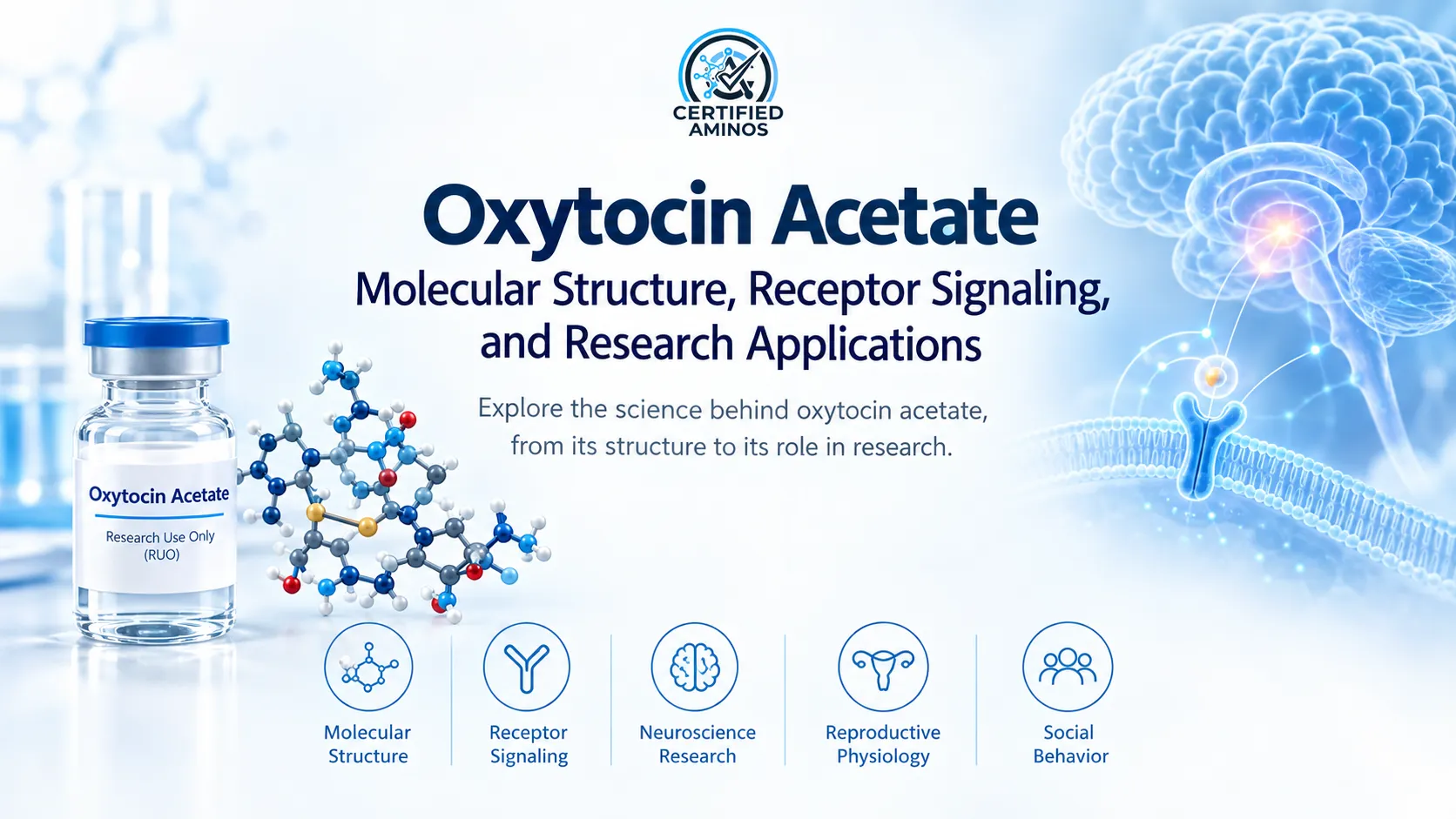
Oxytocin acetate is the acetate-salt form of oxytocin, a naturally occurring nonapeptide hormone synthesized in the hypothalamus and released from the posterior pituitary. Its sequence is Cys-Tyr-Ile-Gln-Asn-Cys-Pro-Leu-Gly-NH2, a cyclic structure formed by a disulfide bridge between its two cysteine residues. The acetate salt form is a common way to supply and stabilize the peptide for laboratory handling; it does not change the underlying oxytocin molecule's identity.
How Does Oxytocin Signal Through Its Receptor?
Oxytocin acts through a single receptor, OXTR, a class A (rhodopsin-like) G-protein-coupled receptor. Its primary coupling is to Gq/11, activating phospholipase C and the downstream IP3 pathway, which releases intracellular calcium — the direct mechanism behind smooth-muscle contraction. OXTR isn't exclusively Gq-coupled, though: it can also engage Gi signaling and activate additional cascades including MAPK, PKC, and CaMK pathways depending on cell type and context [1]. This multi-pathway coupling is part of why oxytocin research spans such different physiological systems — the same receptor, expressed in different tissues, drives meaningfully different downstream effects.
What Does Oxytocin Research Investigate Peripherally?
OXTR expression rises sharply in the myometrium and endometrium near the end of pregnancy, and receptor activation there triggers both direct calcium-driven contraction and increased local prostaglandin production — a combined mechanism that is part of why synthetic oxytocin is used clinically to induce or strengthen labor contractions [1]. Separately, OXTR on myoepithelial cells surrounding the mammary alveoli mediates the milk-ejection reflex: pulsatile oxytocin release contracts these cells to eject milk during lactation, with receptor levels remaining elevated throughout the lactation period [1]. Both mechanisms are well-characterized, mechanistically detailed pharmacology — part of why OXTR antagonists like atosiban are themselves used clinically, as tocolytics to delay preterm labor [1].
Is Oxytocin the Same as the FDA-Approved Drug Used in Labor?
Same molecule, different product and context. Oxytocin is the active ingredient in Pitocin and Syntocinon, FDA-approved injectable drugs used to induce or augment labor and to control postpartum bleeding. FDA's label carries a boxed warning specifically stating the drug is not indicated for elective induction of labor without a medical reason [2]. Separately, in its Warnings and Overdosage sections, the label documents that excessive dosage can cause uterine hypertonicity, tetanic contraction, or uterine rupture, and that oxytocin's intrinsic antidiuretic effect can cause water intoxication — severe enough in documented cases to cause convulsions, coma, or death — particularly during continuous infusion alongside oral fluids [2]. These are real, serious, FDA-documented risks tied to a specific approved product, dose, and clinical context — they describe Pitocin's medical use, not a finding about any separately-sourced research material carrying the oxytocin name.
A research-use oxytocin acetate listing is a separately supplied material, not Pitocin or Syntocinon, and carries no FDA approval of its own. Sharing a molecule name with an approved drug does not transfer that drug's approval, formulation, or safety data to a differently sourced research product.
Does Oxytocin Really Work as a "Trust Hormone"?
This is the part of oxytocin's reputation that popular coverage gets ahead of the evidence. The idea that intranasal oxytocin reliably increases trust and social bonding traces largely to early-2000s behavioral-economics "trust game" studies. That finding has not held up well under scrutiny. A large, high-powered, preregistered replication attempt — run in part by some of the original researchers, with over 95% statistical power — found no effect of intranasal oxytocin on trusting behavior under the original experimental conditions; a post hoc analysis suggested a possible effect specifically in people with an already-low disposition to trust, but the authors stated this needs independent confirmation before it should be relied on [3]. Meta-analyses of the broader trust-game literature have likewise failed to demonstrate a consistent effect, and one commonly cited estimate holds that up to 90% of reported oxytocin behavioral-interaction effects in this literature may be statistical false positives, often from underpowered studies [3].
None of this means oxytocin has no role in social behavior — the receptor is genuinely expressed in brain regions involved in social processing, and research in this area continues. It does mean that specific, widely-repeated claims ("oxytocin is the trust hormone," "a nasal spray increases bonding") rest on a research base with serious, documented reproducibility problems, and should be treated with real skepticism rather than repeated as settled fact.
Oxytocin's Two Research Literatures, Side by Side
What Should Researchers Check Before Selecting an Oxytocin Research Material?
A Certificate of Analysis (COA) tied to a specific batch or lot number is the standard way a supplier documents identity and purity — confirm the lot number matches the vial, that identity was confirmed by a disclosed method such as mass spectrometry, that purity was measured by a disclosed method such as HPLC, that the testing lab is named and independent, and that the analysis has a date tied to that specific batch. As of this review, no batch-specific COA is published for Certified Aminos' oxytocin acetate listing [4].
What This Page Does Not Establish
This page does not establish that oxytocin acetate is safe or effective for any use; that research-grade oxytocin behaves identically to the FDA-approved Pitocin or Syntocinon formulations; that the central "trust hormone" effects widely reported in popular coverage are well-supported by the current replication record; or that this product's purity, identity, or concentration meets any particular standard. It also does not provide dosing, reconstitution, or administration guidance, and none should be inferred from it.
For Researchers
Featured in This Article: Oxytocin Acetate — view the current listing on Certified Aminos to review live specifications, stock status, and documentation. Only features actually stated on that page are referenced in this article; no purity, identity, or testing claim is implied beyond what the page itself states [4].
Related reading: Are Peptides Safe? What Research Shows and Do You Need a Prescription for Peptides? for the broader RUO/FDA distinction.
This material is Research Use Only. It is not medical advice, and it is not a recommendation for human use.