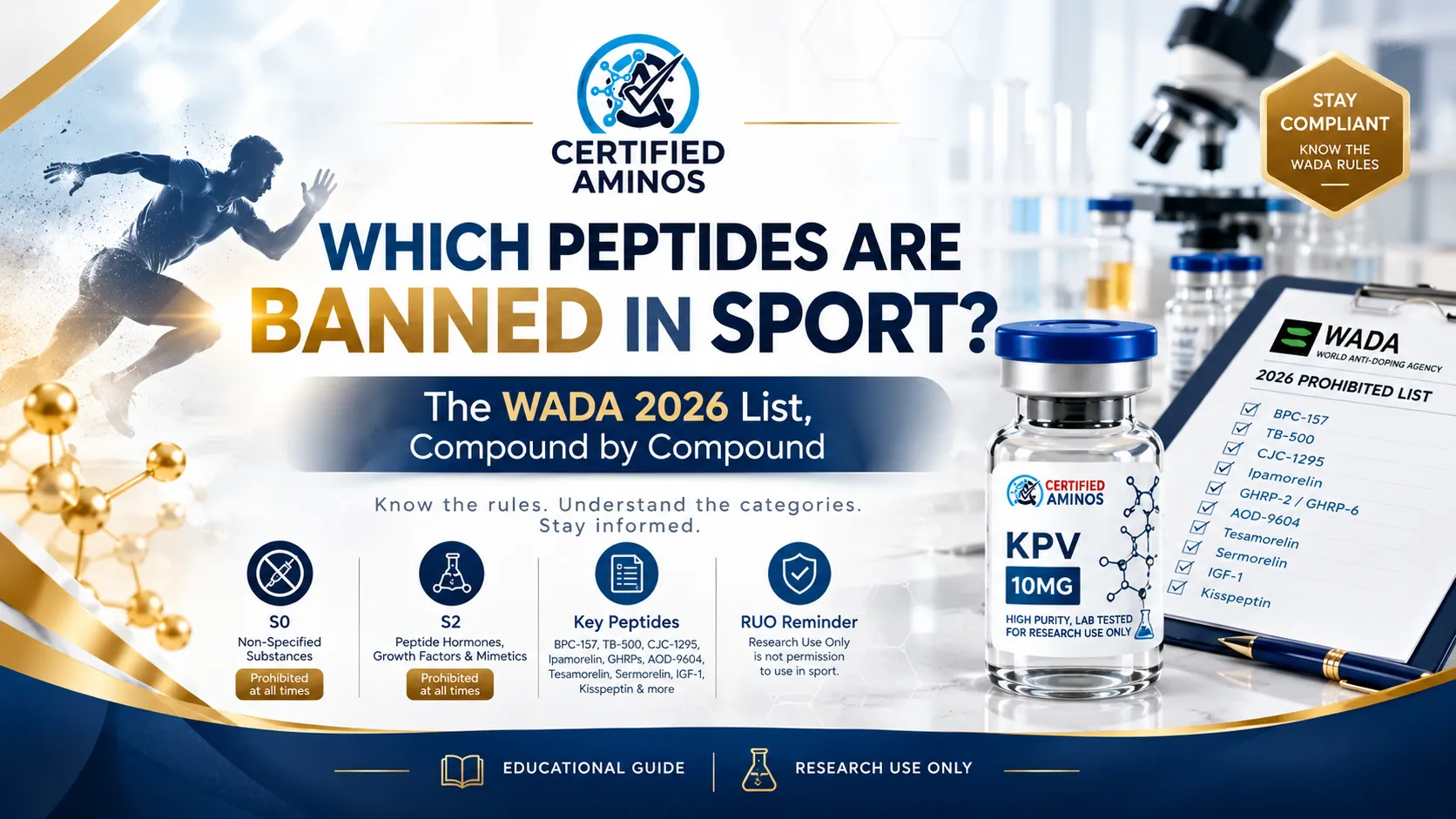
Which Peptides Are Banned in Sport? The WADA 2026 List, Compound by Compound
Compliance & RegulatoryOctober 30, 202615 min read
A verified compound-by-compound explanation of the WADA 2026 peptide categories, including S0 and S2, prohibition timing, RUO labeling, and how athletes can confirm a substance's status.
Many commonly discussed research peptides are prohibited under S0 or S2 of the 2026 WADA List, and these categories apply at all times.
The 2026 List directly names several compounds in this guide. Its wording also covers other substances with similar chemical structures or biological effects, so an incomplete internet list is not a reliable clearance check.
Under the 2026 List, S0 substances are classified as Specified Substances, while all prohibited substances in S2 are non-Specified Substances. Those labels do not remove an athlete's strict-liability responsibility.
Research Use Only (RUO) labeling is not permission to use a compound in sport. Verify the exact substance against the applicable official rules and seek authoritative guidance when needed.
Last reviewed: October 30, 2026. Author: Certified Aminos Research Team.
Several peptide hormones, growth factors, related substances and mimetics are prohibited under the 2026 World Anti-Doping Agency (WADA) Prohibited List. Many of the compounds people ask about—including BPC-157, TB-500, CJC-1293, CJC-1295, ipamorelin, GHRP-2, GHRP-6, hexarelin, AOD-9604, tesamorelin, sermorelin, IGF-1 and kisspeptin—are specifically identified in the 2026 List or its categories. The applicable section matters: S2 substances and S0 substances are prohibited at all times, but their classifications are not identical.
This guide is an educational summary of the 2026 rules in force on October 30, 2026. Use the official WADA Prohibited List as the controlling reference, and contact your National Anti-Doping Organization (NADO) or International Federation (IF) if a specific substance or product remains unclear.
How the WADA 2026 Prohibited List Works
WADA updates its Prohibited List annually. The 2026 version took effect on January 1, 2026, and remains the list in force on the date of this article. WADA's 2027 List has been published but is not scheduled to take effect until January 1, 2027. That timing matters: this article describes the 2026 wording, rather than applying future wording to the current rule.
The List separates substances and methods into categories. Section S2 covers peptide hormones, growth factors, related substances and mimetics. The S2 category is prohibited at all times—both in-competition and out-of-competition—and all prohibited substances within S2 are classified as non-Specified Substances under the 2026 List. Section S0 covers certain non-approved pharmacological substances that are not addressed by the later List categories and have no current approval from a governmental regulatory health authority for human therapeutic use. S0 is also prohibited at all times, but its substances are classified as Specified Substances under the 2026 List.
WADA uses non-exhaustive wording such as "including, but not limited to," as well as wording that covers substances with similar chemical structures or biological effects. For that reason, a compound can be prohibited even if a reader does not find it in a short online checklist. In this article, the table distinguishes compounds directly named in the official wording from the broader principles that may apply to other substances.
Three questions should not be confused: whether a product or compound has government authorization for human therapeutic use; whether it has an established human safety profile; and whether it is permitted under the anti-doping rules that apply to a particular athlete. These are separate determinations.
Which Peptides Are Banned in Sport? The 2026 List, Compound by Compound
The table below summarizes the relevant placement in the 2026 WADA Prohibited List. The named compounds appear in the official text as examples or named substances within the relevant category. "Named in the List" does not mean the table is exhaustive: WADA's class wording can also apply to other substances not individually listed. The official text remains controlling. Where Certified Aminos carries a compound for laboratory research, the compound name below links to that RUO listing for identification and documentation purposes only — the link is not guidance on using the compound in sport, and the WADA classification applies regardless of how a product is labeled.
S2.3 — Growth Factors and Growth Factor Modulators
Prohibited at all times
IGF-1, also identified as mecasermin, and its analogues are named directly. Not currently sold by Certified Aminos.
Kisspeptin and its agonist analogues (sold as Kisspeptin-10)
S2.2.1 — Testosterone-Stimulating Peptides in Males
Prohibited at all times
Kisspeptin and its agonist analogues are named directly in S2.2.1.
Primary source for the classifications above: WADA's official Prohibited List resource. For an athlete-specific decision, confirm the exact product and applicable rules with the relevant anti-doping organization.
BPC-157
BPC-157 appears as an example under S0, Non-Approved Substances, in the 2026 List. S0 covers pharmacological substances that are not addressed elsewhere in the List and do not have current approval from a governmental regulatory health authority for human therapeutic use. BPC-157 is therefore prohibited at all times under the 2026 rules. Its availability through websites that label it a research chemical does not change its anti-doping classification.
TB-500 and Thymosin Beta-4 Derivatives
The 2026 List names thymosin-β4 and its derivatives, giving TB-500 as an example under S2.3. This is not merely a conclusion inferred from a product description; the wording appears directly in the official category. S2 is prohibited at all times, including outside the competition period.
CJC-1293, CJC-1295, Sermorelin and Tesamorelin
These compounds are named in S2.2.4 as examples of GHRH analogues. Because the official text identifies them directly, there is no need to treat their placement as an uncertain inference from the broad category. The List's category wording can also capture other compounds with similar chemical structures or biological effects. A product label, a formulation name, or a seller's explanation should not replace checking the actual ingredient and official category.
Ipamorelin, GHRP-2, GHRP-6 and Hexarelin
Section S2.2.4 names ipamorelin among growth hormone secretagogues and their mimetics. It also names GHRP-2 (pralmorelin), GHRP-6, and examorelin (hexarelin) as examples of GHRPs. These substances are all within S2 and are prohibited at all times under the 2026 List. Similar-sounding names are not a safe basis for classification; match the exact compound and any recognized synonym against the official wording.
AOD-9604
AOD-9604 is named in S2.2.3 as an example of a growth hormone fragment. The relevant restriction is its inclusion in the prohibited category, not whether a seller presents it as a weight-management, recovery, or research product. This article does not assess or endorse any claimed performance, fat-loss, healing, or other effect.
IGF-1 and Analogues
Section S2.3 names insulin-like growth factor 1 (IGF-1, mecasermin) and its analogues. The category also includes examples of other growth factors and growth factor modulators, with wider wording for agents affecting processes such as muscle, tendon or ligament protein synthesis and degradation, vascularization, energy utilization, regenerative capacity, or fibre-type switching. A single short table cannot replace reading the category and seeking authoritative advice where the identity of a substance is uncertain.
Kisspeptin
Kisspeptin and its agonist analogues are explicitly listed in S2.2.1, headed "Testosterone-Stimulating Peptides in Males." As with other S2 entries, the category is prohibited at all times. This anti-doping classification is separate from research into the biological pathway or from any claims about a commercial product — see our Kisspeptin-10 research guide for the mechanism and evidence background, which is a different question from the WADA status discussed here.
What's the Actual Difference Between S0 and S2?
S0 — Non-Approved Substances: In the 2026 List, S0 applies to certain pharmacological substances not addressed elsewhere in the List and without current approval from a governmental regulatory health authority for human therapeutic use. BPC-157 is named as an example. S0 substances are prohibited at all times and are classified as Specified Substances under the 2026 List.
S2 — Peptide Hormones, Growth Factors, Related Substances and Mimetics: S2 includes several subcategories, among them testosterone-stimulating peptides, growth hormone and its analogues or fragments, growth hormone-releasing factors, and growth factors or growth factor modulators. The compounds in the table above are covered by these specific subcategories. All prohibited substances within S2 are non-Specified Substances and are prohibited at all times.
"Specified" and "non-Specified" are regulatory classifications used in anti-doping rules. They do not decide whether a substance is safe, and they do not remove the athlete's responsibility for a prohibited substance found in their sample. The classification also should not be simplified into a guaranteed prediction of the outcome or sanction in an individual case; consequences depend on the applicable rules and facts.
Does Research Use Only Mean a Peptide Is Allowed in Sport?
No. Research Use Only (RUO) is an intended-use statement associated with laboratory research supply. It is not a WADA category, a therapeutic approval, a safety finding, or an exemption from anti-doping rules. A compound can be sold under an RUO label and still be prohibited in sport. Similarly, analytical paperwork such as a certificate of analysis may report the identity or purity of a tested sample, but it does not establish that the substance is safe for human use or permitted for an athlete.
Keep three separate questions in view:
Regulatory authorization: Is the particular substance or drug product approved for human therapeutic use by an applicable governmental authority?
Safety and evidence: Is there adequate evidence to establish safety and effectiveness for the proposed human use? An RUO label alone does not answer that question.
Anti-doping status: Is the exact substance prohibited under the rules that apply to the athlete, sport, and relevant date?
Certified Aminos' educational article What Research Use Only Means When You Buy Peptides provides further context on what RUO labels do and do not establish. The label should never be treated as permission to use a compound for athletic performance or personal administration.
What Athletes Should Know About Drug Testing
Under anti-doping rules, athletes are generally responsible for prohibited substances found in their samples, regardless of how a substance entered the body. A finding can lead to a results-management process and possible consequences under the rules that apply. Do not assume that an unintentional exposure, a product marketed as a supplement, a research label, or a seller's statement automatically resolves an anti-doping concern.
This article does not provide detection windows, washout schedules, cycling advice, masking methods, or timing strategies intended to avoid a positive test. No online summary can guarantee that a substance will be undetectable after a particular interval. If you believe you may have been exposed to a prohibited substance, contact your NADO or IF for advice and follow the applicable reporting and results-management process.
Keep in mind the 2026 classification distinction: S0 substances such as BPC-157 are Specified Substances, while the prohibited substances in S2 are non-Specified Substances. This difference can be relevant to how a case is handled, but it does not remove the strict-liability principle or determine an outcome on its own.
What About a Therapeutic Use Exemption?
A Therapeutic Use Exemption (TUE) may allow an athlete to use a prohibited substance or method for a legitimate medical condition when the applicable criteria are met. Approval is not automatic. The process involves medical documentation and review by the appropriate anti-doping organization; the responsible organization depends on the athlete's level and sporting context. Athletes should seek guidance early and should not assume that a prescription or a seller's statement alone establishes a valid TUE.
Start with the athlete's NADO or IF and the official WADA Therapeutic Use Exemptions guidance. A TUE is a formal process under the anti-doping rules, not general permission to use a research compound. This article does not assess whether a particular substance or medical circumstance would qualify.
How to Check Whether a Peptide Is WADA-Prohibited
Identify the exact substance. Check the active ingredient, recognized name, INN or other chemical synonym; do not rely only on a brand or blend name.
Open the correct annual List. Use the official WADA version applicable to the date in question. On October 30, 2026, the 2026 List remains in force.
Read the category, not just a search result. Review the actual subsection and its accompanying wording, including language covering similar chemical structures or biological effects.
Check timing and sport-specific qualifications. Confirm whether the relevant category is prohibited at all times, in-competition only, or in particular sports. S0 and S2 are prohibited at all times.
Ask the appropriate anti-doping authority if uncertain. WADA itself instructs users to verify with their Anti-Doping Organization when a substance cannot be found or its status is unclear. A failed search result is not evidence of permission.
Recheck when rules change. Lists are updated annually. Save the version or record the date consulted, especially when decisions span the changeover from one year's List to the next.
Global DRO can be useful for checking many medications, but a database result should not be treated as an exhaustive clearance service for every experimental peptide, research chemical, blend, or product sold under an alternate name. When there is no clear result, seek confirmation from the relevant anti-doping organization.
What Changes Between WADA 2026 and the Published 2027 List?
As of October 30, 2026, the 2026 List remains in force through December 31, 2026. WADA published the 2027 List on September 21, 2026, following Executive Committee approval on September 10; it is scheduled to enter into force on January 1, 2027. The 2027 rules should not be presented as if they already govern conduct on October 30, 2026.
USADA's explanation of the published 2027 List notes that the word "peptides" is expressly added to the S0 class, while several named compounds remain covered under other categories such as S2 or S4. This reinforces the need to read the actual version in force for the relevant date. For a comparison, consult the WADA 2027 announcement and the linked official List and modifications documents. Do not apply the 2027 text retroactively to a question about the 2026 rules.
Final Takeaway
The most reliable answer to "which peptides are banned in sport?" begins with the exact WADA List in force for the relevant date. For 2026, BPC-157 is named under S0, while TB-500, CJC-1293, CJC-1295, ipamorelin, GHRP-2, GHRP-6, hexarelin, AOD-9604, tesamorelin, sermorelin, IGF-1 and kisspeptin are named in the relevant S2 subsections. S0 and S2 are both prohibited at all times, but they carry different specified-substance classifications. When a compound, blend, or synonym is unclear, contact the relevant anti-doping organization rather than relying on a supplier's description.
Research Use Only notice: Certified Aminos research-use-only materials are intended exclusively for laboratory research and are not intended for human or veterinary consumption, diagnosis, or treatment. Research Use Only labeling does not establish that a compound is approved for human use, safe for administration, or permitted under anti-doping rules. Athletes and their support teams should consult the applicable official anti-doping authority before making decisions concerning any substance.
Got Questions?
Frequently Asked Questions
The 2026 List names or categorizes multiple relevant compounds under S0 and S2. Examples include BPC-157 under S0; TB-500, IGF-1, CJC-1293, CJC-1295, ipamorelin, GHRP-2, GHRP-6, hexarelin, AOD-9604, tesamorelin, sermorelin and kisspeptin under relevant S2 subsections. S0 and S2 are prohibited at all times. Check the official wording and the specific compound rather than relying on a short list.