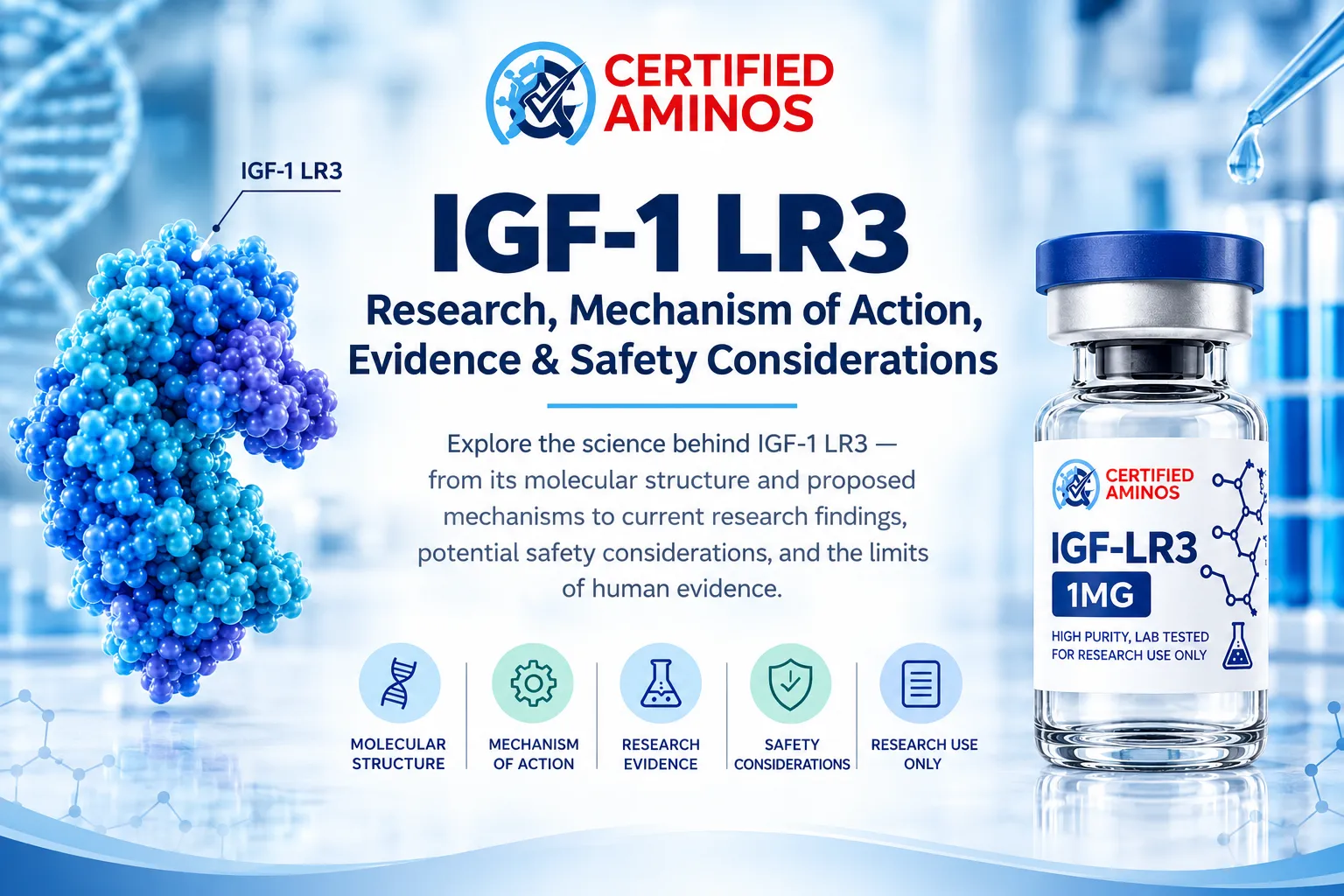
Interest in IGF-1 LR3 has grown alongside interest in other injectable research peptides, and much of what circulates about it online blends real IGF-1 biology with claims that have never been tested in a human clinical trial. That gap matters. Native IGF-1 itself, in its FDA-approved recombinant form, carries labeled warnings for hypoglycemia and other effects precisely because it is a potent, insulin-related signaling molecule. IGF-1 LR3 was engineered to be even more persistent in biological systems, yet it has never gone through the clinical testing that the approved molecule has. Readers researching IGF-1 LR3 deserve an article that keeps those two facts side by side rather than borrowing one molecule's safety record to describe the other.
This guide works through the compound's structure, its proposed mechanism, what cell and animal studies actually measured, and where the evidence runs out — including on muscle growth, dosing, and FDA status.
What Is IGF-1 LR3?
Insulin-like growth factor 1 is a naturally occurring 70-amino-acid hormone that mediates many of growth hormone's downstream effects on tissue growth, cell division, and metabolism. In the body, most circulating IGF-1 travels bound to IGF-binding proteins (IGFBPs), which control how much free IGF-1 is actually available to activate receptors on a cell's surface.
IGF-1 LR3, short for "Long Arg3-IGF-1," is a synthetic variant built specifically to blunt that binding-protein control. According to a Bio-Techne/Novus technical datasheet, the molecule is "a 9.2 kDa synthetic analog of IGF-1" that carries an arginine substitution for the native glutamate at position 3, plus a 13-amino-acid extension at the N-terminus derived from methionyl porcine growth hormone (R&D Systems/Valukine LR3 IGF-1 datasheet, 2024). Those two changes lengthen the molecule from IGF-1's native 70 residues to 83 residues in total, a figure confirmed consistently across multiple independent recombinant-protein datasheets. The product page for this listing describes the same substitution and extension, and states that the structural change has been confirmed by solution-structure NMR.
Because IGFBPs normally bind and sequester the native hormone, a version that binds them poorly behaves differently in a dish or an animal: it stays active longer and is harder for the body's regulatory system to dial back. That is the central reason researchers reach for IGF-1 LR3 in growth-factor signaling studies rather than native IGF-1 itself — not because it is a stronger or safer molecule, but because it is a more experimentally convenient one.
How Does IGF-1 LR3 Work?
IGF-1 LR3 is reported to retain the ability to bind the IGF-1 receptor (IGF-1R) and, at high concentrations, the insulin receptor, per the same Bio-Techne/Novus datasheet. Binding to IGF-1R triggers a receptor tyrosine kinase cascade that is well characterized for native IGF-1. According to a 2021 review in *Viruses*, IGF-1R activation signals through insulin receptor substrate (IRS) and Shc adaptor proteins to engage two major downstream pathways: the PI3K/Akt pathway, which regulates cell proliferation and apoptosis, and the Ras/MAPK pathway, which activates ERK1/ERK2 to drive cell differentiation and proliferation (Józefiak et al., 2021, DOI).
This is where precision matters most. That signaling map describes native IGF-1 biology in general, not a pathway directly traced for the LR3 analogue in a specific tissue. What has been shown specifically for LR3 is upstream of the receptor: its reduced IGFBP affinity leaves more of it "free" to engage IGF-1R for longer, which in laboratory systems translates into stronger and more sustained downstream signaling than an equivalent amount of native IGF-1 produces. The receptor-level biology is inherited from IGF-1; the amplification is the part that is LR3-specific.
Why do people confuse IGF-1 LR3 with growth-hormone peptides?
A common misunderstanding is lumping IGF-1 LR3 in with growth-hormone-releasing peptides and secretagogues such as CJC-1295, Ipamorelin, or Sermorelin. Those compounds act upstream, at the pituitary, to stimulate the body's own release of growth hormone, which then raises IGF-1 production in the liver days later. IGF-1 LR3 skips that entire chain: it is an IGF-1 analogue itself, acting directly at IGF-1 receptors on target tissue. The two categories are not interchangeable, and a product correctly or incorrectly labeled "growth hormone secretagogue" on any listing does not change that underlying biology.
How Does IGF-1 LR3 Compare to Regular IGF-1?
The structural changes that make IGF-1 LR3 useful in a lab — longer-lasting activity, less interference from binding proteins — do not, on their own, make it a more effective or safer compound outside that context. A molecule engineered to resist the body's normal regulatory brakes is a research tool, not a demonstrated improvement on human physiology.
What Does Scientific Research Actually Show?
The oldest and most frequently cited LR3 study is a 1993 *Biochemical Journal* paper in which researchers infused LR3-IGF-1 and a related variant into streptozotocin-induced diabetic rats via osmotic mini-pumps. The LR3 variant was roughly 2.5 to 3 times more potent than native IGF-1 at restoring growth and increasing muscle protein-synthesis rates in that animal model, while not correcting the animals' glucosuria the way insulin did (Tomas et al., 1993, DOI). This is an animal pharmacology study, not a human result, and it describes growth restoration in a disease model, not performance enhancement in healthy humans.
At the cellular level, a 1996 study in human dermal fibroblast cultures found that LR3 stimulated dose-dependent cell proliferation similarly to native IGF-1 and des(1-3)IGF-1, but — consistent with its design — it did not bind IGFBP-3 and did not trigger the same IGFBP-4-proteolysis pathway that native IGF-1 did (Donnelly & Holly, 1996, DOI). A related 1997 study in a human keratinocyte cell line similarly found that long R3 IGF-1 behaved differently from native IGF-1 in how it affected IGFBP-3 processing, again tracing back to its weaker binding-protein interaction (Xu et al., 1997, DOI).
In a 1998 study on murine bone-marrow-derived macrophage precursor cells, long R3 IGF-1 and des(1-3)IGF-1 enhanced cell differentiation in ways that native recombinant human IGF-1 did not under the same conditions, pointing again to IGFBP interaction — specifically, accumulating IGFBP-4 sequestering free native IGF-1 — as the likely explanation (Long et al., 1998, DOI). Collectively, these in-vitro and animal studies converge on one consistent, narrow finding: IGF-1 LR3 produces stronger or more sustained IGF-1-receptor effects than native IGF-1 in the specific cell types and animal models tested, because it escapes the normal binding-protein brake. None of them measured outcomes in humans, and none tested chronic exposure, immune response, or long-term tissue effects.
A related 1996 study in the *Journal of Endocrinology* compared LR3IGF-I against native IGF-I in normal and dexamethasone-treated (catabolic) rats, delivered either by continuous infusion or by once- or twice-daily injection. Under continuous infusion, LR3IGF-I was 1.5 to 2 times more potent than native IGF-I for body-weight gain and organ-weight measures, and it kept an edge under injection for several of those same outcomes — but it was only "barely equipotent" with native IGF-I for reversing muscle protein loss specifically (Tomas et al., 1996, DOI). The size of any potency advantage, in other words, depends heavily on administration route and on which specific outcome is measured, which is one more reason to treat flat "X times more potent" claims about IGF-1 LR3 with caution.
A 2026 peer-reviewed review in *Frontiers in Endocrinology* examined performance-enhancing peptides across the GH–IGF-1 axis and placed IGF-1 LR3 in its lowest evidence tier — defined as compounds with "no peer-reviewed human studies," where claims rest on preclinical extrapolation and self-reported user accounts rather than clinical data (Dominikowski et al., 2026, DOI). The review describes IGF-1 LR3's proposed mechanism in terms of potent receptor activation and mitogenic signaling, but explicitly frames any associated safety concern as theoretical, grounded in known IGF-1/IGF-1R signaling biology rather than in data collected on the LR3 molecule itself.
Does IGF-1 LR3 Actually Build Muscle?
IGF-1 signaling is studied in muscle biology because IGF-1R activation can promote protein synthesis and satellite-cell proliferation in experimental systems — this is well established for the native hormone and is part of why growth hormone's downstream effects include tissue growth. It is biologically plausible, then, that a longer-acting IGF-1 analogue would amplify that signal in muscle tissue specifically.
Plausibility is not proof. The animal data described above measured whole-body growth and nitrogen balance in diabetic rats, not resistance-trained muscle hypertrophy in healthy humans. No controlled human trial has measured IGF-1 LR3's effect on lean mass, strength, or recovery. The "before and after" claims and transformation stories that circulate around IGF-1 LR3 are anecdotal reports, not controlled outcome data, and they cannot be used to confirm a muscle-growth effect. Readers evaluating muscle-growth claims about IGF-1 LR3 should treat the receptor biology as a hypothesis worth studying, not as a demonstrated human benefit.
IGF-1 LR3 Side Effects and Safety Considerations
No dedicated human safety database exists for IGF-1 LR3 itself, which makes this section necessarily a discussion of theoretical and extrapolated concerns rather than a documented adverse-event profile. Three lines of evidence inform that theoretical picture, and each needs to be clearly labeled for what it is.
First, native recombinant human IGF-1 (mecasermin) carries an FDA-labeled warning for hypoglycemia tied to its insulin-like activity: in mecasermin's own clinical trials, hypoglycemia occurred in 42% of subjects (30 of 71), with five cases of severe hypoglycemia and four seizures or loss of consciousness (FDA INCRELEX prescribing information, 2014). Because IGF-1 LR3 activates the same receptor family and, at high concentrations, the insulin receptor, a similar glucose-lowering effect is biologically plausible — but this figure describes native, sequence-identical IGF-1 at labeled clinical doses, not IGF-1 LR3 at an unstudied research dose, and the two should not be equated.
Second, the mitogenic (cell-proliferation-driving) side of IGF-1R signaling is the basis of a separate, longer-horizon theoretical concern. A 2021 retrospective study found that IGF-1 receptor expression in prostate tissue was associated with higher Gleason-pattern aggressiveness in patients who also had diabetes, and the authors proposed that altered insulin/IGF-1 signaling could drive greater mitogenic activity in tumor progression (Broggi et al., 2021, DOI). This is an association found in diseased prostate tissue, not a demonstrated outcome of IGF-1 LR3 exposure, and it should be read as one data point supporting caution about sustained IGF-1R activation generally, not as evidence that IGF-1 LR3 causes cancer.
Third, there is no published data at all on IGF-1 LR3 under chronic or repeated-dose exposure in any species, which means immune responses, injection-site effects, and cumulative tissue effects remain entirely unknown. The 2026 *Frontiers in Endocrinology* review reaches the same conclusion, describing only a "theoretical mitogenic potential based on IGF-1/IGF-1R signalling biology" rather than a measured risk specific to the analogue (Dominikowski et al., 2026).
Does a hypoglycemia warning on native IGF-1 apply directly to IGF-1 LR3?
Not directly, though the underlying mechanism is shared. Mecasermin's hypoglycemia data comes from a clinically dosed, sequence-identical molecule administered under medical supervision with meal-timing protocols. IGF-1 LR3 has no equivalent human dosing study, no meal-timing protocol, and no clinical monitoring framework, so the actual magnitude of glucose-lowering risk at any given research exposure is unknown rather than simply "lower" or "higher."
IGF-1 LR3 Dosage Searches: What Does the Evidence Establish?
Searches for "IGF-1 LR3 dosage" are common, and the honest answer is that no clinically validated human dose exists for this compound. Three points explain why online dosing figures should not be treated as established standards.
Dosing numbers that circulate on forums and marketing pages are not derived from controlled human pharmacokinetic studies; they are typically informal, self-reported figures with no verified safety margin behind them. Animal and cell-culture concentrations, such as the microgram-per-day infusion rates used in the 1993 diabetic-rat study, cannot be mathematically converted into a human dose — species differ in metabolism, receptor density, and clearance in ways that a simple weight-based scaling calculation does not capture. Finally, this product's own listing as "laboratory research use only" is a regulatory and intended-use statement, not a clinical determination that any particular amount is safe or effective in a person. This article does not provide dosing, administration, or reconstitution guidance, and none should be inferred from the research discussed above.
IGF-1 LR3 Before and After: What Can Actually Be Verified?
"Before and after" is one of the most common search patterns around IGF-1 LR3, and it deserves a direct answer: no peer-reviewed, controlled human study has measured before-and-after outcomes for this compound. What exists instead falls into three very different categories. Published experimental findings are the rodent and cell-culture results already described above — real data, but not human outcome data. Anecdotal accounts are self-reported, unverified claims from individuals online, with no controls, no blinding, and no independent measurement. Marketing images are exactly what they sound like: promotional content, not evidence. None of these can substitute for the others, and conflating them is the single biggest source of misinformation about this compound. This article does not present, reference, or imply any specific transformation result.
Is IGF-1 LR3 FDA Approved?
IGF-1 LR3 is not FDA-approved, has no FDA-recognized indication, and has not been evaluated by the FDA for safety or effectiveness in humans. The only related, approved product is mecasermin (brand name INCRELEX), which the FDA label describes as having "the amino acid sequence of the product ... identical to that of endogenous human IGF-1" and which is indicated specifically for "growth failure in children with severe primary IGF-1 deficiency" or growth-hormone gene deletion with neutralizing antibodies (FDA INCRELEX prescribing information, 2014). Mecasermin's approval is for unmodified IGF-1, not for the structurally altered LR3 analogue, and that approval does not extend to IGF-1 LR3 in any jurisdiction, including the United States.
How Should You Evaluate IGF-1 LR3 Product Documentation?
Evaluating a research peptide involves several distinct kinds of documentation, and a buyer should not assume that one test substitutes for all of them. Chemical identity, confirmed by mass spectrometry or similar methods, establishes that a sample is actually the intended molecule. Molecular weight and purity, typically assessed by HPLC, describe how much of the sample is the target compound versus impurities, but an HPLC trace alone does not confirm identity, sterility, or biological activity. Concentration verification confirms how much compound is actually present per unit volume. Sterility and endotoxin testing are separate again, relevant for any material intended for laboratory use involving cell culture or animal work. Lot-specific analytical documentation — a genuine certificate of analysis tied to the exact batch sold — is what ties all of the above to the specific vial a researcher receives, rather than to a generic specification. Our 12-point COA red-flag checklist walks through how to read one of these documents line by line.
As of this review, Certified Aminos' own Certificates page reports zero verified batches sitewide and states that COA documentation is still being added to the catalog. That means any "COA-Verified," "≥99% purity," or "HPLC certified" claim associated with a specific product listing should be treated as a supplier specification pending independent, batch-specific verification, not as a confirmed laboratory result. This article does not state or imply that any particular batch of IGF-1 LR3 has been independently verified.
Why can't a general purity badge stand in for a batch-specific COA?
A purity badge describes a specification the supplier is targeting or has observed on some sample at some point; a batch-specific COA documents an actual, dated laboratory result tied to the exact lot a buyer receives. The two are not interchangeable. A researcher relying on a listing for anything beyond general background information should request the actual certificate of analysis for their specific batch before drawing any conclusions about identity or purity.
What Does Research Use Only Mean for IGF-1 LR3?
"Research Use Only" (RUO) is a regulatory and labeling category for chemicals and biologics intended exclusively for laboratory investigation — things like in-vitro assays, cell-culture experiments, and animal studies conducted under appropriate institutional protocols. An RUO designation explicitly excludes human or veterinary diagnostic, therapeutic, or preventive use. It is not a quality grade, and it does not imply that a compound is safe for personal administration; it is closer to the opposite statement — that the compound has not gone through the review process required to make any such safety claim. IGF-1 LR3 sold under this designation is a research chemical, not a dietary supplement, a cosmetic ingredient, or an investigational drug available for personal use. For a fuller breakdown of what the RUO label does and doesn't establish, see what Research Use Only actually means.
Conclusion
IGF-1 LR3 is a real, well-characterized research tool: an engineered IGF-1 analogue whose reduced IGF-binding-protein affinity makes it useful for studying sustained IGF-1-receptor signaling in cells and animals. What the published record supports is narrow and specific — stronger or longer-lasting IGF-1-receptor effects than native IGF-1 in particular cell lines and a diabetic rodent model. What it does not support is any claim about human muscle growth, fat loss, recovery, or safety at a given dose, because no peer-reviewed human study of this molecule currently exists. The 2026 literature review that placed IGF-1 LR3 in its lowest evidence tier reflects where the science actually stands, not a gap that marketing claims can close.
For researchers who want to study this signaling pathway in a laboratory setting, the IGF-1 LR3 research listing from Certified Aminos provides current product information and specification details for that purpose.