Research Use Only. This material is provided for scientific and educational purposes only. The product discussed is designated for Research Use Only (RUO) and is not intended for human or veterinary consumption, diagnosis, treatment, or prevention of disease. Nothing on this page constitutes medical advice or a recommendation for human use.
What Is Sermorelin Acetate?
Sermorelin acetate is a synthetic 29-amino-acid peptide corresponding to the N-terminal fragment of human growth hormone-releasing hormone (GHRH), a 44-amino-acid hormone normally produced in the hypothalamus. Sermorelin is commonly described in the literature as the shortest synthetic GHRH fragment reported to retain the parent hormone's full biological activity at the pituitary. It is not growth hormone (somatotropin) itself, and it is not interchangeable with it.
Not every product sold under the name "sermorelin" uses the same grade, concentration, or supporting documentation. The identity and specifications of a specific material should be checked directly rather than assumed from the name alone.
Is Sermorelin a GHRH Analog, and What Does GHRH(1-29) Mean?
Yes. The full notation is GHRH(1-29)NH2 — residues 1 through 29 of the 44-residue human hormone, with an amidated carboxyl terminus. Older literature often refers to the same molecule as GRF(1-29)NH2 (growth hormone-releasing factor). The fragment retains GHRH's activity at the pituitary receptor, but it is neither full-length native GHRH nor growth hormone itself — it is a deliberately shortened, synthetic analog built around the minimum sequence needed for activity.
How Is Sermorelin Proposed to Work?
Sermorelin is proposed to bind the GHRH receptor, a G-protein-coupled receptor on the surface of pituitary somatotroph cells. Receptor binding activates the Gs/adenylate cyclase pathway, raising intracellular cyclic AMP (cAMP), which in turn drives protein kinase A activity and the release of growth hormone the somatotroph has already synthesized and stored. This general second-messenger pathway for GHRH-receptor signaling is well established pharmacology.
The body's own feedback loops shape the result: somatostatin opposes GHRH's effect, which is part of why GH is released in pulses rather than as a steady stream. A measured rise in growth hormone after sermorelin administration shows that this receptor pathway is engaged — it does not, on its own, establish a clinical benefit from repeated use.
What Does the Published Research on Sermorelin Actually Show?
The published human literature on sermorelin falls into three broad groups, and most of it is decades old:
- Diagnostic testing for growth hormone deficiency. Sermorelin (and related GHRH preparations) has been used as a stimulation test — a rise in GH after a single dose helps assess whether the pituitary can respond, though a single test's limits are discussed below.
- Growth studies in short children. Several trials from the 1990s examined sermorelin's effect on growth velocity in children with growth hormone deficiency, generally in small cohorts with varying dosing regimens.
- Small studies in healthy older adults. A 1997 study administered long-term nightly GHRH(1-29) injections to healthy, age-advanced men and women and reported that IGF-1 levels rose within about two weeks and remained elevated through twelve weeks of treatment [1]. Secondary sources disagree on whether that same trial found a meaningful change in body composition (fat and lean mass) — this article could not independently confirm the body-composition result against the full original paper, and it should be checked directly before being repeated as settled.
Across all three groups, sample sizes are small, regimens differ between studies, and none of this literature tested today's research-use-only sermorelin material specifically. A study from one population, dose, and decade does not automatically describe what a different product does in different hands today.
Does Sermorelin Raise Growth Hormone in Everyone Who Takes It?
No. Responses to GHRH-class peptides vary with factors including obesity, blood glucose, free fatty acid levels, and underlying pituitary or hypothalamic disease. Radiation-related pituitary damage has been reported to blunt the response in prior small studies. A related clinical limitation: a single normal GHRH-stimulation-test result cannot, by itself, rule out growth hormone deficiency of hypothalamic origin, since the test checks whether the pituitary itself can respond, not whether the hypothalamus is signaling it correctly in the first place.
How Is Sermorelin Different From HGH?
HGH (somatropin) is recombinant human growth hormone itself — a 191-amino-acid protein that supplies growth hormone directly. Sermorelin is a 29-amino-acid peptide that is proposed to prompt the pituitary to release its own stored growth hormone, rather than supplying GH directly. In pediatric studies, reported height-velocity gains from sermorelin looked smaller than those reported for somatropin, but no head-to-head trial directly comparing the two was located for this article. They are not interchangeable, mechanistically or in regulatory status.
How Is Sermorelin Different From Ipamorelin?
Sermorelin and ipamorelin both influence growth hormone release, but through entirely different receptors. Sermorelin works through the GHRH receptor, described above. Ipamorelin is a five-amino-acid peptide and selective agonist at the ghrelin receptor (GHS-R1a) — the same receptor pathway the hormone ghrelin binds naturally [2]. Ipamorelin's foundational human pharmacokinetic data comes from a dose-escalation trial in healthy male volunteers showing a single, dose-dependent GH pulse with a short (~2-hour) elimination half-life [2].
Because the receptor pathways, molecule size, and evidence base differ, findings from sermorelin's literature cannot be assumed to transfer to ipamorelin, or vice versa — this is the same reasoning that applies to any two peptides proposed to act on the GH axis through different mechanisms.
What Is Known About Sermorelin's Safety Profile?
A review of pediatric sermorelin studies reported generally good tolerability, with transient facial flushing and injection-site pain as the most commonly reported effects. Two small adult studies reported no significant adverse effects, but both were short in duration. One pediatric study reported increases in fasting glucose and insulin during treatment. None of the sources reviewed for this article include long-term, controlled safety data in healthy adults using current research-use material, and none should be assumed from decades-old studies of a different, FDA-regulated formulation.
What Is Sermorelin's FDA Approval Status?
It depends entirely on which product is meant. A prescription sermorelin acetate injection, branded Geref, held FDA approval under two New Drug Applications — NDA 019863 (1990) and NDA 020443 (1997). The manufacturer discontinued the product for business reasons (secondary sources place the discontinuation around 2008–2009; this article could not independently confirm the exact year against a primary FDA record). In 2013, responding to a citizen petition, FDA published a formal determination that neither Geref product had been withdrawn from sale for reasons of safety or effectiveness — a finding that, among other things, allows generic (ANDA) applications to reference the discontinued approval [3].
That history belongs to a specific, now-discontinued prescription product. It does not make any other sermorelin product — compounded or research-use — FDA-approved. The Certified Aminos research-use-only listing for this compound carries no FDA approval of its own.
Is Compounded Sermorelin the Same as an FDA-Approved Medicine?
No. FDA states plainly that compounded drugs are not FDA-approved, and that the agency does not verify their safety, effectiveness, or quality before they reach the market [4]. Compounding status also cannot be inferred from a product's name or marketing. Whether a specific preparation meets the legal conditions for pharmacy compounding under federal law is a regulatory question that a product listing does not settle on its own.
What Does Research Use Only Mean for Sermorelin?
Research Use Only is a seller's designation indicating that a material is intended for laboratory research, not an FDA approval, clearance, or finding of any kind. Certified Aminos' sermorelin listing states it is sold strictly for research use, not for human or veterinary use, and that current RUO material carries no FDA approval (checked 2026-10-20) [5].
Sermorelin vs. HGH vs. Ipamorelin
Sharing a loose goal — raising growth hormone or its downstream effects — does not make these three substances interchangeable in mechanism, evidence, or regulatory history.
What Does Certified Aminos' Own Product Page Say About This Listing?
Checked directly on certified-aminos.com/product/sermorelin [5] and certified-aminos.com/certificates [6], 2026-10-20.
How Can Readers Evaluate Claims About Sermorelin Products?
Match each claim to the exact molecule, population, and study type being described — a result from a 1990s pediatric GHD trial does not describe what a research-use product does in a different population today. Look for batch-specific Certificates of Analysis that name the lot, testing method, and result, rather than a general company-wide purity badge. Treat any purity or identity figure as a supplier claim until batch-specific data exists. Confirm the product's actual intended-use label before assuming anything about its regulatory status.
What This Page Does Not Establish
This page does not establish that sermorelin is safe or effective for any use; that research-use sermorelin behaves identically to the discontinued, FDA-approved Geref formulation; that the mechanism described here has been independently confirmed for this specific product's material; or that this product's purity, identity, or concentration meets any particular standard. It also does not provide dosing, reconstitution, or administration guidance, and none should be inferred from it.
For Researchers
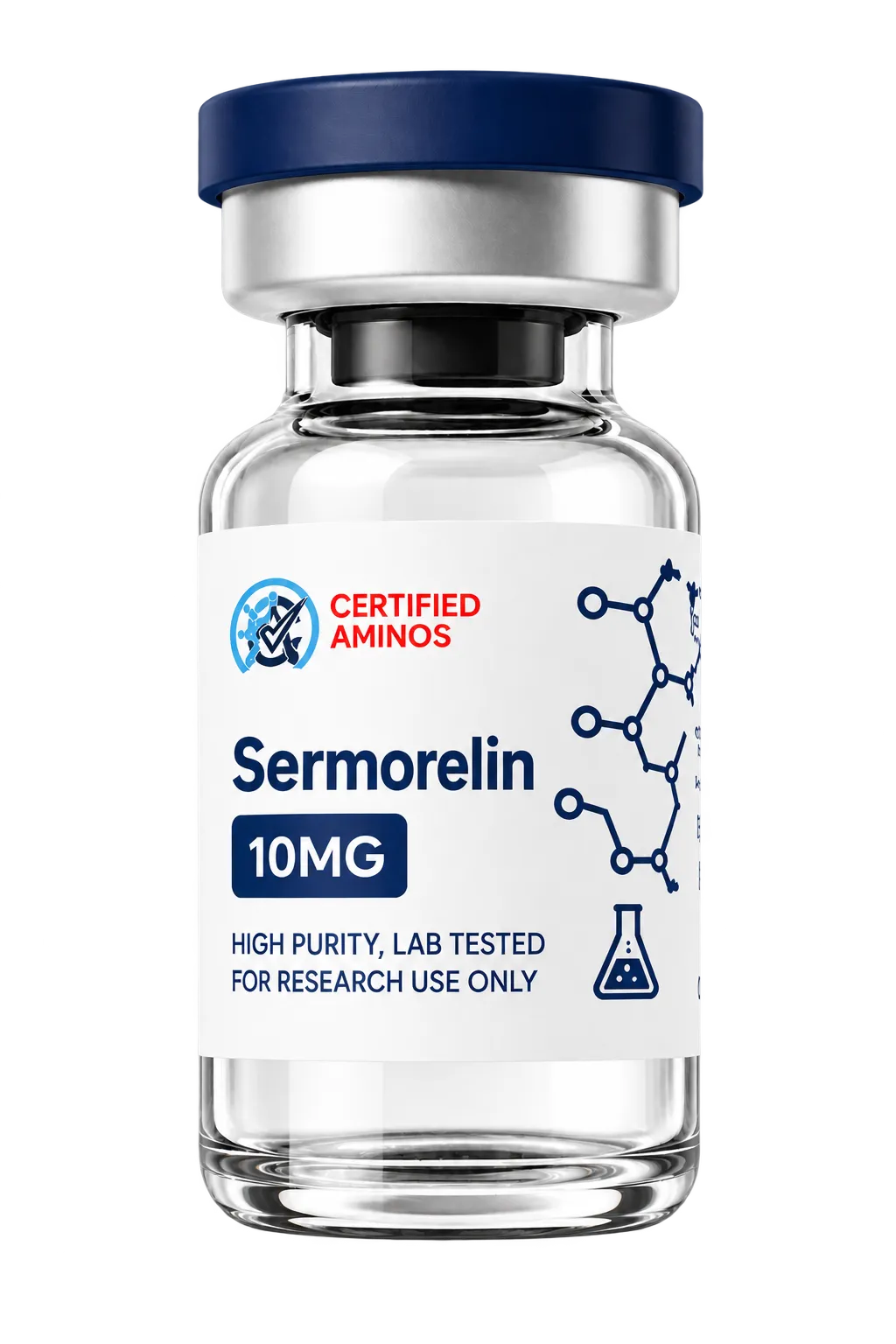
Featured in This Article: Sermorelin — view the current listing on Certified Aminos to review live specifications, stock status, and documentation. Only features actually stated on that page are referenced in this article; no purity, identity, or testing claim is implied beyond what the page itself states [5].
Related reading: the standalone Ipamorelin listing and Ipamorelin Peptide: What Research Shows; Are Peptides Safe? What Research Shows; and Do You Need a Prescription for Peptides? for the broader RUO/FDA distinction.
This material is Research Use Only. It is not medical advice, and it is not a recommendation for human use.