What Is Ipamorelin Peptide?
Ipamorelin belongs to a class of molecules called growth hormone secretagogues (GHS) — synthetic peptides designed to prompt the pituitary gland to release more of the body's own growth hormone, rather than supplying growth hormone itself. Structurally, it is a short pentapeptide, part of a wave of GHS research that began in the 1990s as researchers looked for alternatives to growth-hormone-releasing hormone (GHRH) analogs that could selectively trigger GH release without broadly activating other pituitary hormone pathways.
What sets Ipamorelin apart from many other secretagogues studied in this family is the selectivity claim attached to it in the early pharmacology literature: it was characterized as stimulating GH release with comparatively little effect on cortisol, prolactin, or adrenocorticotropic hormone (ACTH) — hormones that some earlier secretagogues affected more broadly. That selectivity profile is a pharmacological characterization from receptor-binding and animal research, not a demonstrated clinical outcome in humans.
It's also worth being precise about what Ipamorelin is not. It is not human growth hormone (HGH), and it is not a hormone itself — it is a receptor agonist that interacts with a specific receptor system to influence the body's own hormone output. That distinction matters for every comparison later in this guide, and for understanding why Ipamorelin's regulatory status differs from growth hormone products themselves.
How Does Ipamorelin Work?
Ipamorelin's studied mechanism runs through the growth hormone secretagogue receptor, GHS-R1a — the same receptor the hunger-signaling hormone ghrelin naturally activates. This receptor sits on cells in the pituitary gland and the hypothalamus. When Ipamorelin binds to GHS-R1a, research indicates it triggers a pulsatile release of growth hormone — meaning GH is released in a burst pattern similar to the body's natural secretion rhythm, rather than as a sustained, constant elevation.
This is fundamentally different from how direct growth hormone administration works. Injecting recombinant human growth hormone bypasses the pituitary and delivers the hormone itself. Ipamorelin, by contrast, depends on a functioning pituitary-hypothalamic axis to produce an effect — it stimulates the body's own machinery rather than replacing its output.
It's important to separate the mechanism from the outcome. That Ipamorelin activates a receptor known to be involved in GH release is a mechanistic fact supported by receptor pharmacology research. Whether that receptor activation reliably produces a specific, meaningful clinical benefit in any given population is a separate question — one current evidence does not fully answer (see “What Does Human Research Say About Ipamorelin?” below).
What Does Ipamorelin Do?
Direct answer: Ipamorelin has been studied for its ability to stimulate growth hormone secretion through the ghrelin receptor pathway, with research spanning receptor pharmacology, animal models, and a small amount of human interventional research. The existence of this mechanism does not, by itself, establish a proven clinical benefit.
Research into Ipamorelin and related GHS-R1a agonists has explored several angles:
Growth hormone secretion: The core, most directly studied effect — pulsatile GH release following receptor activation.
Endocrine physiology: How GHS-R1a activation interacts with the broader hypothalamic-pituitary axis, including feedback loops involving somatostatin and IGF-1.
Experimental metabolic and body-composition research: Some preclinical work in this peptide class has examined downstream metabolic effects of increased GH exposure, but this sits at the animal/mechanistic level for Ipamorelin specifically, not confirmed human outcomes.
What the current record does not support is converting any of this into a specific promise — that Ipamorelin “builds muscle,” “burns fat,” or “reverses aging” in a person using it. Those are outcome claims that would require human interventional evidence at a much larger scale than currently exists for this compound. The one placebo-controlled human trial identified for Ipamorelin (detailed later in this guide) tested a narrow clinical question — gastrointestinal recovery after surgery — and did not meet its primary endpoint.
Ipamorelin Benefits: What Does the Evidence Actually Support?
“Benefits of Ipamorelin” is one of the most-searched phrases connected to this compound, which makes it worth answering carefully rather than with a marketing list.
Organized by evidence tier:
Mechanistic/cellular: GHS-R1a activation is a documented receptor-pharmacology finding.
Animal/preclinical: Characterization work in this compound class has explored GH-release selectivity and dosing behavior in animal models; FDA's own 2024 review of the nonclinical literature did not identify standard toxicology datasets specific to ipamorelin.
Human observational: None identified in this review.
Human interventional: Limited to the Beck et al. (2014) postoperative-ileus trial, which did not show a statistically significant benefit over placebo on its primary endpoint.
Published clinical evidence of benefit: None identified for the outcomes commonly discussed online — fat loss, muscle gain, sleep quality, anti-aging, recovery.
In practice, this means a claim that Ipamorelin “has been investigated for” a GH-axis effect is defensible; a claim that it “is proven to” produce a specific downstream human benefit currently is not. Readers evaluating vendor or forum claims about Ipamorelin should ask which tier of evidence is actually being cited — a mechanism, an animal study, or a completed human trial — because these are not interchangeable.
Ipamorelin Side Effects and Safety: What Is Known?
This is a YMYL (your-money-or-your-life) topic, so it deserves a tier-by-tier answer rather than a generic side-effect list.
Preclinical findings: FDA's 2024 evaluation of ipamorelin as a candidate compounding substance flagged two nonclinical signals: a potential for behavioral-reinforcing (addiction-related) properties, and a possible negative effect on reproductive health and pregnancy outcomes — both described as class effects associated with ghrelin-receptor agonists generally, rather than findings unique to confirmed human studies of ipamorelin itself.
Human evidence: The one published placebo-controlled human trial (IV ipamorelin in surgical patients) reported similar rates of treatment-emergent adverse events between the ipamorelin and placebo groups (87.5% vs. 94.8%), and the authors described the compound as well tolerated over the up-to-seven-day dosing period studied.
Regulatory/FDA safety concerns: In reviewing ipamorelin-related bulk drug substance nominations, FDA searched its adverse-event databases. The FDA Adverse Event Reporting System (FAERS) search returned two non-serious reports tied to compounded ipamorelin products — one involving increased lacrimation and headache after use of a nasal-spray product, and one involving arthralgia in a product that also contained sermorelin. A parallel search of the CAERS database returned no cases. FDA also raised chemistry-based concerns: potential impurities and peptide-related aggregates in compounded ipamorelin acetate that it said it could not rule out as a source of immunogenicity risk.
Evidence gaps: There is no comprehensive, peer-reviewed human safety profile for Ipamorelin across routes, doses, and populations. Reports of use mostly come from wellness-clinic and medical-spa marketing contexts that FDA's review noted are not supported by the evidence it was able to identify.
Is Ipamorelin FDA Approved?
No FDA-approved drug product containing Ipamorelin — in either its free-base or acetate form — has been identified.
That answer is worth unpacking, because several related facts are often blurred together online:
An FDA substance or UNII record is not approval. A compound can have a recognized chemical identity in FDA systems without any product containing it having gone through the drug-approval process.
FDA compounding review is not drug approval. In October 2024, FDA's Pharmacy Compounding Advisory Committee reviewed nominations to add ipamorelin (free base) and ipamorelin acetate to the list of bulk drug substances outsourcing facilities may use under Section 503A. FDA's own evaluation states it “believes the evaluation criteria weigh against placing both ipamorelin (free base) and ipamorelin acetate on the list” — citing characterization and solubility problems with the free base, impurity-related immunogenicity concerns, and insufficient data supporting effectiveness for the conditions examined. This is a substance-listing evaluation, not a drug-approval decision, and the regulatory record can change — confirm the current status before relying on this.
A vendor selling a product labeled “Research Use Only” is not an FDA approval claim, and shouldn't be read as one.
Ipamorelin vs CJC-1295: How Are They Different?
Ipamorelin and CJC-1295 are frequently searched and sold together, but they work through different receptor systems. Ipamorelin is a ghrelin-receptor (GHS-R1a) agonist. CJC-1295 is a growth-hormone-releasing hormone (GHRH) analog — it targets the GHRH receptor, a separate pathway that also converges on pituitary GH release but through different signaling.
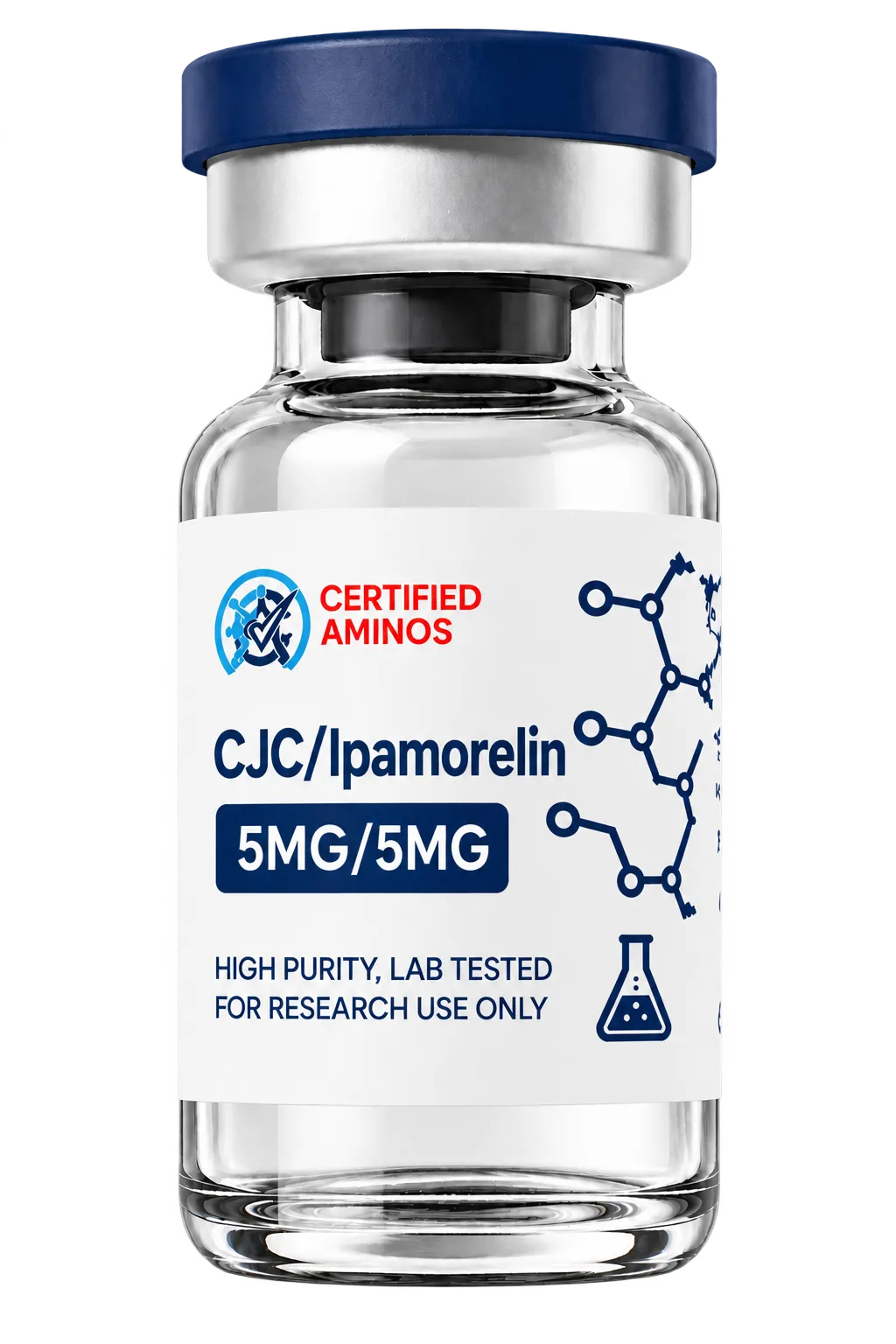
The two are marketed together because, mechanistically, a GHRH-receptor agonist and a GHS-R1a agonist act on complementary parts of the same GH-release pathway — the rationale behind combination products like the CJC-1295/Ipamorelin blend sold as a single research vial. That rationale is pharmacological reasoning, not a demonstrated human outcome: no published head-to-head or combination human efficacy trial for this pairing was identified in this review.
Neither compound has an FDA-approved drug product. Evidence limitations that apply to Ipamorelin alone apply independently to CJC-1295; one should not be used to fill evidentiary gaps in the other. This guide does not provide a combination dosing protocol, and readers should not treat “stacking” the two as a validated research approach without independently reviewing primary literature.
Ipamorelin vs Tesamorelin
Tesamorelin and Ipamorelin are both connected to the growth hormone axis, but they are not interchangeable, and their regulatory stories diverge sharply.
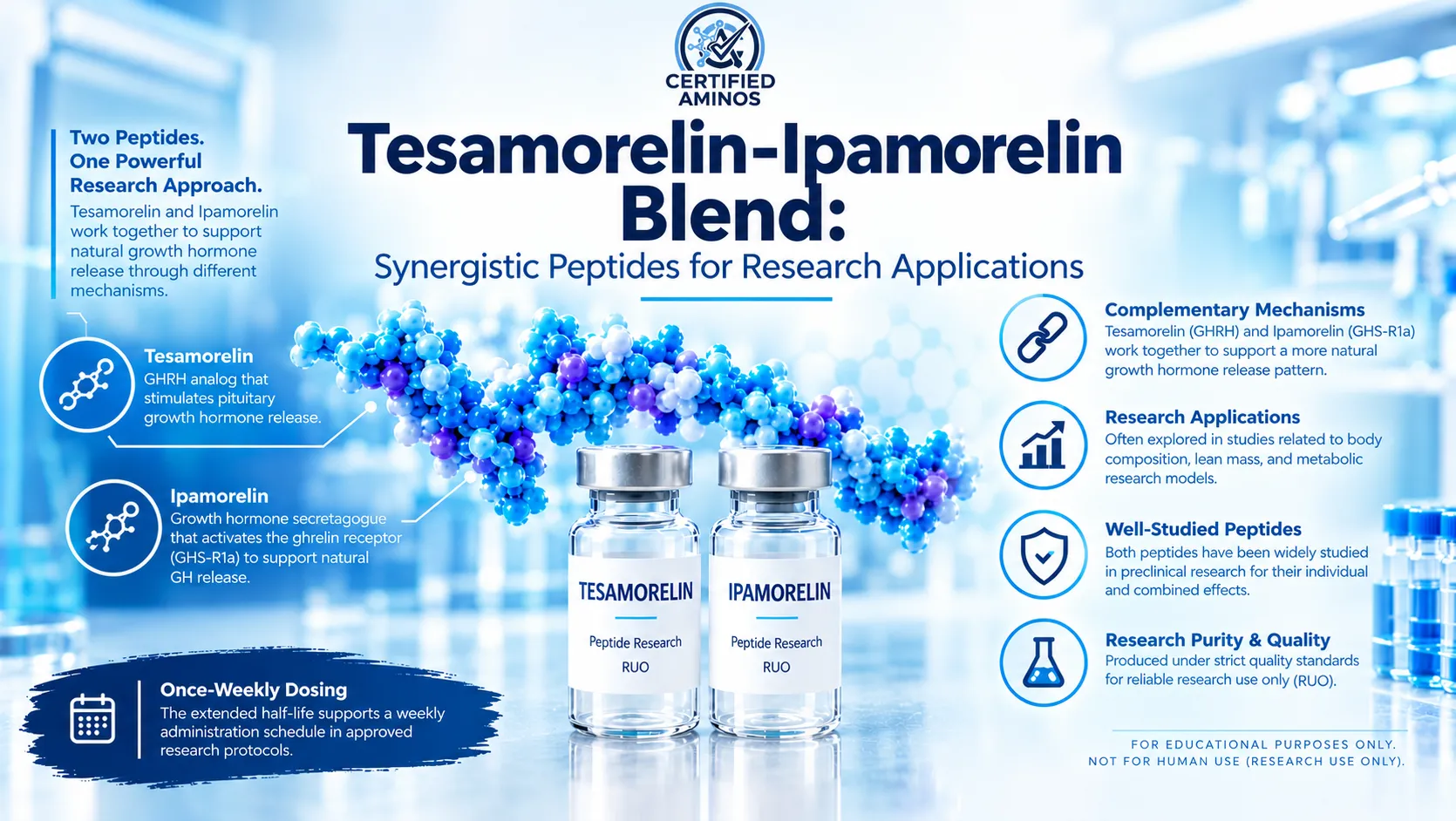
Tesamorelin is a GHRH analog — like CJC-1295, it targets the GHRH receptor rather than the ghrelin receptor Ipamorelin acts on. It should not be described as a growth hormone secretagogue in the same technical sense as Ipamorelin; the two operate through different pituitary-signaling pathways.
The key distinction: tesamorelin is the active ingredient in an FDA-approved drug product (marketed as Egrifta), indicated for reducing excess abdominal fat in adults with HIV-associated lipodystrophy — confirm the current label and indication at publication, since approvals and labeling can be updated. That approval is specific to that branded product, its formulation, and its approved indication. It does not extend to tesamorelin sold as an unbranded research compound outside that approved product, such as the Tesamorelin/Ipamorelin blend sold for research use, and it tells you nothing about Ipamorelin's own regulatory status, which remains unapproved.
Neither compound's approval status should be read as a verdict on relative safety or effectiveness for research purposes; they answer different questions about different products.
Ipamorelin vs Sermorelin
Sermorelin is also a GHRH(1-29) analog, placing it in the same receptor-pathway family as CJC-1295 and Tesamorelin rather than Ipamorelin's ghrelin-receptor route. Mechanistically, sermorelin and GHRH analogs act on the GHRH receptor; Ipamorelin acts on GHS-R1a — a meaningful pharmacological distinction even though both pathways influence GH release.
Sermorelin has a more complicated regulatory history than Ipamorelin. An FDA-approved sermorelin acetate product (marketed as Geref) existed from 1997 until its manufacturer voluntarily discontinued it in 2008, reportedly for manufacturing reasons rather than a safety or efficacy finding. That approved product is no longer marketed. Sermorelin sold today — including as a compounded or research-labeled product — is not that discontinued approved product, and carries the same unapproved status that applies to Ipamorelin and CJC-1295 in their current commercial forms.
Clinical or research evidence differences between sermorelin and Ipamorelin should be evaluated independently; a finding about one GHRH-pathway compound does not transfer to a ghrelin-receptor compound like Ipamorelin.
Ipamorelin vs Growth Hormone (HGH)
It's worth stating this distinction plainly because it's a common point of confusion: Ipamorelin is not HGH, and the two are not pharmacologically equivalent.
Recombinant human growth hormone supplies the hormone itself directly, bypassing the pituitary gland. Ipamorelin, as a GHS-R1a agonist, depends on stimulating the body's own pituitary-hypothalamic machinery to produce GH — meaning its effect, to the extent one occurs, is mediated through a different, upstream biological step. If the pituitary's ability to respond is impaired, a secretagogue approach and a direct-replacement approach would not be expected to behave the same way.
This distinction also matters for safety and regulatory discussion: FDA-approved growth hormone products have gone through controlled trials for specific indications, with corresponding labeled risks. Ipamorelin, with no FDA-approved product, does not have that same evidence base, and the two should not be discussed as if they carry equivalent evidence or equivalent regulatory standing.
Ipamorelin Dosage: Why There Is No Universal Research Protocol
“Ipamorelin dosage,” “ipamorelin peptide dosage,” and “ipamorelin 10mg” are all high-interest search terms, and the honest answer is that no single, validated research protocol exists for this compound.
Several factors explain why dosing information online varies so widely:
Study design differences: The one identified placebo-controlled human trial used intravenous dosing (0.03 mg/kg, twice daily) in a specific surgical-recovery context — a protocol built for that research question, not a general-purpose guideline.
Route of administration: Research and compounded products have used different delivery routes (injectable, nasal), which are not interchangeable in terms of exposure or effect.
Formulation: A compound's acetate salt form versus its free base can behave differently in solution and in the body — one of the characterization issues FDA raised in its 2024 compounding-substance evaluation.
Research population and objective: A dose studied in post-surgical patients for a GI-recovery endpoint was not designed to answer questions tied to other research objectives.
This article does not provide a human milligram-per-day or milligram-per-week figure, injection frequency, reconstitution instructions, or a cycling schedule, because no verified, generally applicable protocol exists to responsibly report. Vendor, forum, and social-media dosing claims should not be assumed to reflect validated research.
What Does Human Research Say About Ipamorelin?
Separating human evidence into categories helps clarify how much is actually known:
Human observational evidence: None identified in this review.
Human pharmacology studies: No dedicated human pharmacokinetic/pharmacodynamic characterization study (outside the trial below) was identified.
Human interventional studies: One published, randomized, double-blind, placebo-controlled Phase 2 trial — Beck et al. (2014), registered as NCT00672074 — tested intravenous ipamorelin (0.03 mg/kg twice daily) against placebo in 114 adults recovering from bowel-resection surgery, evaluating time to tolerate a solid meal as its primary endpoint. The result: a median of approximately 25.3 hours with ipamorelin versus 32.6 hours with placebo — a difference that did not reach statistical significance (p = 0.15). The compound was reported as well tolerated, with similar adverse-event rates across both arms. A second trial record, NCT01280344, also studied ipamorelin for recovery of gastrointestinal function; its detailed outcomes were not independently confirmed in this research pass and should be checked directly on ClinicalTrials.gov before being cited.
Published clinical outcomes supporting broader marketed uses (fat loss, muscle building, anti-aging, sleep, athletic performance): none identified.
In short, human evidence for Ipamorelin is real but narrow — one completed trial, in one specific surgical context, that did not demonstrate the benefit it was testing for. That is a meaningfully different statement than “there are no human studies,” and also different from “human studies support Ipamorelin's benefits.”
How Researchers Evaluate Ipamorelin Quality
For anyone purchasing a research-use compound, analytical quality and clinical safety are two separate questions, and conflating them is a common error.
Researchers typically evaluate a peptide research compound's quality through:
Identity confirmation: Mass spectrometry to confirm the molecule's weight matches the target peptide structure.
Purity testing: High-performance liquid chromatography (HPLC), typically on both incoming raw material and the finished batch, to quantify how much of the sample is the intended peptide versus impurities or degradation products.
Third-party/independent testing: Analysis performed by a laboratory independent of the seller, reducing conflict-of-interest risk in reported results.
Certificates of Analysis (COAs): Documentation tying a specific tested batch to its results, ideally with batch/lot traceability so a buyer can confirm which COA corresponds to the product in hand.
The critical distinction: analytical purity is not the same thing as clinical safety or efficacy. A high-purity, well-documented sample confirms what is in the vial — it says nothing about whether that compound produces a specific effect in humans, or about its regulatory status. A COA is testing documentation, not an FDA approval, and third-party purity testing does not, by itself, establish human therapeutic safety. Researchers should treat quality documentation and clinical-evidence review as two independent steps, not substitutes for one another.
Certified Aminos Ipamorelin Research Compound
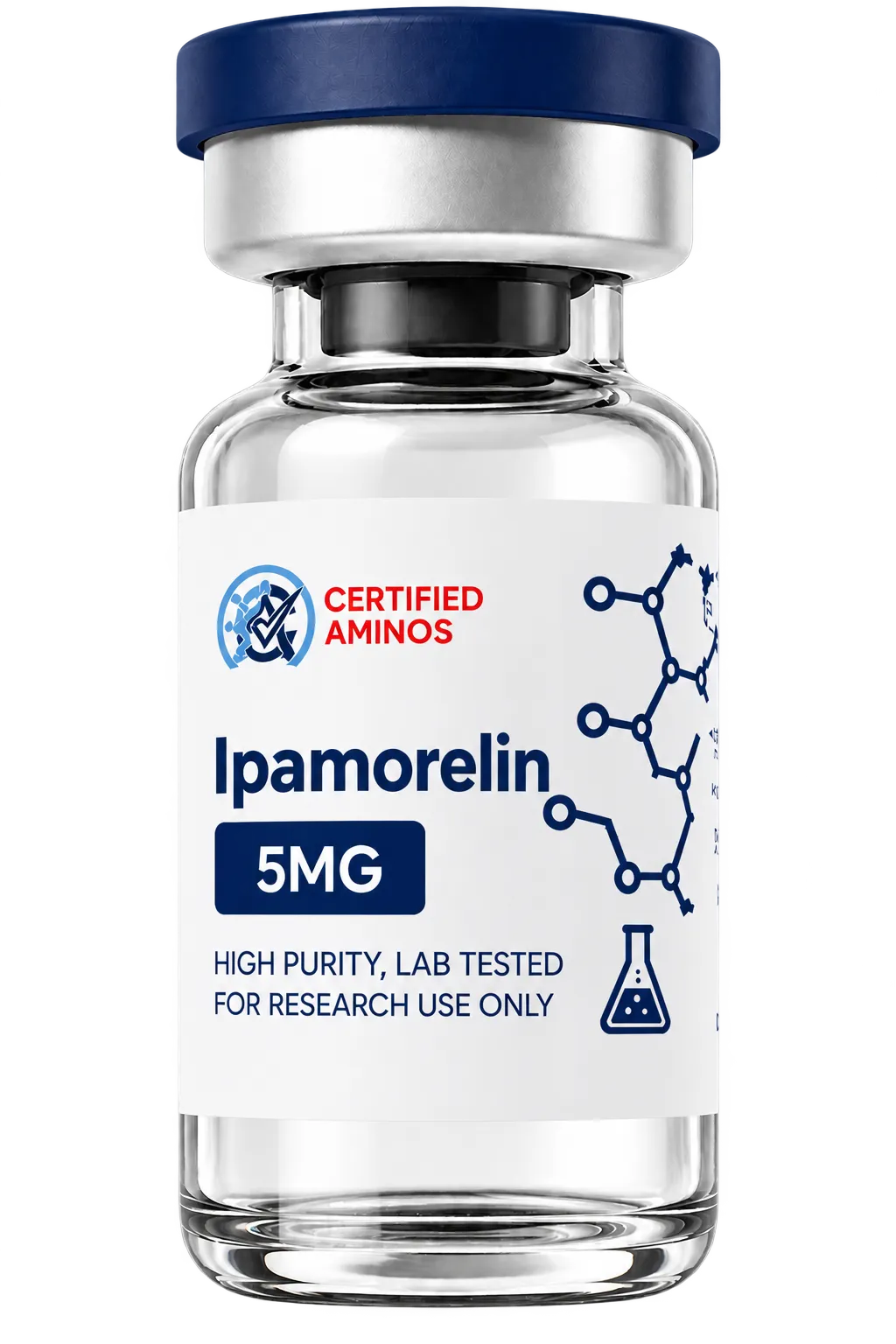
Certified Aminos lists Ipamorelin in 5MG and 10MG sizes within its Growth Hormone Secretagogue category, described on the product page as “a selective growth hormone secretagogue studied for its targeted, pulsatile GH-release profile with minimal off-target receptor activity.” The listing carries the same purity and testing claims shown across the site's research-peptide catalog — purity reported at ≥99% by HPLC, with third-party, independent lab analysis referenced under the product's quality section.
Per Certified Aminos' own Certificates page, batch-specific COA documents are still being added across the current catalog, and the page directs buyers to contact the company directly for a specific batch's Certificate of Analysis. As with every product in this category, this listing is positioned for laboratory research use, not for human administration, diagnostic use, or treatment of any condition — nothing on this page should be read as a clinical-safety, efficacy, or FDA-approval claim. Readers with general questions about peptide safety or FDA status can also see Certified Aminos' own “Are Peptides Safe?” and “FDA-Approved Peptides” guides, or the site FAQ.