Research Use Only. This material is provided for scientific and educational purposes only. The product discussed is designated for Research Use Only (RUO) and is not intended for human or veterinary consumption, diagnosis, treatment, or prevention of disease. Nothing on this page constitutes medical advice or a recommendation for human use.
1. What Is the Tesamorelin–Ipamorelin Blend, and How Does It Differ From Either Compound Alone?
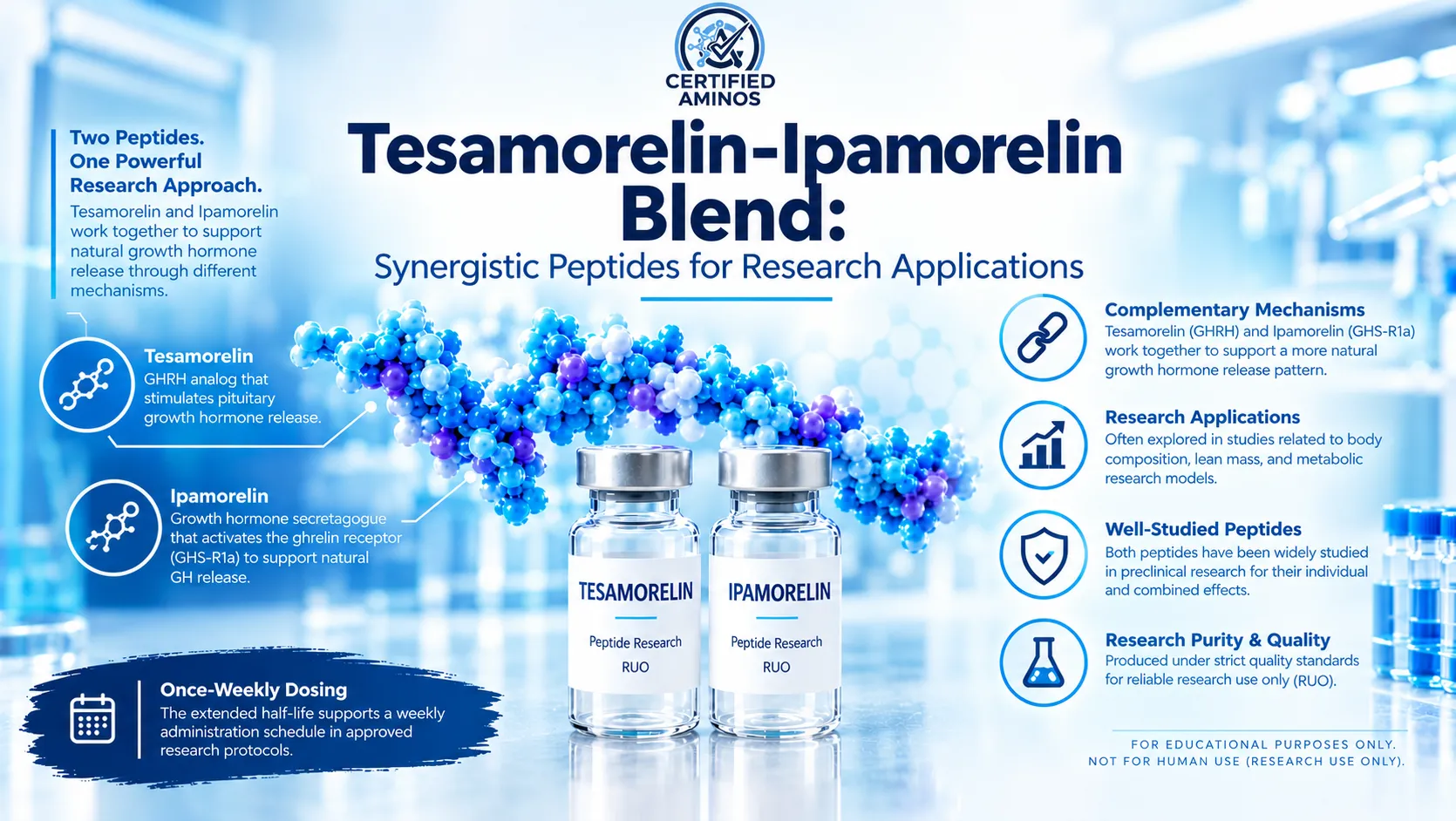
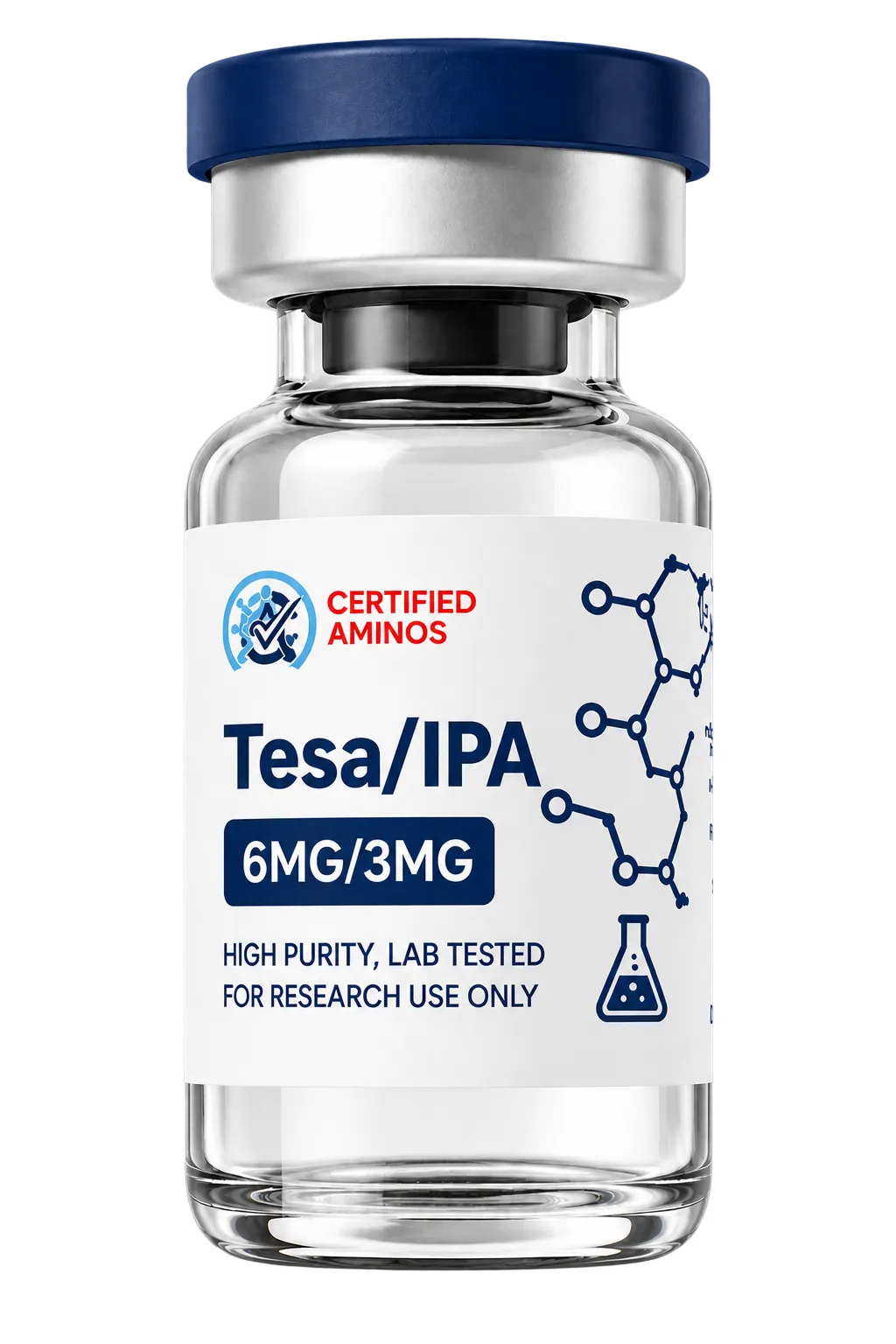
A tesamorelin ipamorelin blend like this one combines two separately-acting research peptides into a single vial, rather than being a new, independently characterized molecule. Tesamorelin contributes signaling through the GHRH receptor; Ipamorelin contributes signaling through the ghrelin receptor (GHS-R1a) [3][5]. Putting the two in one vial reflects a research question — does engaging both pathways at once change the GH response — not a validated or clinically tested formulation.
Certified Aminos lists this product in two label sizes, 6mg/3mg and 13mg/3mg, but the product page itself does not specify which number is Tesamorelin and which is Ipamorelin [8]. Until that's clarified on the listing, there's no way to tell from the label alone whether a given vial is weighted toward one peptide or the other.
2. Are Tesamorelin and Ipamorelin the Same Type of Molecule?
No. They are structurally and mechanistically distinct, as the table below summarizes.
Identity and classification per Dhillon 2011 [3] and Gobburu et al. 1999 [5]; brand/approval reference per the FDA label [7].
Sharing the end result — a growth hormone pulse — does not make the two molecules variants of each other; they reach that result through different receptors entirely.
3. How Does Tesamorelin Work?
Tesamorelin is a synthetic, stabilized analogue of human GHRH(1-44), engineered to resist rapid enzymatic breakdown. It binds the GHRH receptor on pituitary somatotroph cells, prompting the pituitary to synthesize and release the body's own growth hormone, which in turn raises circulating insulin-like growth factor-1 (IGF-1) [3][4].
This is the mechanism behind Tesamorelin's one approved use. In the pivotal six-month trial, visceral adipose tissue (VAT) fell by roughly 11% on tesamorelin versus under 1% on placebo (P<0.0001) [1]. A 52-week extension confirmed the reduction held at approximately 18% with continued treatment, though VAT re-accumulated once the drug was stopped [2].
4. How Does Ipamorelin Work?
Ipamorelin is a pentapeptide and selective agonist at the ghrelin receptor (GHS-R1a) — the same receptor the hormone ghrelin binds naturally. Activating it triggers a GH pulse through a mechanism distinct from the GHRH pathway Tesamorelin uses [5].
The clearest human evidence is a dose-escalation pharmacokinetic/pharmacodynamic trial in healthy male volunteers: intravenous ipamorelin produced a single, dose-dependent GH release peaking around 40 minutes post-infusion, with a short (~2-hour) elimination half-life [5]. That confirms the receptor mechanism works in humans — it says nothing about body composition, long-term GH/IGF-1 change, or any other downstream outcome.
5. Is Tesamorelin FDA-Approved?
Yes, but narrowly. Tesamorelin is the active ingredient in Egrifta/Egrifta WR, FDA-approved specifically to reduce excess visceral abdominal fat in HIV-infected adults with lipodystrophy, per the agency's own 2025-revision label [7]. That approval is tied to a specific formulation, dose, and indication established across two randomized trials [1][2][4] — it does not extend to research-grade tesamorelin sold for laboratory use.
6. Is Ipamorelin FDA-Approved?
No. No FDA approval for ipamorelin, for any indication, was identified. Researchers understand exactly how Ipamorelin binds its receptor — that's just never been enough, on its own, to earn a drug an FDA approval [5].
7. Does Research on Each Compound Separately Prove the Blend Works?
No. The table below separates what is actually documented for each compound from what remains unestablished for the pairing.
Comparison built from sources [1][2][5][7][8][9]; it does not rank effectiveness or safety, since no comparative data of that kind exists for the pairing.
Two independently reasonable mechanisms do not automatically add together once mixed, and nothing in the tesamorelin or ipamorelin literature individually establishes what the combination does.
8. Has Anyone Studied Tesamorelin and Ipamorelin Together?
Not that this review could locate. A direct PubMed search for the combination returned no controlled human or animal study of this exact pairing. The closest adjacent finding is a 2026 narrative review of injectable peptide therapy (Mayfield et al.), which notes that CJC-1295 — a different, longer-acting GHRH analogue, not Tesamorelin — combined with Ipamorelin improved tetanic tension in a mouse model of glucocorticoid-induced muscle loss [6]. That finding does not transfer to the Tesamorelin+Ipamorelin pairing: CJC-1295 and Tesamorelin are distinct molecules with different pharmacokinetics, and the result itself is confined to a rodent model [6].
9. What Does the Direct Human Evidence Actually Show?
Every row in that table is about one compound alone — nobody has run the matching study on the two together.
10. What Does Certified Aminos' Own Product Page Say About This Specific Blend?
The table below sets common marketing-style claims next to what the company's own pages state when checked directly.
Checked directly on certified-aminos.com/product/tesamorelin-ipamorelin-blend [8] and certified-aminos.com/certificates [9], 2026-10-17.
11. What Are the Known Safety Considerations and Limitations?
Growth hormone and IGF-1 signaling have complex, system-wide effects, and findings from controlled research do not translate directly to a different protocol, dose, or combination. In the tesamorelin trials, reported adverse events were generally injection-site reactions and effects consistent with GH-axis stimulation (arthralgia, headache, peripheral edema), in a specific population on a specific approved dose [1][2] — that profile cannot be assumed to apply to research-grade tesamorelin used differently, or to a mixture with a second secretagogue. Ipamorelin's long-term human safety profile is largely uncharacterized beyond the short PK/PD trial [5].
12. What Does "Research Use Only" Mean for This Product?
FDA approval attaches to a specific drug product, formulation, and indication — not to a molecule in the abstract. Egrifta/Egrifta WR's approval covers that prescription product for HIV-associated lipodystrophy only [7]; it says nothing about research-grade tesamorelin, and nothing about ipamorelin, which holds no approval of any kind. "Research Use Only" means a product is intended for laboratory and scientific research, not human or animal administration — RUO status is not an FDA safety or efficacy evaluation. The Certified Aminos Tesamorelin–Ipamorelin Blend is sold and labeled on this RUO basis [8].
13. What Should a Researcher Check on a Certificate of Analysis (COA)?
For this product, no batch-specific COA is currently published, so none of the above can yet be checked against a document [8][9].
What This Page Does Not Establish
This page does not establish that the Tesamorelin–Ipamorelin Blend is safe or effective for any use; that the two compounds act synergistically when combined; that this specific product's purity, identity, or composition ratio meets any particular standard; or that Tesamorelin's FDA approval in its Egrifta/Egrifta WR formulation extends to this or any other RUO product. It also does not provide dosing, reconstitution, or administration guidance, and none should be inferred from it.
For Researchers
Featured in This Article: Tesamorelin–Ipamorelin Blend — view the current listing on Certified Aminos to review live specifications, stock status, and documentation. Only features actually stated on that page are referenced in this article; no purity, identity, or testing claim is implied beyond what the page itself states [8].
Related reading: the standalone Tesamorelin and Ipamorelin listings; Ipamorelin Peptide: What Research Shows; FDA-Approved Peptides: The 2026 Guide; and Do You Need a Prescription for Peptides? for the broader RUO/FDA distinction.
This material is Research Use Only. It is not medical advice, and it is not a recommendation for human use.