Research Use Only. This material is provided for scientific and educational purposes only. The product discussed is designated for Research Use Only (RUO) and is not intended for human or veterinary consumption, diagnosis, treatment, or prevention of disease. Nothing on this page constitutes medical advice or a recommendation for human use.
What Is SNAP-8 (Acetyl Octapeptide-3)?
SNAP-8 is the trade name most commonly used for acetyl octapeptide-3, a synthetic peptide built from eight amino acids. It is structurally an elongated version of Argireline (acetyl hexapeptide-8, also called acetyl hexapeptide-3), a six-amino-acid peptide first described in a 2002 paper modeling its sequence on the N-terminal region of SNAP-25, a protein involved in neurotransmitter release [1]. SNAP-8 extends that sequence by two additional residues.
Not every product labeled "SNAP-8" uses the same concentration, grade, or supporting documentation. The identity and specifications of a specific material should be checked directly rather than assumed from the name alone.
How Is SNAP-8 Proposed to Work?
The proposed mechanism is competitive interference: SNAP-8 is modeled to resemble part of the SNAP-25 protein closely enough that it competes with the body's own SNAP-25 for a position in the SNARE complex, the molecular machinery that lets a nerve terminal release acetylcholine. If SNAP-8 occupies that position without completing the same function, the theory goes, less acetylcholine gets released and the muscle contracts less — producing an effect description-wise similar to (though mechanistically different from) botulinum toxin.
This is the same proposed logic used for Argireline, SNAP-8's parent peptide. A 2002 study reported that Argireline inhibited calcium-dependent norepinephrine release in isolated chromaffin cells by roughly 40%, compared to about 50% for botulinum toxin A in the same in vitro system [1]. That is laboratory cell-culture data, not a measurement of what happens when the peptide is applied to skin.
Where Does That Mechanism Actually Come From — and Is It Confirmed for SNAP-8 Itself?
No independently published, peer-reviewed study isolating SNAP-8's own SNARE-binding activity was located for this article. The mechanism commonly cited for SNAP-8 is extrapolated from Argireline's in vitro data and from manufacturer and patent literature describing SNAP-8 as an extended analogue [1]. Certified Aminos' own product listing for this ingredient states the same thing directly: the proposed mechanism "traces to manufacturer and patent literature rather than independently published peer-reviewed research" (checked 2026-10-20) [5].
Even for Argireline, a 2025 peer-reviewed review found that none of the available in vivo studies confirmed actual muscle inhibition from topical use, and suggested that any observed effects may be epidermal and multifactorial rather than the result of blocked neurotransmission [2]. A proposed mechanism and a confirmed one are different claims, and that gap is wider for SNAP-8 — which has even less independent study behind it — than it is for Argireline.
How Does Botulinum Toxin Actually Work, for Comparison?
Botulinum toxin's mechanism is well-established and mechanistically distinct from SNAP-8's proposed one. It is a zinc-dependent protease that cleaves specific SNARE proteins directly — types A, C, and E cleave SNAP-25 itself — physically destroying the protein's ability to participate in vesicle fusion, which blocks acetylcholine release for weeks to months [3]. SNAP-8 is not proposed to cleave anything; it is proposed to compete for a binding position, a reversible and much weaker mode of action even in the most favorable reading of the theory.
SNAP-8 vs. Argireline vs. Botulinum Toxin
Sharing a loosely analogous goal — reducing the appearance of expression lines — does not make these three substances comparable in mechanism, evidence, or regulatory status.
Is There Clinical Evidence for SNAP-8 Specifically?
One relevant peer-reviewed human study was located. A 2024 study in *Annals of Dermatology* tested a dissolving microneedle patch on 24 subjects (21 completed), applying the active patch to one eye and a hyaluronic-acid-only placebo patch to the other over 28 days [4]. The active patch's composition was 5% ascorbic acid 2-glucoside, 4% sodium cyclic lysophosphatidic acid, 0.03% SNAP-8, and 90% hyaluronic acid [4].
The study reported statistically significant reductions in peak wrinkle height and several roughness measures, along with improved eye-lifting, versus the placebo patch [4]. It did not test SNAP-8 alone, so it cannot attribute those results to SNAP-8 specifically rather than to the other two active ingredients or their combination. The authors' discussion attributes part of the early effect to "SNAP-8's muscle-relaxing mechanism," but that is the authors' interpretation, not something the three-arm-missing study design directly tested [4].
Certified Aminos' own product page references two peer-reviewed human studies of multi-ingredient formulations containing acetyl octapeptide-3 (checked 2026-10-20) [5]; this article independently verified one of them [4]. Beyond multi-ingredient formulation studies, the widely repeated single-ingredient efficacy figures for SNAP-8 (variously reported as up to 35%, 52%, or 63% wrinkle reduction across different secondary sources) trace back to manufacturer-reported data that is not indexed in PubMed and was not independently reproducible in the sources checked for this article. Where different secondary sources report different percentages for what is described as the same underlying claim, that inconsistency is itself a reason for caution.
Can a Topical Peptide Actually Reach the Neuromuscular Junction?
This is the mechanism's biggest open question, and it's a basic physical-chemistry problem independent of SNAP-8's proposed activity. The 2025 review of Argireline's skin permeability found that this smaller, related peptide "faces limited permeability through the lipophilic stratum corneum," that tape-stripping studies show most of the applied peptide staying in the outer stratum corneum, and that "the transdermal delivery of [Argireline] to induce a paralyzing effect in muscles is likely impossible" at the concentrations and formulations studied [2].
SNAP-8 is a larger, more hydrophilic molecule than Argireline, which would not be expected to improve on that penetration problem. No published study demonstrating that SNAP-8 reaches the neuromuscular junction at a pharmacologically meaningful concentration after topical application was located for this article.
Is SNAP-8 Regulated as a Cosmetic Ingredient or an Approved Drug?
SNAP-8 (acetyl octapeptide-3) is typically marketed and sold as a cosmetic ingredient, not an approved drug. Cosmetic ingredients sold in this category in the U.S. are not subject to the same premarket approval process as drugs, so being sold under a cosmetic designation says nothing on its own about demonstrated clinical efficacy — that is a separate question from regulatory category. No Cosmetic Ingredient Review (CIR) safety assessment specifically covering acetyl octapeptide-3 was located for this article.
Is SNAP-8 Equivalent to Botox?
No. SNAP-8 and botulinum toxin are different substances with different mechanisms, as the comparison above lays out: one enzymatically destroys a SNARE protein, the other is proposed to compete for a binding site without being able to reach it in any confirmed way at a meaningful concentration. They should not be considered clinically equivalent, and claims of comparable effects require evidence this article did not find.
What Does Certified Aminos' Own Product Page Say About This Listing?
Checked directly on certified-aminos.com/product/snap-8 [5] and certified-aminos.com/certificates [6], 2026-10-20.
What Should a Researcher Check on a Certificate of Analysis (COA)?
For this product, no batch-specific COA is currently published, so none of the above can yet be checked against a document [5][6].
What This Page Does Not Establish
This page does not establish that SNAP-8 reduces the appearance of wrinkles when used alone; that its proposed SNARE-complex mechanism has been directly confirmed, rather than extrapolated from its parent peptide's in vitro data; that it penetrates skin to a pharmacologically relevant depth; that this specific product's purity, identity, or concentration meets any particular standard; or that it is safe or suitable for any use. It also does not provide dosing, formulation, or administration guidance, and none should be inferred from it.
For Researchers
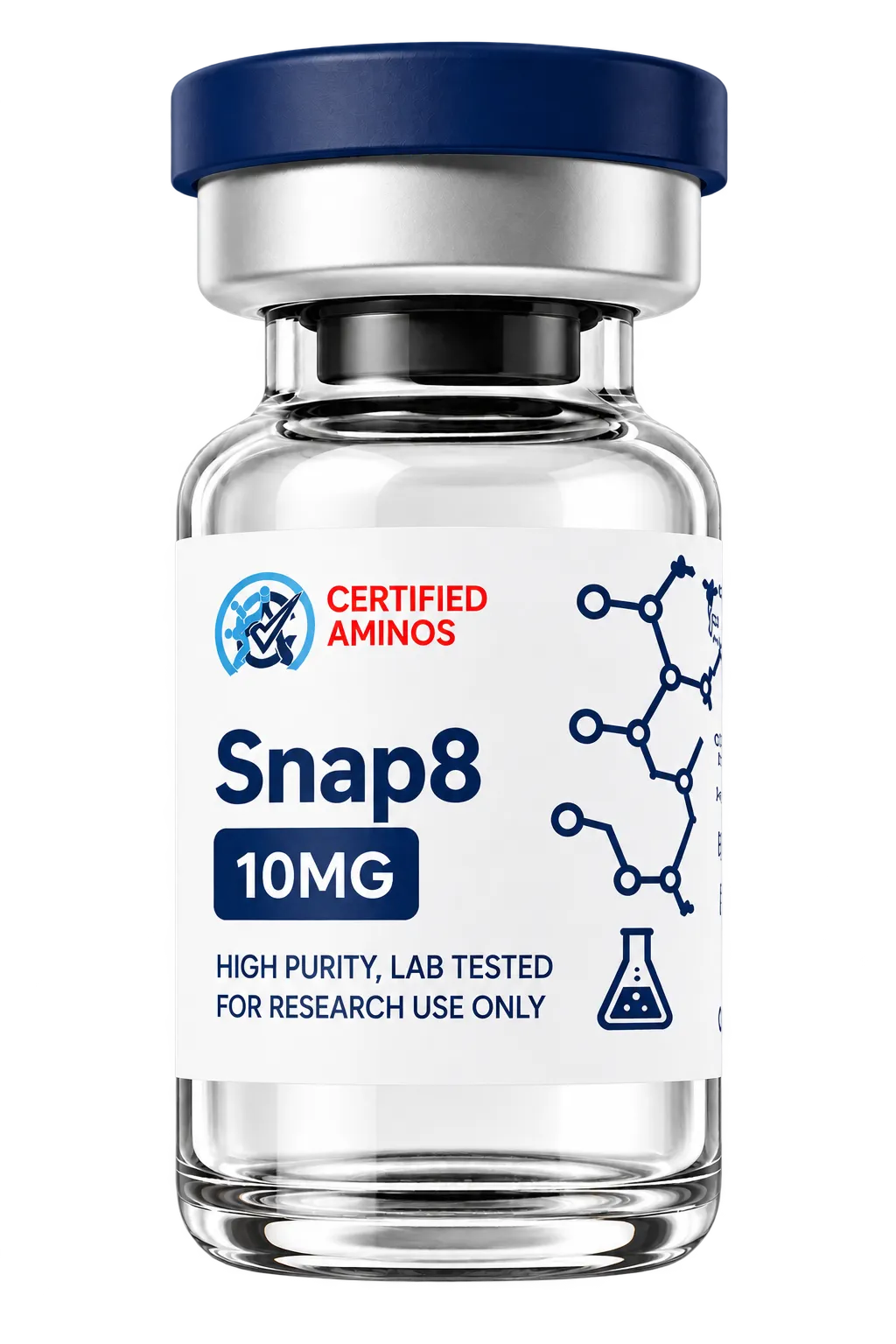
Featured in This Article: SNAP-8 — view the current listing on Certified Aminos to review live specifications, stock status, and documentation. Only features actually stated on that page are referenced in this article; no purity, identity, or testing claim is implied beyond what the page itself states [5].
Related reading: Are Peptides Safe? What Research Shows and Do You Need a Prescription for Peptides? for the broader regulatory and safety context behind cosmetic research peptides.
This material is Research Use Only. It is not medical advice, and it is not a recommendation for human use.