Melanotan-1 Peptide vs. Afamelanotide: What the Research Actually Shows
Cosmetic & SkinOctober 23, 202611 min read
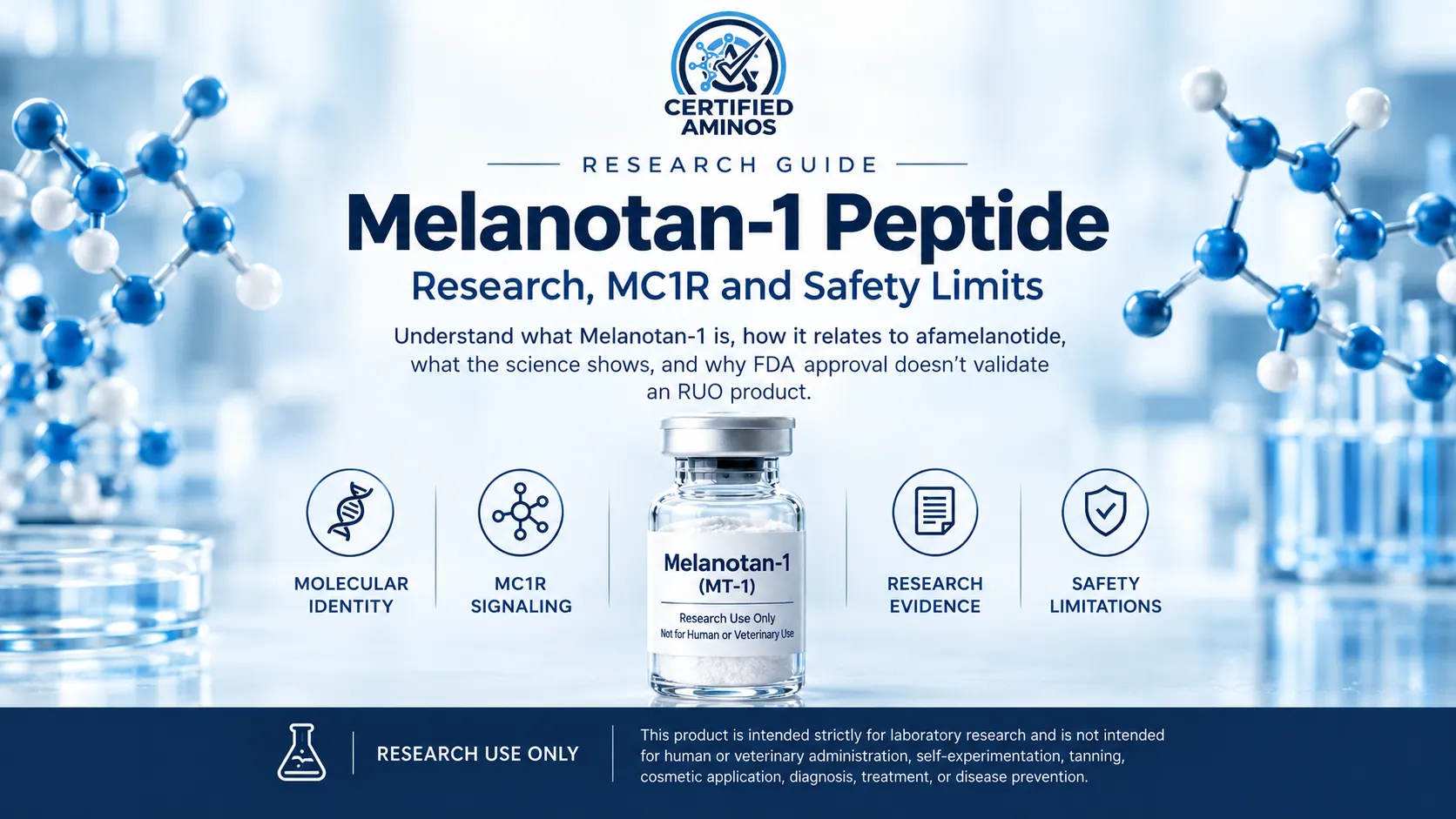
Melanotan-1 shares its sequence with afamelanotide, an FDA-approved drug — but that relationship does not establish the identity, purity, safety, or effectiveness of a separate research-use listing.
Melanotan-1 is a synthetic analogue of alpha-melanocyte-stimulating hormone. Afamelanotide contains the same active peptide sequence in a specific pharmaceutical product.
The FDA-approved Scenesse indication is for increasing pain-free light exposure in adults with erythropoietic protoporphyria (EPP), not cosmetic tanning.
Receptor-binding data, mechanistic research, and clinical evidence answer different questions. A biological mechanism alone does not establish a clinical benefit or a product's safety.
A published sequence or advertised purity percentage does not independently verify a particular batch. Product-specific claims require appropriate, traceable analytical documentation.
What Is Melanotan-1?
Featured In This Article
RESEARCH PEPTIDE
Melanotan 1
Highly purified synthetic peptide prepared for rigorous laboratory research.
$65.00
RESEARCH PEPTIDE
Melanotan 2
Highly purified synthetic peptide prepared for rigorous laboratory research.
$65.00
Melanotan-1 (MT-1) is a synthetic analogue of alpha-melanocyte-stimulating hormone (alpha-MSH) — [Nle4, D-Phe7]-α-MSH — that shares its exact sequence with afamelanotide, the active ingredient in the FDA-approved drug Scenesse. The compound has been studied in relation to melanocortin receptor pharmacology and pigmentation biology.
The terms MT-1 and MT1 appear in scientific and commercial contexts, but abbreviations alone do not verify the identity of a material in a particular vial. Researchers should distinguish the published identity of a compound from analytical evidence about a specific sample.
The name also appears in consumer searches about tanning and skin darkening. Those search trends should not be mistaken for proof that an unapproved product is suitable for cosmetic use. This article addresses the science and evidence limitations, not a human-use protocol.
How Does Melanotan-1 Relate to Alpha-MSH and Afamelanotide?
Alpha-MSH is a naturally occurring peptide involved in melanocortin signaling. Melanotan-1 is a synthetic analogue designed to alter aspects of the native peptide's biological properties. Afamelanotide is the name of the active pharmaceutical ingredient used in Scenesse.
The important distinction is between molecular identity and pharmaceutical-product identity. Scenesse is a defined medicinal product with a particular formulation, manufacturing process, delivery system, clinical evidence, and approved indication. A separate research-use listing does not inherit those properties simply because its intended amino acid sequence matches that of afamelanotide — the same pattern we walked through for how an FDA-approved drug relates to a research-use listing of the same molecule in our oxytocin guide applies here too.
Researchers should therefore assess each claim independently: sequence identity requires appropriate analytical confirmation; purity requires relevant testing; and clinical safety or effectiveness requires evidence applicable to the specific product and intended use.
What Does MC1R Signaling Mean?
The melanocortin 1 receptor (MC1R) is a G-protein-coupled receptor expressed by melanocytes, the cells responsible for producing melanin. Activation of this signaling pathway can increase intracellular cyclic adenosine monophosphate (cAMP) and influence pigment-production pathways.
This mechanism helps explain why melanocortin signaling is relevant to pigmentation research. It does not, by itself, establish a predictable cosmetic result, quantify an effect in humans, or demonstrate that an unverified research product is safe.
Scientific interpretation should distinguish receptor-binding results, cell-based observations, animal studies, and human clinical outcomes — how researchers separate mechanism from clinical evidence is the same discipline we apply in our Semax guide. A mechanism can support a research hypothesis without proving a clinical claim.
How Does Melanotan-1 Differ From Melanotan-2?
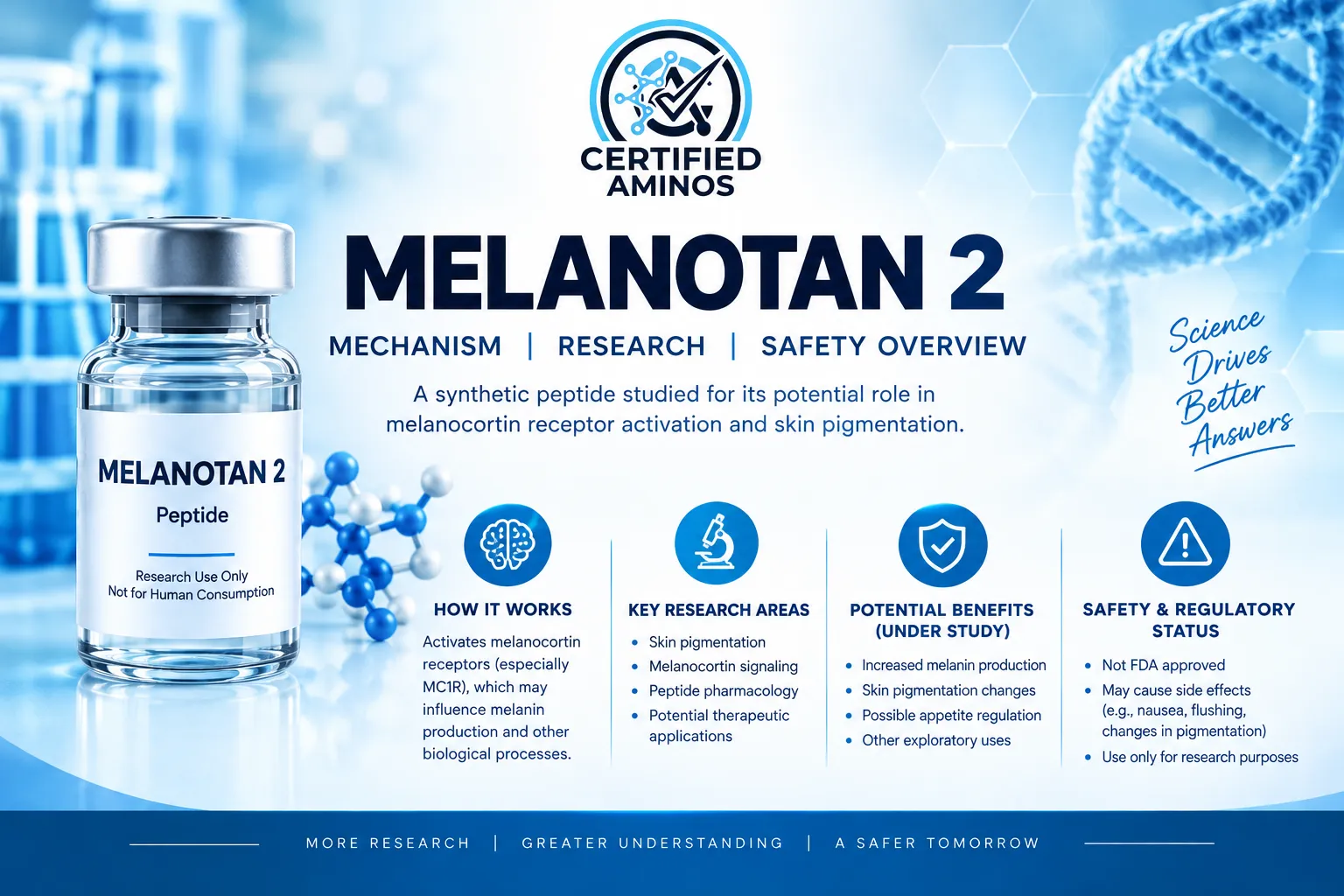
Melanotan-1 and Melanotan-2 are related by their association with melanocortin research, but they are structurally distinct compounds. Melanotan-1 is generally described as a linear 13-residue peptide analogue. Melanotan-2, covered in our Melanotan-2 research listing, is a smaller cyclic peptide with a different structure.
Attribute
Melanotan-1
Melanotan-2
Structure
Linear 13-residue peptide analogue
Smaller cyclic peptide
Relationship to alpha-MSH
Synthetic analogue, commonly identified as [Nle4, D-Phe7]-alpha-MSH
Reagent-supplier binding data report picomolar-to-nanomolar affinity across MC1, MC3, MC4, and MC5 — a flat "MC1-selective" claim oversimplifies this
Published data also describe activity across multiple melanocortin receptor subtypes, including MC4R; direct head-to-head comparison against Melanotan-1 is limited
Regulatory distinction
Same active peptide sequence as afamelanotide, the active ingredient in Scenesse for its approved indication
Scenesse approval does not apply to Melanotan-2
Product verification
Requires evidence relevant to the specific batch and claims made
Requires evidence relevant to the specific batch and claims made
Evidence limitations
Do not infer cosmetic use, safety, or effectiveness for a separate RUO listing
Do not transfer findings to Melanotan-1 without direct evidence
Published pharmacological reference data should be examined carefully before making claims about receptor selectivity. Melanocortin receptor activity is not adequately summarized by saying that one compound acts exclusively at MC1R while the other acts broadly. The strength and functional consequences of receptor activity depend on the experimental method and the evidence being compared.
Direct comparative human evidence is limited. Findings about the safety, effectiveness, composition, or regulatory status of one compound should not automatically be attributed to the other. Some product descriptions characterize Melanotan-1 as strictly "MC1-selective" in contrast to Melanotan-2. Reagent-supplier receptor-binding data for [Nle4,D-Phe7]-α-MSH (R&D Systems/Tocris, product 3013) report Ki values of 0.085 nM at MC1, 0.4 nM at MC3, 3.8 nM at MC4, and 5.1 nM at MC5 — all subnanomolar to low-nanomolar, meaning the compound binds MC3, MC4, and MC5 as well, just somewhat less tightly than MC1. A flat "MC1-selective" claim is therefore an oversimplification rather than an established fact. A useful comparison identifies structural differences, describes the source and limits of receptor data, and avoids unsupported rankings of safety or efficacy.
What Does FDA Approval of SCENESSE Actually Mean?
The FDA approved Scenesse (afamelanotide) on October 8, 2019, for increasing pain-free light exposure in adults with a history of phototoxic reactions associated with erythropoietic protoporphyria (EPP), a rare inherited disorder. The approved medicinal product is a subcutaneous implant administered in a medical setting.
The approval applies to the specific pharmaceutical product and indication evaluated by the regulator. It does not cover cosmetic tanning, general pigmentation enhancement, or an independently manufactured research-use listing.
Clinical trial findings for afamelanotide should be described in their original context, including the population studied, formulation used, measured outcomes, and limitations. They should not be represented as evidence that a separate research-use material has equivalent quality, safety, or effectiveness.
How Should Tanning-Related Claims Be Evaluated?
Queries about Melanotan compounds often concern tanning, pigmentation, or before-and-after results. These searches reflect consumer interest, not evidence that a particular product is approved or appropriate for those purposes.
A mechanistic relationship with melanin production does not establish a reliable cosmetic outcome, eliminate the risks associated with ultraviolet exposure, or demonstrate protection against skin cancer. Claims of this kind require direct, relevant evidence and must not be inferred from receptor activity alone.
Regulatory warnings about products marketed for tanning should also be attributed precisely. Australian Therapeutic Goods Administration findings concerning Melanotan II products must not be presented as direct test results for Melanotan-1. Compound-specific evidence matters, and a lack of a located enforcement report does not prove that a product is safe.
Why Is Human Dosing Guidance Inappropriate for an RUO Listing?
A Research Use Only listing is not a human-use dosing reference. Human dosing instructions, administration protocols, preparation instructions for personal use, or cycling recommendations would imply a use that the listing is not intended to support.
The existence of dosing information for an approved pharmaceutical product does not make that information transferable to a separate research-use material. Formulation, route of delivery, product quality, clinical evidence, and the intended indication all matter.
Readers searching for Melanotan dosage should be given a clear explanation of this limitation rather than an unverified number or protocol. A Melanotan-1 listing sold for laboratory research should not be positioned as a guide to tanning or self-administration.
What Is Known About Safety and What Remains Uncertain?
The melanocortin pathway and afamelanotide's approved medical use have been investigated scientifically. Those findings provide useful context, but they do not establish the safety profile of every material sold under the Melanotan-1 name.
For a specific research-use listing, relevant questions include whether the material's identity has been analytically confirmed, whether batch-specific purity documentation exists, and whether other tests appropriate to the intended laboratory work have been performed. Where those records are unavailable, the uncertainty should be stated directly rather than assumed away.
Melanotan-2-specific safety reports should not be used as though they were direct evidence about Melanotan-1. Conversely, the absence of a Melanotan-1-specific regulatory finding is not evidence that all Melanotan-1 products are safe. Both conclusions go beyond the available evidence.
What Can Sequence Information Establish?
A published amino acid sequence, molecular formula, or chemical identifier describes a compound's intended molecular identity. It does not establish that a particular batch contains the intended compound or that the material is free from relevant impurities.
Product-specific identity assessment may use suitable analytical techniques, such as mass spectrometry, with methods selected for the substance and the question being tested. A technical reference describing the expected molecule is not a substitute for a result tied to the actual batch.
For readers reviewing research suppliers, the central question is whether the documentation identifies the tested lot and clearly describes the method and result. Where no batch-specific report is available, that gap should be stated, not implied away.
What Does an HPLC Purity Result Establish?
High-performance liquid chromatography (HPLC) can be used to assess the relative chromatographic composition of a sample. However, a reported purity percentage must be interpreted in the context of the method, sample, detection conditions, and report provided.
A percentage alone does not necessarily establish molecular identity, sterility, biological activity, or the absence of every relevant contaminant. It is also not evidence that a particular batch was tested unless the result can be traced to that batch.
A useful Certificate of Analysis (COA) identifies the lot, testing laboratory, methods, date, and results relevant to the claims being made. If a seller displays a purity badge but does not provide supporting batch-specific documentation, the badge should not be treated as independently verified.
This distinction is worth checking on any listing, including this one: a badge promising testing on "every batch" is a policy statement, while a spec table disclosing that no batch-specific COA is yet published is the actual status of the lot for sale. When the two disagree, the spec table is the one tied to your order.
How Do Identity, Purity, Sterility, and Activity Testing Differ?
These tests address different questions:
Identity testing evaluates whether the material corresponds to the intended compound.
Purity testing estimates the composition of the tested sample using a defined analytical method.
Sterility testing assesses microbial contamination under the conditions of the test.
Biological activity testing examines whether a material produces the expected activity in a specified experimental system.
A result in one category does not automatically establish a result in another. A purity result cannot be used by itself to claim sterility, and a sequence reference cannot establish the measured biological activity of a specific batch.
The appropriate documentation depends on the research context. Claims should be limited to the tests actually performed and the conclusions the methods support.
How Can Readers Evaluate Scientific Claims?
A practical way to evaluate claims about Melanotan-1 is to separate evidence into distinct categories.
First, official regulatory records establish the approved status and indication of a specific medicinal product. Second, human clinical studies provide evidence about the studied formulation and population. Third, mechanistic studies help explain biological pathways but do not independently prove clinical outcomes. Fourth, supplier technical data can provide useful reference information about a molecule, but it is not automatically independent testing of a seller's batch. Finally, commercial claims and anecdotal photographs should not be treated as equivalent to controlled scientific evidence.
Every claim should be checked against the source that directly supports it. If evidence is preliminary, indirect, or absent, that is worth saying outright — it is more useful to researchers than an overstated claim of certainty.
Featured Research Listing
The Melanotan-1 listing carries the current specification table and compliance language — read it alongside this guide, since product pages get updated independently of articles like this one. Its molecular identity, purity, and quality should not be treated as independently verified unless the listing itself provides appropriate, batch-specific documentation.
Conclusion
Melanotan-1 is a scientifically relevant compound in melanocortin research, and afamelanotide has a documented, specific pharmaceutical use. These facts should not be conflated. Scenesse's approval does not validate a separate research-use listing, and mechanistic research does not prove a cosmetic benefit or product-specific safety. Readers assessing research materials should look for evidence tied to the actual batch and distinguish molecular identity, purity, sterility, and biological activity. Where documentation is missing or conflicting, the responsible conclusion is to disclose the limitation rather than imply verification.
Research Use Only: This product is intended strictly for laboratory research and is not intended for human or veterinary administration, self-experimentation, tanning, cosmetic application, diagnosis, treatment, or disease prevention.
Got Questions?
Frequently Asked Questions
Melanotan-1 is a synthetic analogue of alpha-melanocyte-stimulating hormone, commonly identified as [Nle4, D-Phe7]-alpha-MSH. It has been studied for activity at melanocortin receptors. The name of a compound does not independently confirm the identity or quality of a particular research-use sample.