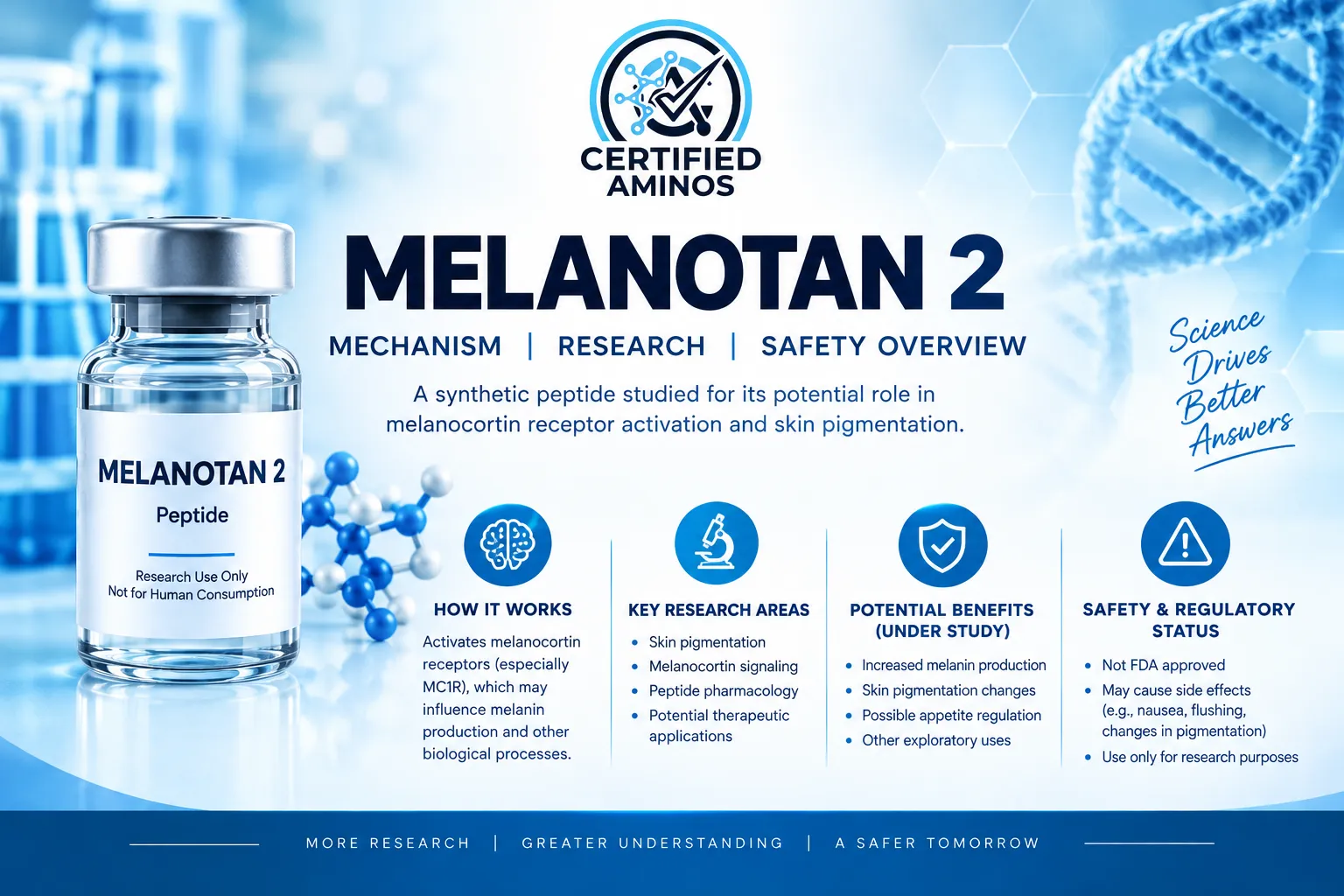
Melanotan-2 (MT-2) is a laboratory peptide that activates several melanocortin receptors at once. Its published human research is limited, but it is not confined to a single small pilot study: alongside a 1996 pigmentation-focused pilot, two later double-blind, placebo-controlled crossover studies examined its effect on erectile function and sexual desire in men with psychogenic and organic erectile dysfunction. A separate and growing case-report literature documents renal infarction, new melanocytic lesions, and other adverse events in people who used it outside a research setting. These are different bodies of evidence answering different questions — a pigmentation finding, an erectile-function endpoint, and a real-world adverse event are not interchangeable, and treating any one of them as proof about the others misrepresents all three. This guide works through the mechanism, the controlled human research that exists, the safety-signal literature, and where Melanotan-2 actually stands with regulators, using only sources that could be independently verified. It does not cover dosing, administration, or tanning protocols: a listing labeled Research Use Only (RUO), like the one this article links to for identification purposes, is intended strictly for laboratory and scientific research, not for self-administration.
Melanotan-2 (MT-2, Melanotan II) is a synthetic cyclic peptide built around the same core sequence as alpha-melanocyte-stimulating hormone (α-MSH), the natural hormone that signals pigment-producing cells in the skin. Researchers developed it while studying melanocortin receptor pharmacology, using a lactam bridge to lock the peptide into a cyclic (ring) structure — a modification that made it far more potent per milligram than linear α-MSH analogs, and gave it a broader receptor profile than its linear counterpart, Melanotan-1.
It is important to be precise about what that means and what it doesn't. Melanotan-2 is a research compound, not an approved medicine. No Melanotan-2 product has completed the clinical trial process the FDA requires for a drug approval, and none is authorized for human or veterinary use in the United States, Australia, or Ireland — the jurisdictions with the clearest public regulatory record on it.
How Does Melanotan-2 Work?
α-MSH normally acts on melanocortin receptors — a family of five G-protein-coupled receptors (MC1R through MC5R) that each sit on different tissues and drive different downstream effects. Melanotan-2 was engineered to bind several of them at once, and both laboratory pharmacology and controlled clinical research bear this out: it is described as a non-selective agonist at MC1R, MC3R, and MC4R.
Each receptor drives a different effect, and this is not merely inferred from receptor biology — it has been tested directly. MC1R, expressed on melanocytes in the skin, is the receptor responsible for the pigmentation effect covered below. MC3R and MC4R, expressed primarily in the central nervous system, are linked to appetite regulation and sexual function; two double-blind, placebo-controlled crossover studies — run by the same research group behind the original pilot trial — tested Melanotan-2's effect on erectile function directly, one in men with psychogenic erectile dysfunction and one in men with erectile dysfunction linked to organic risk factors. Both found that Melanotan-2 produced significantly more frequent and sustained erections than a placebo vehicle, and the organic-risk-factor study additionally found a significantly higher level of self-reported sexual desire after Melanotan-2 compared with placebo. A later review article by the same group summarized this combined research program rather than reporting an additional independent trial. Receptor activation in a lab assay or a controlled study describes a documented mechanism and a measured endpoint in those specific trials — it is not evidence of a cosmetic benefit, and it does not extend to outcomes those trials never tested, such as long-term safety or tanning-specific risk.
What Is the Relationship Between Melanotan-2 and Skin Pigmentation?
The pigmentation effect of Melanotan-2 is biologically real and mechanistically understood: by activating MC1R on melanocytes, it increases melanin synthesis the same way the body's own α-MSH does during sun exposure, independent of UV light. The 1996 pilot study documented measurable increases in skin pigmentation in two of three subjects following a short, controlled subcutaneous dosing schedule.
What this mechanism does not establish is any protective effect against UV damage. Melanin produced this way is the same pigment the skin produces in response to sunlight, but increased pigmentation from a melanocortin agonist is not equivalent to sunscreen, does not reliably indicate increased UV resistance, and does not eliminate the DNA damage pathway that ultraviolet radiation causes. Separately, because MC1R activation drives melanocyte activity generally, it also affects existing nevi (moles) and can be associated with the appearance of new pigmented lesions — a point covered in more clinical detail below. A cosmetic pigmentation change and a dermatological risk signal can both be true of the same mechanism at once.
What Does Human Clinical Research Actually Show?
Published human research on Melanotan-2 is limited, but it is not confined to the 1996 pilot study, and the available studies examine different questions rather than forming one continuous dataset.
The earliest study — a 1996 pilot Phase I trial — was a single-blind, placebo-controlled, dose-escalation trial in three male volunteers, focused on pigmentation and general tolerability over a short dosing schedule. It found dose-dependent skin pigmentation, along with nausea and, in one of two subjects at the highest dose tested, transient somnolence and fatigue; spontaneous erections were also observed as an incidental finding.
Two later, independently reported studies shifted focus to erectile function. A 1998 double-blind, placebo-controlled crossover study tested Melanotan-2 in ten men with psychogenic erectile dysfunction (no identified organic cause), using real-time monitoring over a several-hour observation period; eight of ten men developed clinically apparent erections, with significantly longer sustained rigidity than placebo. A second study, published in 2000, used the same crossover design in ten men with erectile dysfunction linked to organic risk factors, and additionally measured self-reported sexual desire; Melanotan-2 again produced significantly more and longer erections than placebo, along with significantly higher reported sexual desire. A review article, published later the same year by the same research group, summarized this combined erectile-function research program — it is a review of that work, not an additional independent trial on a separate cohort.
Together, these three controlled studies represent a small but real body of published human research. The two erectile-function studies are not a restatement of the 1996 pilot: they tested a different population (men with erectile dysfunction, not healthy volunteers) and a different primary endpoint (erectile response, not pigmentation). None of the three studies was large, none extended beyond a short observation window, and none was designed to establish a comprehensive safety profile across all effects or populations. No Phase III trial of Melanotan-2 was identified in the published literature reviewed for this article, and no Melanotan-2 product has received FDA approval for any indication; readers seeking a definitive, current answer on trial status should check public registries directly. Separately, a 2021 qualitative study analyzed self-reported experiences from 623 online forum posts by 205 participants — useful for understanding real-world use patterns, but methodologically distinct from any of the three controlled trials: it describes what people say happened to them outside a research setting, not a controlled measurement.
What Side Effects Have Been Reported?
The documented effects differ by study population and focus, and each finding stays attached to its source rather than folded into one generic list.
In the 1996 pigmentation-focused pilot (three healthy volunteers), the controlled findings were: dose-dependent skin pigmentation; mild nausea at most dose levels, not requiring treatment; spontaneous erections; and, at the highest dose tested, transient Grade II somnolence and fatigue in one of two subjects.
In the two later erectile-function studies (twenty men total, across psychogenic and organic-risk-factor erectile dysfunction), the controlled findings centered on the intended endpoint — more frequent and sustained erections than placebo, and in the organic-risk-factor study, significantly increased self-reported sexual desire — alongside side effects reported more often with Melanotan-2 than with placebo: nausea, stretching or yawning, and decreased appetite. The organic-risk-factor study specifically recorded severe nausea in a minority of treatment observations, not in every subject or every dose.
Separately, the 2021 qualitative study of online forum discussions reported a wider range of self-described effects and concerning practices among unsupervised users, including unclear dosing regimens and concurrent sunbed use — real-world reports, not controlled measurements, and not necessarily reflective of the same product purity the controlled studies used. A controlled-trial finding with a verified study drug is a different category of evidence from a self-reported experience with an unverified product, and this article does not merge the two into a single adverse-effect list, nor does it treat any single study's side-effect rate as a frequency anyone can expect from a different product.
What Do Case Reports Say About Serious Safety Signals?
Two case reports in particular document serious adverse events associated with Melanotan-2 use. A 2020 case report in CEN Case Reports described a patient with a renal infarction (a disruption of blood flow to the kidney) that the authors attributed, on review, most likely to Melanotan-2 use; the paper's accompanying literature review raises thrombotic and direct renal-toxicity mechanisms as possible explanations, while noting that renal infarction from Melanotan-2 has not been separately reported to Swedish poison-control authorities. A 2013/2014 case report in the journal Dermatology described a 20-year-old woman who developed a melanoma roughly three months after a three-to-four-week course of self-administered Melanotan-2 injections combined with sunbed tanning; the case was one of several in the literature describing new or transformed pigmented lesions following Melanotan-2 use.
A case report documents a single, real, clinically verified event — it is a legitimate and necessary form of medical evidence, but it is not a controlled trial and it cannot establish an incidence rate, a dose-response relationship, or proof that the compound caused the outcome rather than merely preceding it. The melanoma case, for example, involved concurrent sunbed use, a known independent melanoma risk factor, which the case authors themselves could not fully separate from the compound's effect. Case reports like these exist specifically to flag signals worth further investigation, not to close the question of causation.
Does Melanotan-2 Have Established Long-Term Safety?
No. There is no published long-term safety data for Melanotan-2 in humans. What exists is three short controlled studies — a two-subject-at-top-dose pigmentation pilot and two single-session crossover trials of erectile function in ten men each — plus a scattering of individual case reports describing adverse events that in some cases emerged after weeks to months of unsupervised use. None of the controlled studies followed subjects for more than a short observation window, and none was designed to detect effects that accumulate over extended use.
The absence of large-scale, long-duration adverse-event data is sometimes misread as evidence of safety — if nothing bad has been systematically documented, the reasoning goes, nothing bad is likely occurring. That inference doesn't hold here: Melanotan-2 has circulated for decades primarily through unregulated, unsupervised channels, which is precisely the setting where long-term adverse events are least likely to be captured, reported, and published. A lack of comprehensive long-term safety data is not equivalent to a demonstrated absence of long-term risk; it means the question remains genuinely open.
How Is Melanotan-2 Different From Melanotan-1?
Melanotan-1 and Melanotan-2 are related but structurally and pharmacologically distinct compounds, and the distinction has real consequences for interpreting research on either one. Melanotan-1 ([Nle4, D-Phe7]-α-MSH) is a linear peptide and shares its exact amino-acid sequence with afamelanotide, the active ingredient in the FDA-approved drug Scenesse. Melanotan-2 is a separate, cyclic (lactam-bridged) molecule, synthesized to be more potent and metabolically stable than linear α-MSH analogs, and — critically — to act non-selectively across MC1R, MC3R, and MC4R rather than acting primarily through MC1R. Their research histories also diverged early: Melanotan-1's sequence was carried forward into afamelanotide's clinical development for light-sensitivity disorders, while Melanotan-2's controlled human research program shifted toward erectile function and was never developed into an approved pharmaceutical product.
Because research on afamelanotide answers questions about a selective MC1R agonist developed into an approved drug for a specific clinical population, and research on Melanotan-2 involves a non-selective agonist studied in small erectile-function trials and never developed further, findings from one should not be read across to the other. For a deeper look at Melanotan-1's own research base and its relationship to afamelanotide, see Certified Aminos' Melanotan-1 research guide.
Is Melanotan-2 the Same as Afamelanotide (Scenesse)?
No, and this distinction is one of the more commonly blurred points in Melanotan-2 discussions. Afamelanotide, sold under the brand name Scenesse, is a selective MC1R agonist delivered as a subcutaneous implant. The FDA approved it on October 8, 2019, for a single, specific indication: increasing pain-free light exposure in adult patients with a history of phototoxic reactions from erythropoietic protoporphyria (EPP), a rare genetic disorder that causes severe light sensitivity. That approval was based on two parallel-group controlled trials in EPP patients and came with priority review and orphan drug designation.
Melanotan-2 did not go through that review process, is not the same molecule as afamelanotide (it has a different, non-selective receptor profile), and has never been evaluated by the FDA for any indication, including the erectile-function use its own controlled trials examined. A regulatory approval granted to one compound, for one rare disease, based on trials in that specific patient population, does not transfer to a structurally different compound studied for an entirely different purpose. Any comparison between the two is useful only for understanding how differently two related melanocortin peptides can be positioned — not as evidence that Melanotan-2 shares afamelanotide's safety or approval status.
What Is the Regulatory Status of Melanotan-2?
Melanotan-2 is not FDA-approved for any use in the United States and has not been evaluated by the FDA for safety or efficacy. Outside the US, regulators in at least two other jurisdictions have issued specific public warnings. In Australia, the Therapeutic Goods Administration (TGA) classifies Melanotan II as a prescription-only medicine, with no Melanotan II-containing products listed on the Australian Register of Therapeutic Goods (ARTG) or approved for supply; TGA laboratory testing of seized tanning products found actual Melanotan II content varying substantially from what labels claimed, and the agency has pursued infringement actions against unlawful suppliers. In Ireland, the Health Products Regulatory Authority (HPRA) has repeatedly warned that Melanotan 2 is an unauthorized substance not evaluated for safety, citing reported effects including new or darkened moles, and has removed hundreds of social media and e-commerce listings advertising it.
These are jurisdiction-specific findings, and should be read that way: a TGA classification describes Australian law, an HPRA warning describes the position in Ireland, and neither one is a global legal conclusion or a substitute for checking the rules that apply wherever a reader is located. What is consistent across all three regulators referenced here is the underlying fact: none has approved Melanotan-2 for human use, for tanning, or for any other indication, including the erectile-function use studied in its own controlled trials.
How Can Researchers Evaluate Purity, Identity, and Documentation Claims?
Two analytical methods come up constantly in peptide research documentation, and they answer different questions. High-performance liquid chromatography (HPLC) separates the components of a sample and estimates purity — what percentage of the sample is the intended molecule versus synthesis byproducts or degradation products — under the specific conditions the test was run. Mass spectrometry (MS) measures molecular weight to confirm identity — that the sample actually is the peptide it's labeled as, rather than a different compound of similar size. These are not interchangeable tests, and neither one, alone or together, establishes sterility, long-term stability, or biological activity; they characterize a sample at a single point in time, not its safety for any particular use.
A batch-specific Certificate of Analysis (COA) is the document that ties a specific test result to a specific manufactured lot, typically by lot number, so a researcher can confirm that the vial in hand matches the analysis on paper. A general purity badge or percentage displayed on a product listing is not the same thing as a batch-specific COA, and a published testing methodology page describing a company's general process does not substitute for a document tied to the lot a researcher actually receives. As a transparent, relevant example: Certified Aminos' own certificates page states that independent third-party US laboratories test every batch via HPLC and mass spectrometry, but as of this writing lists zero verified batches in its testing library — meaning purity, HPLC-certified, and COA badges shown on individual product listings, including the Melanotan-2 listing referenced in this article, currently describe the company's stated methodology rather than a published, batch-specific result. That gap between a general quality claim and a documented one is exactly what a COA is meant to resolve, and it is worth checking for directly rather than assuming a badge implies it. This observation describes a sitewide documentation gap as of this writing; it is not a claim about any specific batch's actual purity or identity, which this article cannot determine either way.
What Does Research Use Only Mean for Melanotan-2?
Research Use Only (RUO) is a labeling category, not a safety certification. It means a product is manufactured and sold for laboratory and scientific research purposes, has not been evaluated by the FDA for human consumption, and carries no claim — explicit or implicit — of safety, efficacy, purity, or legal authorization for human or animal use. RUO labeling exists to keep research-grade materials available to legitimate laboratory work; it does not, by itself, prove that a given batch is pure, correctly identified, sterile, or appropriate for any use beyond controlled research settings.
There is a meaningful and deliberate difference between discussing Melanotan-2's mechanism and evidence base, as this article does, and recommending its administration, which this article does not do at any point. The mechanism research, the controlled-study and case-report literature, and the regulatory findings above all describe what has been scientifically documented about this compound — not instructions for using it. Readers interested in pursuing this subject further are better served reading the primary sources cited below, the official regulatory pages referenced above, and PubMed-indexed literature searches than self-use guidance from unregulated sources.
Conclusion
Melanotan-2's mechanism is well understood at the receptor level: it is a non-selective melanocortin agonist, and that single fact explains both its documented pigmentation effect and its documented effect on erectile function and sexual desire — effects that distinguish it from Melanotan-1. What's less settled is everything downstream of that mechanism: human research is limited to a small pigmentation pilot and two controlled erectile-function trials, no Phase III trial was identified in this research, and the case-report literature documents serious adverse events without establishing how often they occur or exactly why. None of that is resolved by a regulatory approval, because no regulator has approved Melanotan-2 for any use, and none of it is resolved by a purity badge, because a general quality claim is not the same as a batch-specific, independently verified result. Readers evaluating Melanotan-2 as a subject of research are better served by reading the primary sources directly — starting with the ones cited throughout this guide — than by treating any single claim, favorable or alarming, as the final word.
Research Use Only: Melanotan-2 is discussed here for scientific and educational purposes. The product listing referenced in this article is designated for laboratory research only and is not intended for human or veterinary administration, self-experimentation, tanning, diagnosis, treatment, or disease prevention. Research-use-only labeling does not establish safety, efficacy, purity, or regulatory approval.