What Is Lipo-C?
In direct answer: Lipo-C is not a single, standardized chemical compound. It's a commercial name, historically overlapping with "MIC" injections (methionine, inositol, choline), long sold through weight-management clinics and compounding pharmacies, sometimes with vitamin B12 or other additions. Because no regulatory body standardizes the term, two products both labeled "Lipo-C" can legitimately contain different ingredients in different amounts.
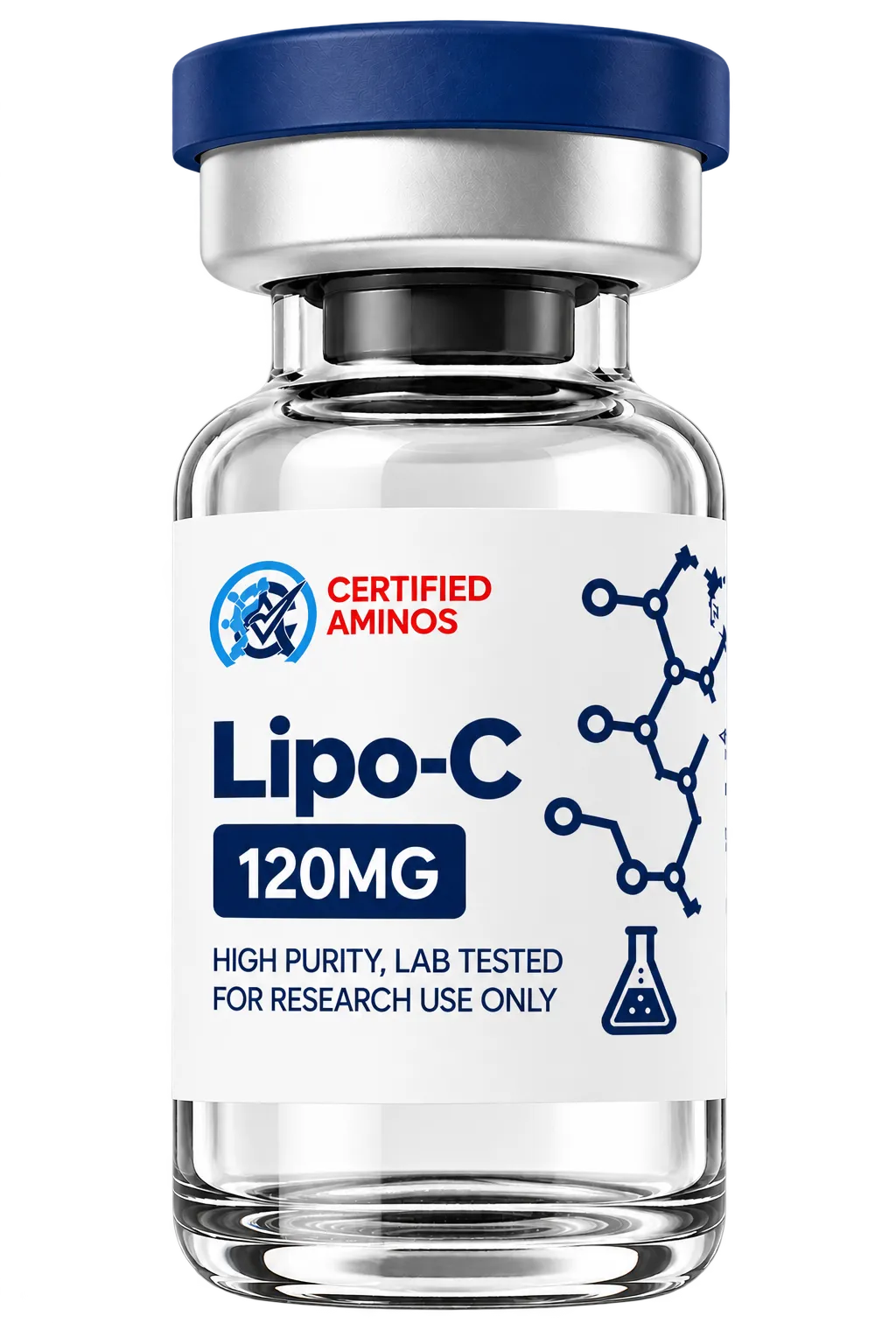
Certified Aminos' own listing is a lipotropic compound blend supplied in a 120mg total quantity, intended strictly for laboratory research. As of this writing, the listing does not publish an ingredient-by-ingredient breakdown, and its own product page and FAQ say so directly — the composition should not be assumed to match any particular combination sold under a similar name by other suppliers or compounding pharmacies. That's the single most important fact to carry into everything that follows: the biochemistry discussed below describes compounds commonly associated with the Lipo-C/MIC category in general, not confirmed contents of this specific vial.
Is Lipo-C a Peptide?
No — at least not in the way the term is typically used for this product category. Classic Lipo-C/MIC formulations are combinations of small-molecule nutrients and a sulfur-containing amino acid (methionine), not chains of amino acids linked by peptide bonds. That distinguishes them, as a category, from the peptide research compounds (growth-hormone secretagogues, GLP-1 analogues, and similar) that are also sold under RUO listings. Because this specific product's ingredient list isn't published, its exact composition can't be confirmed component by component — but nothing in the "lipotropic blend" category description suggests a peptide-based formulation.
Why Do Lipo-C Formulations Vary? Lipo-C vs. MIC vs. Lipo-B
There's no FDA-standardized "Lipo-C formula." Historically, compounding pharmacies have mixed their own versions, and different clinics market overlapping names — MIC, Lipo-B, and Lipo-C — for blends that are related in concept but not identical in practice. A reader researching this space runs into all three names interchangeably, which is exactly why composition should never be assumed from a label.
Two practical implications follow directly from this: first, a reader cannot treat "Lipo-C" and "MIC" as strictly interchangeable without checking the specific supplier's documentation. Second, for Certified Aminos' own listing — where the ingredient breakdown isn't published at all — none of the ingredient assumptions commonly made about MIC-type products (methionine, inositol, choline, with or without B12) can be confirmed one way or the other from the product page alone.
What Ingredients Are in Lipo-C?
Certified Aminos' LIPO-C listing does not currently publish an ingredient-by-ingredient breakdown. The subsections below describe compounds commonly discussed in connection with the Lipo-C/MIC product category in general — they are not a confirmed ingredient list for this specific listing, and none should be assumed present without a supplier-issued formulation sheet.
L-Carnitine and the Carnitine Shuttle
L-carnitine is a small molecule required to ferry long-chain fatty acids across the inner mitochondrial membrane, where they're broken down for energy — a process known as the carnitine shuttle. According to a peer-reviewed review in Biochimica et Biophysica Acta, carnitine is accumulated by cells and retained by the kidneys via a dedicated transporter, and the body can both synthesize it and obtain it from the diet (Longo et al., 2016, PMID 26828774). That's an account of normal human fatty-acid transport physiology — it is not evidence that any particular supplement or research blend containing carnitine changes body fat.
Methionine and One-Carbon (Methyl-Group) Metabolism
Methionine is a sulfur-containing amino acid converted to cysteine via the transsulfuration pathway, with homocysteine as an intermediate; this route also produces S-adenosylmethionine (SAM), a key metabolite used throughout the body for methylation reactions, as described in a peer-reviewed human biochemistry review (Pajares & Pérez-Sala, 2018, PMID 29186975). This is a basic biochemical role methionine plays in human cells generally — it is not, on its own, evidence of a weight- or liver-related clinical effect from a finished product.
Choline and Phospholipid/Lipid-Export Biology
Choline is an essential nutrient the body uses as a source of methyl groups for metabolic reactions and to build phosphatidylcholine, a phospholipid that helps move lipids out of the liver; a choline deficiency can allow fat to accumulate there, according to the National Institutes of Health's Office of Dietary Supplements (NIH ODS, Choline — Health Professional Fact Sheet). This is normal human lipid-handling physiology, described for the nutrient choline in general — it is not evidence that any specific choline-containing research blend causes fat loss.
Myo-Inositol and Phosphoinositide Signaling
Inositol-based phospholipids (phosphoinositides) are signaling lipids that regulate numerous cellular processes by binding specific proteins and influencing their location and activity, a role reviewed in Biochimica et Biophysica Acta Molecular and Cell Biology of Lipids (Collier et al., 2026, PMID 41580111). This is fundamental cell-signaling biology; it says nothing about a finished product's effect on weight, appetite, or liver fat.
Vitamin B12
Some commercial Lipo-C/MIC-type products include a form of vitamin B12, and public explainer pages describe this as common practice in the category — but B12 is not confirmed in Certified Aminos' own listing. It should not be assumed present without the supplier's documentation.
Taken together, these four or five compounds are studied, individually, as participants in lipid transport, methyl-group metabolism, and membrane-lipid synthesis, in each case citing a human-relevant or directly on-topic peer-reviewed or government source. None of that establishes that a combined blend — let alone this specific, ingredient-undisclosed listing — produces any particular outcome. Evidence about one ingredient, studied alone, cannot simply be transferred to a mixture.
How Do Lipotropic Compounds Relate to Metabolism?
The term "lipotropic" describes agents that support the export of fat from the liver and participate in methyl-group cycling, the same roles described for choline above. These are normal physiological processes that run continuously in every person's liver, with or without a supplement. Describing a compound as lipotropic is a statement about its biochemical role, not a claim that taking more of it produces a clinical benefit in humans.
What Does Scientific Research Actually Show?
The published evidence splits cleanly into two tiers, and conflating them is the single most common error in how this category gets discussed online. This is the same evidence-tier distinction covered in more depth in Do Peptides Actually Work? — mechanism, animal data, and controlled human trials answer different questions, and that discipline applies just as much to a lipotropic blend as it does to a peptide.
Tier 1 — individual-compound biochemistry is well established, as summarized in the ingredient sections above: carnitine's role in fatty-acid transport, methionine's role in methyl-group metabolism, choline's role in phospholipid synthesis and lipid export, and inositol's role in cell signaling are all documented in peer-reviewed or government sources.
Tier 2 — finished-blend clinical evidence is essentially absent. We did not identify a controlled human trial establishing weight-loss efficacy for a finished MIC/Lipo-C combination in the PubMed literature searched for this article (search conducted Oct 24, 2026, limited to PubMed-indexed records). That is a statement about this search, not a claim that no such research exists anywhere or will ever exist. Independent consumer health-information resources reviewing this product category report a similar gap when summarizing the literature. A literature gap means the specific claim ("this blend causes weight loss") currently has no controlled human evidence behind it in what we searched — not that the claim has been disproven.
Lipo-C and Weight-Loss Claims: What Can the Evidence Support?
Marketing claims about lipotropic injections — that they burn fat, boost energy, curb appetite, or "detoxify" the liver — extend Tier 1 biochemistry into Tier 2 territory without the evidence to support the jump. The biochemical roles described above are normal physiology, present in everyone regardless of whether they take a lipotropic product; they are not, by themselves, evidence that adding more of these compounds through an injection changes weight, appetite, or liver fat in a meaningful way. Where people combined with a Lipo-C or MIC injection program do lose weight, the far better-supported explanation is the calorie-restricted diet and exercise plan the injections are typically bundled with, not the injection itself. This article makes no weight-loss, fat-burning, energy, or detoxification claim about Lipo-C, and none should be inferred from the biochemistry discussion above.
Lipo-C Research Material vs. Compounded Lipo-C Injections
The two categories are not interchangeable, and composition, dosing, or safety information from one should never be assumed to apply to the other — a point Certified Aminos' own product FAQ already makes directly. Not every compounded preparation carries identical legal or prescription status; regulatory treatment depends on the specific preparation and the rules of the jurisdiction and pharmacy involved.
Why Ingredient Transparency and a Certificate of Analysis Matter
A proper certificate of analysis (COA) identifies the specific batch tested, states the analytical method used, and reports the measured results for that exact batch — ideally confirmed by more than one method (for example, HPLC for purity alongside mass spectrometry for identity). A COA on its own does not establish safety or efficacy; it establishes what was measured, in which batch, by which method. Our 12 Peptide Red Flags guide covers the full verification checklist for reading any supplier's COA claims.
It's worth separating several things that get blurred together in marketing copy: ingredient identity (is the labeled compound actually present), per-component quantity (how much of each), purity (what percentage of the sample is the intended compound versus contaminants or byproducts), and batch traceability (does the documentation match the lot number on the vial in hand). An HPLC purity percentage alone does not establish the identity of every ingredient in a mixture, and a generic supplier statement does not automatically establish the properties of any one specific batch.
As of this review (re-checked Oct 24, 2026), Certified Aminos' certificates page shows zero batches verified sitewide, and no batch-specific COA is currently linked for the LIPO-C listing. Any purity, identity, or "COA" badge shown elsewhere on the listing should be treated as a supplier claim rather than an independently confirmed result until batch-specific documentation is published and matched to an actual lot number — which is exactly what the product's own listing already advises.
What Information Should Researchers Verify Before Evaluating a Lipotropic Blend?
- A complete ingredient list with per-component quantities, not just a total milligram figure
- A batch-specific COA matched to the lot number on the vial received
- The analytical method(s) used (e.g., HPLC, mass spectrometry) and what each one actually confirms
- Storage and handling documentation appropriate to the listed ingredients
- Published literature on the specific combination being evaluated, not just its individual components
- Clear confirmation of RUO status and intended use from the supplier
This checklist is for evaluating documentation only — it is not preparation, reconstitution, dosing, or administration guidance, none of which is appropriate for an RUO research listing.
Research Limitations and Important Unknowns
A plausible biochemical mechanism, a finding in an animal or cell-culture model, and a demonstrated outcome in human trials are three different levels of evidence, and this article has tried to keep them separate throughout. For Certified Aminos' specific LIPO-C listing, the open questions are straightforward: what ingredients it actually contains, in what amounts, and whether that exact combination has ever been studied as a unit. None of those questions can be answered from the current listing, and none should be guessed at.
Understanding the Certified Aminos LIPO-C Listing
Verifiable facts only, re-checked Oct 24, 2026:
- Product name: LIPO-C
- Listed category: "GLP-1 & Metabolic" on the live storefront; this is a merchandising category, not a confirmed mechanism — a lipotropic blend is not the same thing as a GLP-1 receptor agonist
- Total quantity: 120mg per vial
- Ingredient-by-ingredient composition: Not currently published
- Intended use: Laboratory research only (RUO)
- Batch-specific COA: Not currently linked
For current pricing, stock status, and the supplier's own FAQ on this listing, see the Certified Aminos LIPO-C research listing directly.
Conclusion
"Lipo-C" names a category, not a single compound — and for Certified Aminos' own 120mg listing, the ingredient-by-ingredient composition is not yet published. The underlying lipotropic ingredients commonly associated with this category (carnitine, methionine, choline, inositol) have real, documented roles in lipid transport and methyl-group metabolism, but that ingredient-level science does not establish what a finished, undisclosed blend does, and no controlled trial identified in our search demonstrates that a MIC/Lipo-C injection causes weight loss on its own. Anyone evaluating this listing for research purposes should look for a published formulation sheet and a batch-matched certificate of analysis before drawing conclusions about identity or purity. The current Certified Aminos LIPO-C research listing is the place to check for updates to that documentation.