Biochemically, L-carnitine's job is specific: it shuttles long-chain fatty acids across the inner mitochondrial membrane so they can be used for energy. That mechanism is real and well documented. It does not, on its own, prove that adding more carnitine to a system that already has enough of it produces more fat loss, more energy, or better performance. This guide walks through the mechanism, what human trials on weight and exercise outcomes actually show, how L-carnitine differs from related compounds like acetyl-L-carnitine, and why the Certified Aminos L-Carnitine listing discussed near the end is strictly a Research Use Only (RUO) material — not a medicine or a supplement.
What Is L-Carnitine?
L-carnitine — also called levocarnitine — is a small, naturally occurring compound the body makes from the amino acids lysine and methionine. It's also present in food, mainly from animal sources. The NIH Office of Dietary Supplements notes that healthy people generally produce enough carnitine on their own, which is why it's considered conditionally essential rather than a nutrient most people need to supplement.
It's worth stating plainly: L-carnitine is not a peptide. Peptides are chains of amino acids joined by peptide bonds; L-carnitine is a single small-molecule metabolite with no peptide backbone at all. When a retailer lists it under a peptide category or works the word "peptide" into a product title, that's a catalog convention — not a change in the compound's chemistry.
"L-carnitine" and "levocarnitine" are the same L-enantiomer, the form the body actually uses. That's distinct from D-carnitine, which behaves differently and isn't the subject of the research discussed here.
How Does the Carnitine Shuttle Work?
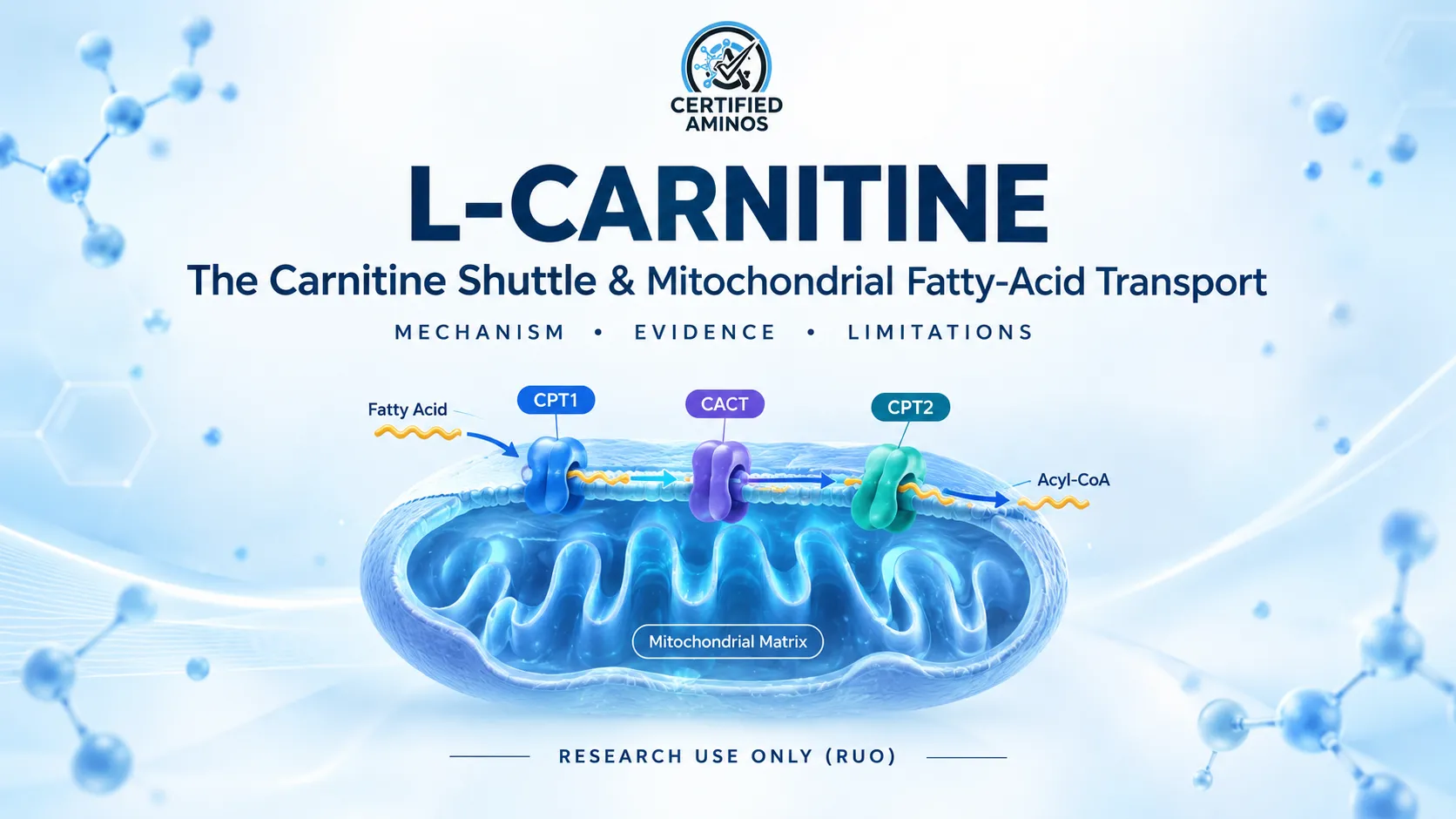
Long-chain fatty acids can't cross the inner mitochondrial membrane unassisted. The carnitine shuttle solves that problem through a three-enzyme relay, described in detail in McGarry and Brown's classic review of the mitochondrial carnitine-palmitoyltransferase system. Carnitine palmitoyltransferase 1 (CPT1) attaches carnitine to a long-chain fatty acyl-CoA, forming acylcarnitine. A carnitine-acylcarnitine translocase (CACT) then shuttles that acylcarnitine across the inner membrane in exchange for free carnitine moving the other way. Once inside the matrix, carnitine palmitoyltransferase 2 (CPT2) removes the carnitine, regenerating acyl-CoA so beta-oxidation can proceed — freeing the carnitine to be reused.
CPT1 is also the pathway's rate-limiting, regulated step: it's sensitive to malonyl-CoA, a signal that fatty-acid synthesis is already underway, which is one reason fat oxidation and fat synthesis don't run at full speed in the same cell at the same time.
This mechanism is exactly why L-carnitine is biochemically interesting — and exactly where marketing claims tend to overreach. Having an intact, efficient shuttle is necessary for fatty-acid oxidation. It doesn't mean that adding extra carnitine on top of an already-sufficient supply makes a healthy person burn fat faster.
What Is the Difference Between L-Carnitine and Acetyl-L-Carnitine?
Acetyl-L-carnitine (ALCAR) is the acetylated ester of L-carnitine — related, but not the same molecule, and not interchangeable in the research literature. ALCAR crosses the blood-brain barrier more readily than free L-carnitine and has built its own separate body of research, mostly around mood and neurological outcomes rather than weight or exercise. A 2018 meta-analysis in *Psychosomatic Medicine* pooled twelve randomized trials and found that ALCAR reduced depressive symptoms, with effects comparable to established antidepressants in head-to-head comparisons — a finding specific to ALCAR, not something that extends to plain L-carnitine or to any weight-related claim.
Because the two compounds are pharmacologically distinct, evidence generated in an ALCAR trial shouldn't be cited for L-carnitine products, and vice versa. Check which exact compound a study actually administered before treating its results as relevant to a different one.
How Does L-Carnitine Differ From L-Carnitine Tartrate and Other Forms?
Several "carnitine" products sold commercially aren't plain L-carnitine. L-carnitine L-tartrate (LCLT) pairs L-carnitine with L-tartaric acid in a salt form that's common in sports-nutrition research because of its solubility and dosing characteristics. Propionyl-L-carnitine (PLC) is a different ester, studied mainly in peripheral vascular research. Each form has its own absorption profile and its own separate clinical trial literature.
This matters directly for a research listing: a product sold simply as "L-Carnitine" shouldn't be assumed to be a tartrate or other salt form unless the manufacturer's own documentation explicitly says so. Applying a tartrate-specific or ester-specific finding to a free-base listing — or the reverse — is a common and avoidable error in secondary summaries of the literature.
What Does Research Say About L-Carnitine and Fat Metabolism?
The rationale for studying L-carnitine's role in fat metabolism is straightforward: because the carnitine shuttle is required for long-chain fatty-acid transport into mitochondria, researchers have asked whether increasing carnitine availability could increase the rate of fat oxidation, particularly in people whose muscle carnitine stores might be comparatively low.
The evidence splits into two layers that are easy to conflate. The mechanistic layer — that carnitine participates in fatty-acid transport — is well established. The outcome layer — whether raising circulating or muscle carnitine actually increases whole-body fat oxidation or reduces fat mass in healthy, carnitine-sufficient adults — is a separate empirical question, and the results have been considerably more modest and inconsistent than the mechanism alone would suggest. Carnitine transport into skeletal muscle is itself tightly regulated and saturable, which is one proposed explanation for why supplementation doesn't reliably translate mechanism into a large physiological effect in people who aren't carnitine-deficient.
Does L-Carnitine Cause Weight Loss or Fat Loss?
Several systematic reviews have pooled randomized trials on this question, and the pattern is consistent in direction but modest in size. A 2016 meta-analysis in *Obesity Reviews* pooling nine randomized trials (911 participants) found that people taking carnitine lost about 1.33 kg more on average than control groups — with the effect shrinking the longer the trial ran. A larger 2020 meta-analysis in *Clinical Nutrition ESPEN*, covering 37 trials and 2,292 participants, found a similar average reduction in body weight (about 1.21 kg) and fat mass (about 2.08 kg), but no significant effect on waist circumference or body-fat percentage; restricting the analysis to the highest-quality trials still confirmed the body-weight effect while leaving the other outcomes uncertain.
Read together, these reviews support a modest, measurable average effect in supplementation trials. They don't support calling L-carnitine a guaranteed fat burner, a weight-loss solution, or a predictable body-composition intervention for any one person. Most of these trials also enrolled people with overweight, obesity, or type 2 diabetes — the findings shouldn't be stretched to healthy, carnitine-sufficient adults using an RUO research material without that caveat.
What Does Research Say About Exercise Performance and Recovery?
The exercise literature is genuinely mixed, and which way it leans depends on intensity, dosing protocol, and the carnitine form used. A 2021 systematic review in *Nutrients*, which separated moderate- from high-intensity exercise, found that oral L-carnitine or glycine-propionyl-L-carnitine — at doses of roughly 3 to 4 g taken 60 to 90 minutes before testing, or 2 to 2.7 g per day for 9 to 24 weeks — was linked to improvements in several high-intensity measures: lower perceived exertion, higher peak power on Wingate tests, and greater work capacity in some protocols. The same review found no significant improvement for moderate-intensity performance, whether dosing was acute or chronic.
Separately, research on propionyl-L-carnitine and walking distance in peripheral arterial disease gets cited alongside general "carnitine and performance" discussions, but it studies a different population (people with diagnosed vascular disease), a different carnitine form, and a clinical walking-distance endpoint — not athletic performance in healthy exercisers.
Taken together, the human evidence doesn't support promising more stamina, faster recovery, or better athletic performance as an established outcome. At most, it supports a research question that some trials have found positive signals for under specific high-intensity protocols, and others haven't replicated.
What Is Known About L-Carnitine, Energy Metabolism, and Mitochondrial Function?
L-carnitine's biochemical role in mitochondrial fatty-acid transport isn't in dispute — it's a textbook pathway. What isn't established is that adding carnitine beyond what a well-nourished person already has translates into noticeably more usable cellular energy, less subjective fatigue, or a measurable clinical benefit. The muscle carnitine transport system is saturable, and most of the trials discussed above measured exercise-specific endpoints — power output, perceived exertion — rather than generalized "energy levels," which are difficult to quantify objectively. A normal biochemical role in a well-characterized pathway is a reason a mechanism is worth studying. On its own, it isn't evidence that additional material produces an additional benefit in people who aren't deficient.
What Safety Questions and Research Limitations Have Been Reported?
The NIH Office of Dietary Supplements lists gastrointestinal effects — nausea, vomiting, abdominal cramps, diarrhea — and a fishy body odor as the most commonly reported side effects, generally at doses around 3 g per day and up. It also notes that carnitine can worsen muscle weakness in people with uremia and may trigger seizures in people with a seizure disorder, and that several anticonvulsants (valproic acid, phenobarbital, phenytoin, carbamazepine) reduce blood carnitine levels — valproic acid carrying its own separate hepatotoxicity and hyperammonemia risks. No tolerable upper intake level has been established for carnitine.
A more debated question involves gut bacteria. A widely cited 2013 study in *Nature Medicine* by Koeth and colleagues found that intestinal microbes metabolize dietary L-carnitine into trimethylamine-N-oxide (TMAO), a compound described as proatherogenic, and that plasma carnitine levels predicted cardiovascular risk only in people who also had high TMAO — an association, not a controlled trial proving carnitine causes heart disease on its own. The NIH fact sheet notes that a later trial in people with metabolic syndrome found higher cholesterol and more carotid plaque in some participants taking L-carnitine, while separate meta-analyses in acute heart-attack and heart-failure populations have reported improved markers like reduced mortality or better ejection fraction — a genuinely mixed picture the NIH itself describes as "not well understood."
None of this is a substitute for personal medical advice, a diagnosis, or an individualized treatment recommendation, and none of it applies to the handling or use of a laboratory research material.
What Is the Difference Between Medical Levocarnitine and an RUO Research Compound?
Levocarnitine is also the active ingredient in FDA-approved prescription products — for example, CARNITOR, labeled for primary and secondary carnitine deficiency, a specific diagnosed metabolic condition confirmed through clinical evaluation, not a general wellness or weight-management use. That approval, the manufacturing controls behind it, and the associated clinical dosing guidance are specific to those pharmaceutical products.
The Certified Aminos L-Carnitine listing is a separate, Research Use Only material. Its approval status, manufacturing process, and quality documentation aren't the same as an FDA-approved medicine's, and the existence of an approved levocarnitine drug elsewhere doesn't mean this RUO listing is approved, proven safe, or suitable for any clinical or human-consumption purpose.
How Should Researchers Evaluate L-Carnitine Identity, Purity, and COA Documentation?
A batch-specific Certificate of Analysis (COA) documents the identity and purity of one particular manufactured lot — typically via HPLC and mass spectrometry — and it's only meaningful when its lot number matches the material in hand. A COA for a different batch doesn't establish anything about the material actually received.
As reviewed on October 28, 2026, the Certified Aminos L-Carnitine product page states that purity is not independently verified, identity has not been independently confirmed by mass spectrometry or an equivalent method, and no public batch-specific COA is currently published — even though the page separately references a ≥99% HPLC purity figure with third-party verification as the site's own existing claim, not one re-confirmed against a batch-specific COA for this exact SKU. The site's certificates page also shows zero verified batches sitewide as of this writing, despite describing a third-party testing process. Treat the advertised purity and testing language as an unverified supplier claim rather than an established fact until batch-matched documentation is published, and remember that a COA — when one exists — documents identity and purity for that lot specifically, not human safety, clinical effectiveness, or suitability for any particular research application.
What Should Readers Understand Before Interpreting L-Carnitine Research?
Four distinctions recur throughout the L-carnitine literature and are worth holding onto when reading any individual study or summary:
- Mechanism versus outcome. An established transport pathway is not the same as a proven downstream effect.
- Research model versus clinical population. Trial results in people with obesity, diabetes, or vascular disease don't automatically generalize to healthy adults, and vice versa.
- Compound identity versus related formulations. L-carnitine, acetyl-L-carnitine, and L-carnitine L-tartrate are chemically distinct and should be evaluated on their own separate evidence bases.
- Scientific interest versus established application. A compound can be a legitimate, active research subject without any single study establishing it as an effective intervention for a specific outcome.
Conclusion
The research record on L-carnitine is substantial at the mechanism level: the carnitine shuttle is a textbook pathway, and L-carnitine's role in it is well characterized. The record is considerably thinner at the outcome level. Meta-analyses report a modest average weight-loss effect across trial populations, not a reliable fat-burning outcome for any one person. Exercise-performance evidence is mixed and protocol-dependent. And L-carnitine, acetyl-L-carnitine, and L-carnitine L-tartrate are chemically distinct compounds that shouldn't be treated as interchangeable evidence for each other.
None of that makes L-carnitine scientifically uninteresting — it's a legitimate, active research subject. It does mean that a laboratory listing like the one Certified Aminos carries is best read as raw material for further controlled study, not as a finished conclusion about what the compound does for weight, energy, or performance in any particular context. And until a batch-specific COA is published for this listing, any purity or identity figure attached to it should be treated as a supplier claim, not an independently verified fact.