NAD+ is a four-letter abbreviation, not a brand — nicotinamide adenine dinucleotide, a coenzyme present in every living cell. This piece covers what it is, how it functions in redox biology and energy metabolism, why researchers study it, what the current evidence actually shows (and doesn't), and how to evaluate a research-grade NAD+ compound — including the one Certified Aminos sells.
What Is NAD+?
Nicotinamide adenine dinucleotide — NAD+ for short — is a small molecule present in every living cell. Chemically, it's a coenzyme: a non-protein helper that enzymes rely on to move electrons from one reaction to another. NAD+ specifically refers to the oxidized state of this molecule; its counterpart, NADH, is the reduced state after it has picked up electrons (Xiao et al., Antioxidants & Redox Signaling, 2018, DOI).
Because electron transfer underlies so much of basic metabolism, NAD+ shows up across an unusually wide swath of biology — energy production, DNA-repair signaling, cellular stress responses. That breadth is also why the molecule gets flattened into vague marketing language. Worth saying plainly: NAD+ is a research compound and a basic biological entity, not a treatment, and no serious reading of the literature describes it as a cure for anything.
What Does NAD+ Do in Cells?
NAD+ does two distinct jobs. First, redox chemistry: it accepts electrons during the breakdown of nutrients and becomes NADH, which hands those electrons to the mitochondrial electron transport chain, where most of a cell's ATP gets made. Second, NAD+ is consumed outright — not just passed back and forth — by a separate group of enzymes, including sirtuins and poly(ADP-ribose) polymerases (PARPs), which use it as a substrate for DNA repair and chromatin regulation (Verdin, Science, 2015, DOI).
That second role explains why NAD+ supply, not just NAD+ presence, matters to researchers: enzymes that consume it can draw down the available pool independent of how much is cycling through energy metabolism at any given moment.
NAD+ vs NADH
NAD+ and NADH are the same coenzyme in two chemical states — not two separate compounds. NAD+ is the electron-poor, oxidized form; NADH is the electron-rich, reduced form, carrying the electrons picked up during catabolism. The balance between the two, the NAD+/NADH ratio, is itself a research variable: it shifts under oxidative stress, hypoxia, and in several metabolic disease models, and tracking it tells researchers something about a cell's redox state that measuring either molecule alone wouldn't (Xiao et al., 2018, DOI). When an article or a vendor says ‘NAD+ research compound,’ it should mean specifically the oxidized form — not NAD generically, and not NADH.
NAD+ and Cellular Energy Metabolism
NAD+'s clearest, best-supported role sits in energy metabolism: glycolysis and the mitochondrial pathways that convert glucose and fat into ATP. It's worth being precise here, because ‘NAD+ boosts energy’ is a common but imprecise shorthand. NAD+ isn't consumed as fuel — glucose and fatty acids are the fuel. NAD+ is the reusable shuttle that keeps those fuel-burning reactions moving, regenerated continuously through biosynthesis and salvage pathways rather than depleted with use the way fuel is (Covarrubias et al., Nature Reviews Molecular Cell Biology, 2021, DOI).
NAD+ and Redox Biology
Redox biology is really the throughline connecting everything above. ‘Redox’ — reduction and oxidation — describes any reaction where electrons move from one molecule to another, and NAD+/NADH is one of the cell's primary redox couples, alongside NADP+/NADPH. Researchers studying oxidative stress, mitochondrial dysfunction, or metabolic disease frequently track NAD+-related redox markers because they reflect how well a cell is managing electron flow under strain (Xiao et al., 2018, DOI).
Why Researchers Study NAD+
NAD+ and Aging Research
Tissue and cellular NAD+ levels decline with age in rodents and, in more limited data, in humans — one of the more consistently replicated findings in this field (Covarrubias et al., 2021, DOI). A 2020 study traced part of that decline to a specific mechanism: senescent cells promote the activity of NAD+-consuming CD38+ macrophages in aging tissue (Covarrubias et al., Nature Metabolism, 2020, DOI).
What this doesn't establish is the more popular claim — that restoring NAD+ reverses or meaningfully slows aging in people. The correlation between age and declining NAD+ is well documented; the human-outcome question is still open (Verdin, 2015, DOI).
NAD+ and Mitochondrial Research
Because NAD+/NADH cycling is so tightly coupled to mitochondrial function, NAD+ depletion appears repeatedly in frameworks describing the broader ‘hallmarks of aging’ — alongside senescence, genomic instability, and loss of proteostasis — as one of several interconnected mechanisms under active study (Sanada et al., Frontiers in Cardiovascular Medicine, 2025, DOI).
NAD+ and Cellular Signaling
Beyond energy production, NAD+ functions as a signaling substrate. Sirtuins and PARPs don't just happen to use NAD+ — their activity is directly gated by how much of it is available, which links cellular NAD+ status to processes like chromatin remodeling, inflammatory signaling, and the cell's response to DNA damage (Verdin, 2015, DOI). This is a separate line of research from the energy-metabolism story, and the two are often conflated in summaries that aren't reading the primary literature closely.
What Does Current NAD+ Research Show?
Cellular and Preclinical Evidence
The clearest causal data — NAD+ depletion worsening a specific injury model, restoration measurably improving it — comes from cell culture and animal studies (Verdin, 2015, DOI; Covarrubias et al., 2020, DOI). This is where NAD+ biology has been most rigorously tested, and where researchers have the most mechanistic confidence.
Human Evidence
Human data is thinner, and mostly concerns NAD+ precursors — nicotinamide mononucleotide (NMN) and nicotinamide/niacinamide — rather than NAD+ itself. A 2023 review of human NMN trials found a growing but still early body of safety and pharmacokinetic data, with most antiaging-specific claims unconfirmed in humans so far (Song et al., Advances in Nutrition, 2023, DOI). Separately, a randomized crossover trial of oral nicotinamide in glaucoma patients measured improved retinal electrophysiology over 12 weeks — a specific finding in a specific patient population, not a general NAD+ claim (Hui et al., Clinical & Experimental Ophthalmology, 2020, DOI).
What Remains Uncertain
Several questions are genuinely unresolved: how reliably different delivery routes raise NAD+ levels in human tissue, whether biomarker changes translate into functional benefits, and what sustained supplementation looks like over the long term rather than a short trial window. None of this is settled science yet, and treating it as settled is where most consumer-facing NAD+ content goes wrong (Song et al., 2023, DOI).
Intranasal NAD+ Research: What the Literature Actually Shows
Short answer: Intranasal NAD+ has been tested in rodent models of brain ischemia, where it raised brain NAD+ levels and reduced injury markers. That's animal-model evidence — it isn't a Certified Aminos product claim, and it hasn't been replicated in human trials.
Two studies anchor most of what's published here. Ying et al. (2007) delivered NAD+ intranasally in rats with transient focal cerebral ischemia and reported smaller infarcts and fewer neurological deficits than controls (DOI). A 2012 follow-up in mice found that NAD+ administration reduced ischemic brain damage, in part by limiting autophagy (DOI).
Both are legitimate, peer-reviewed rodent studies conducted under controlled lab conditions with direct measurement of brain NAD+ content. Neither supports claims about human nasal-spray use, at-home administration, or wellness outcomes of any kind. For a research buyer, the honest takeaway is narrow: intranasal delivery is a documented route of administration in experimental animal research — which is exactly why the term keeps surfacing in NAD+ search data — not a human-use finding, and not something Certified Aminos sells or claims.
Evaluating NAD+ Research Material
Purity
Purity, usually expressed as a percentage, reflects how much of a sample is the target compound versus residual impurities from synthesis. It's a meaningful number only when it's tied to a specific test and a specific batch — a purity claim with no supporting method or lot reference isn't verifiable.
HPLC
High-performance liquid chromatography (HPLC) is the standard method for confirming both identity and purity of a compound like NAD+. It separates a sample into its components and measures them against known references, which is how a lab can state a specific purity figure with confidence rather than estimate it.
COA
A Certificate of Analysis (COA) is the document that reports what a lab actually found when it ran that testing — identity, purity, sometimes additional parameters, for one specific batch. Certified Aminos states that its NAD+ research material is HPLC-verified at 99% or higher purity through independent third-party testing, and that the company is actively building out a public COA library by batch (see Certified Aminos' certificates page).
Batch Documentation
Because a COA applies to one batch, not a product line indefinitely, it's reasonable to ask whether the COA on hand actually matches the lot received, and whether a vendor tests every batch or only periodically. Certified Aminos' own documentation notes that its COA library is still being populated — a detail worth checking directly before treating batch-level documentation as complete.
Research Use Only: What RUO Means
Certified Aminos' NAD+ research material, like the rest of its catalog, is labeled Research Use Only (RUO). That means the product is intended for laboratory and research applications exclusively — it has not been evaluated or approved by the FDA for human consumption, clinical use, or veterinary application (see Certified Aminos' FAQ). RUO labeling isn't a formality; it reflects that research-grade compounds haven't been through the clinical trial process required of approved drugs, regardless of how extensively the underlying molecule has been studied in preclinical settings. Nothing in this article should be read as suggesting RUO NAD+ material is appropriate to dose or administer for personal health purposes.
Certified Aminos NAD+ Research Material
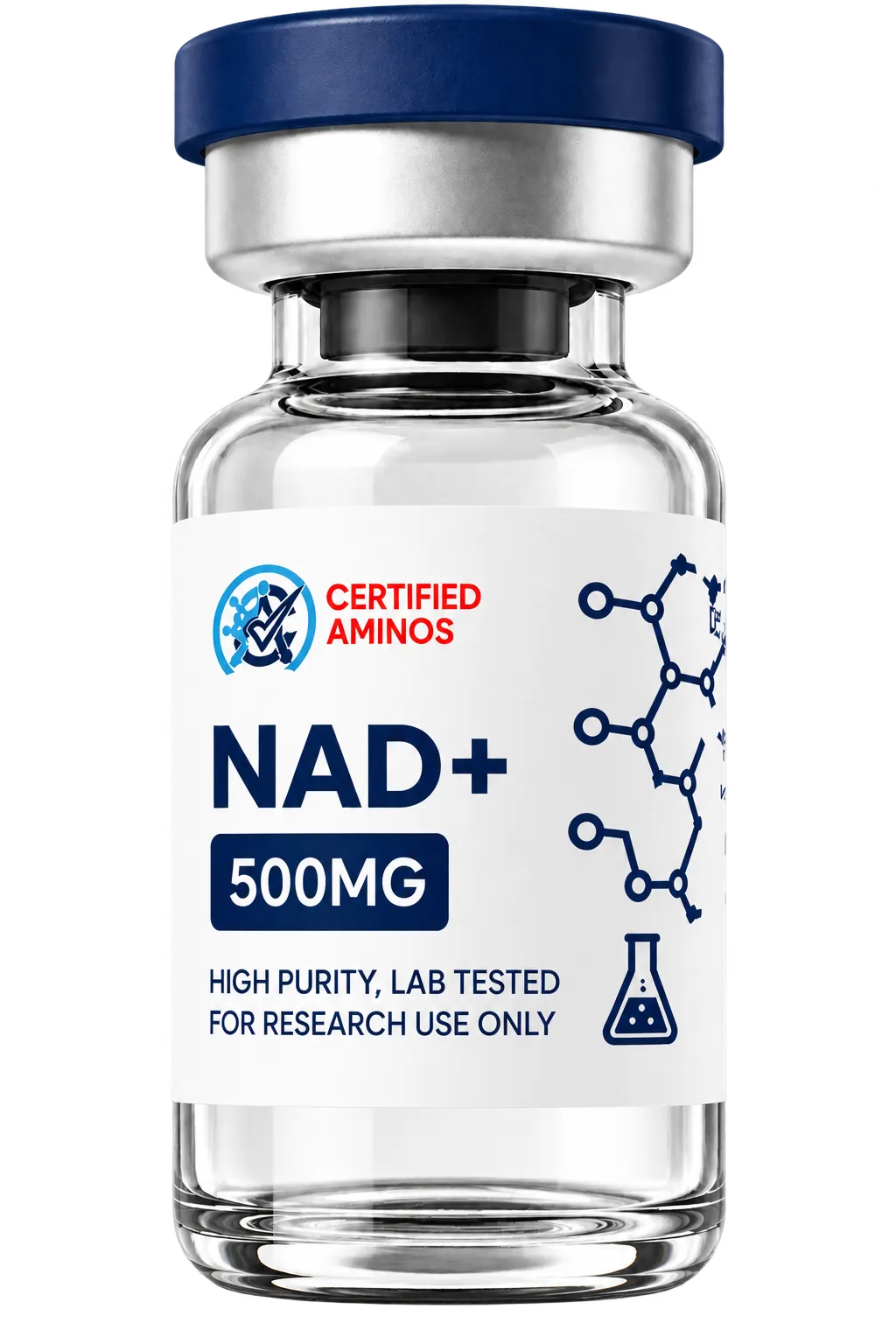
Certified Aminos sells NAD+ as a research-grade powder in two sizes, 500mg and 1000mg, independently HPLC-tested at 99%+ purity (see the product listing). It is not sold as a nasal spray, and no formulation, excipient, or delivery-device information beyond ‘powder’ is published on the product page — this article doesn't speculate about specifications the company hasn't disclosed. For researchers comparing vendors, the questions worth asking are the ones covered above: is there batch-specific, third-party COA documentation, is the testing method disclosed, and is RUO labeling explicit and consistent.
Conclusion
NAD+ earns its research attention honestly — it sits at a genuine intersection of energy metabolism, redox signaling, and aging biology. The evidence that holds up, though, is more specific and more conditional than most consumer summaries suggest: strong in cell and animal models, still developing in humans, and largely about precursor compounds rather than NAD+ itself when human trials do exist. For a research buyer, that distinction — and documentation that actually backs it up — matters more than any single headline claim.
For research use only. Not for human or veterinary use.