What Is MOTS-c Peptide? What the Research Actually Shows
Metabolic researchOctober 8, 202612 min read
MOTS-c interest is rising alongside a newly recruiting human trial — neither means it's proven. What the research shows, and where 2026 FDA status stands.
MOTS-c's cell and mouse mechanisms are real research findings, but they are not the same thing as a proven human benefit.
A Phase 2a human trial (NCT07505745) is recruiting, but with no posted results it confirms a question is being asked, not an answer to it.
MOTS-c is not FDA-approved. A 2026 advisory-committee vote recommending it for a compounding list is a separate, non-binding procedural step, not approval or a safety/efficacy verdict.
Search interest in MOTS-c has climbed alongside the rest of the mitochondrial-peptide category, and a registered human trial is now recruiting for it. Neither fact means the compound is proven to work or safe for human use — and that gap between rising interest and actual evidence is why this page exists.
Featured In This Article
RESEARCH PEPTIDE
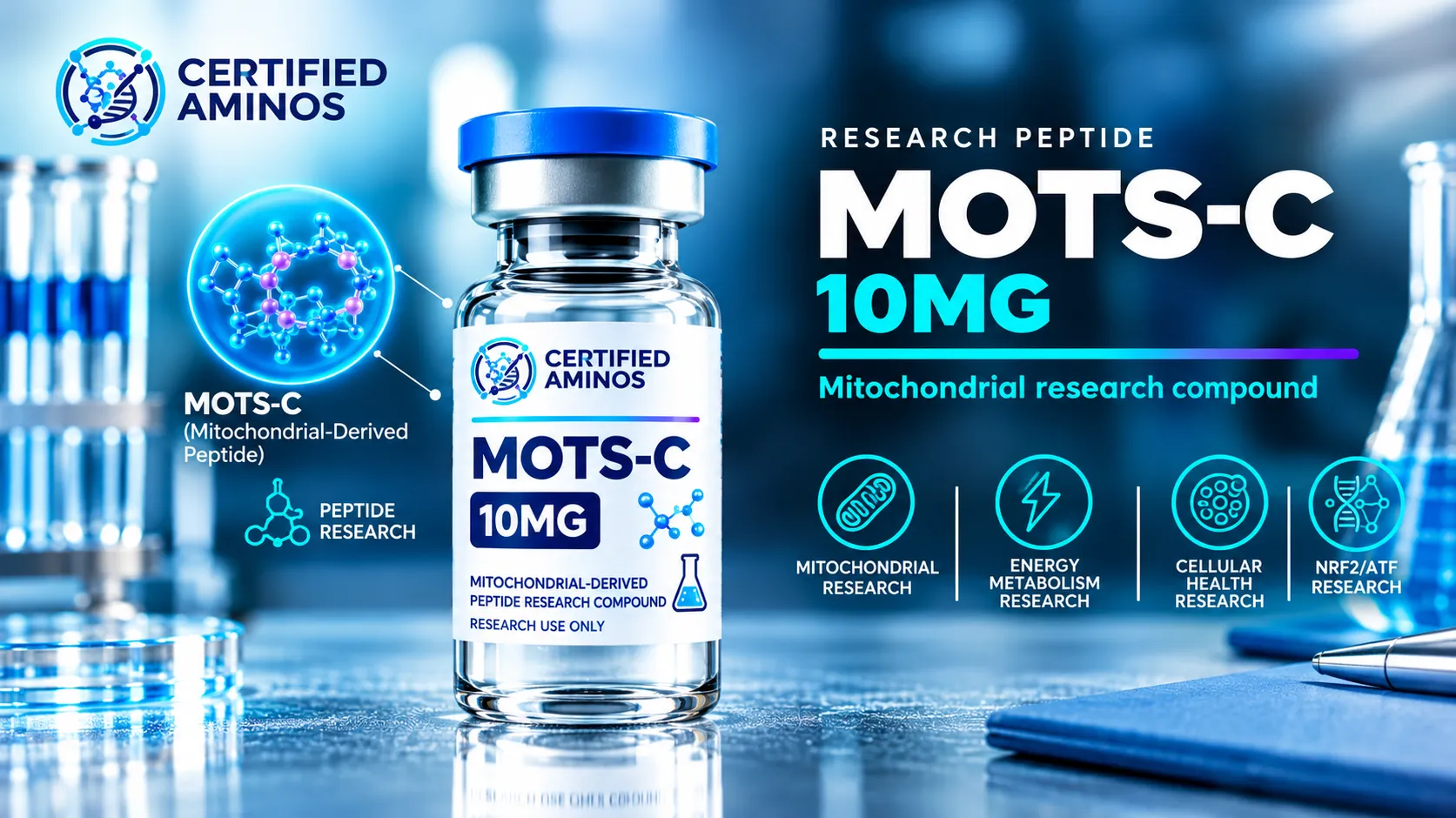
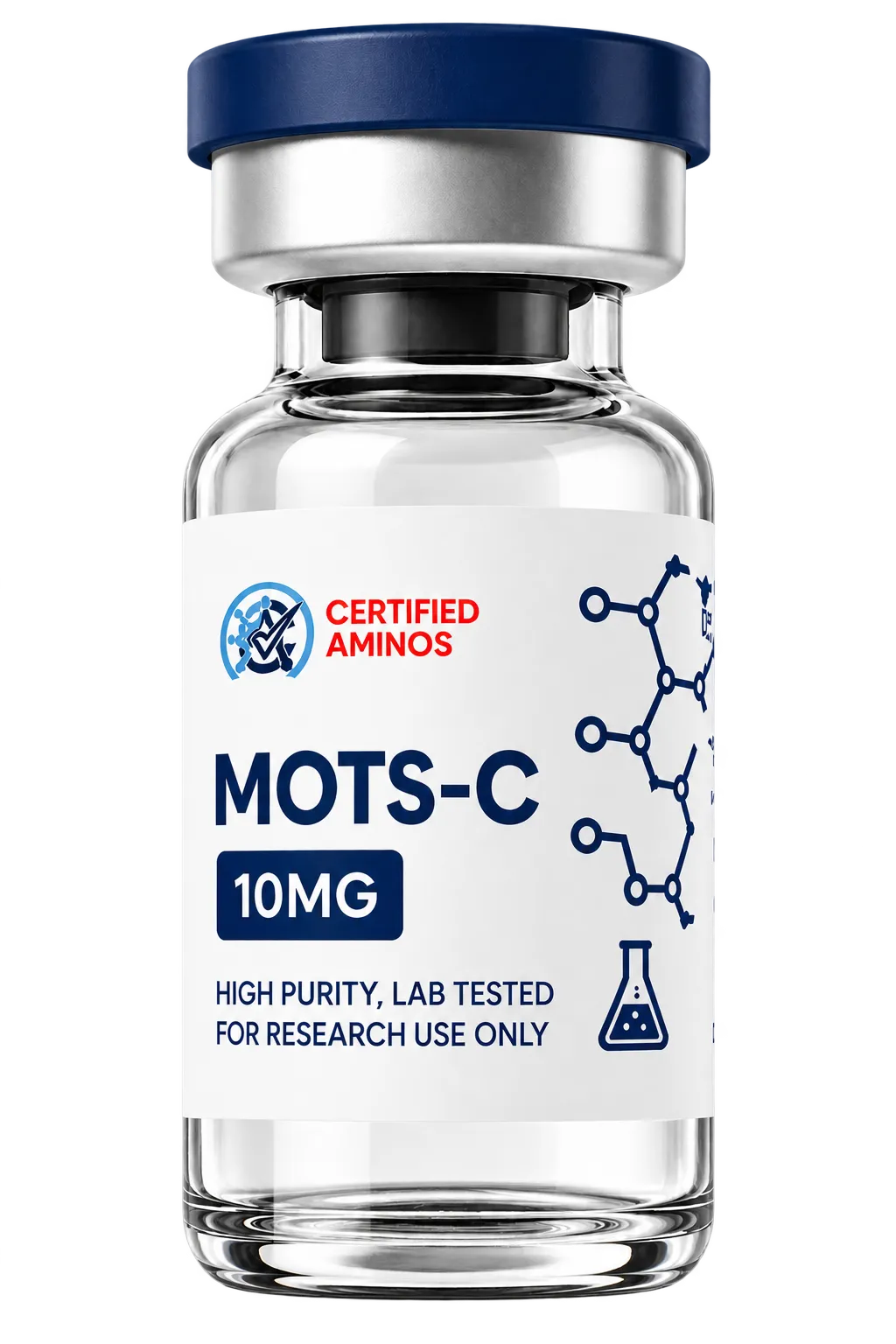
MOTS-c
Highly purified synthetic peptide prepared for rigorous laboratory research.
$59.00
MOTS-c is a mitochondrial-derived peptide studied for its connection to cellular energy metabolism and metabolic signaling. Almost everything written about it describes cell and mouse research. Almost nothing written about it is honest about how thin the human evidence still is, or clear about where things stand with FDA.
This page grades the evidence by what actually investigated it: cellular studies, animal studies, human observational biomarker studies, and the one registered human interventional trial currently underway. It also covers MOTS-c's 2026 regulatory status in plain terms, why no dosage chart is scientifically defensible yet, and what to check before sourcing a research-grade MOTS-c material.
What Is MOTS-c Peptide?
MOTS-c is a 16-amino-acid peptide encoded inside the mitochondrial genome, within a short open reading frame (sORF) of the 12S rRNA gene. It was identified and named in 2015 by a research team that showed it moves out of the mitochondria and influences cellular energy metabolism — the reason it's classified as a mitochondrial-derived peptide (MDP), a small but growing family that also includes humanin.
That classification matters for how you should read everything that follows. MOTS-c is not a drug with a treatment history. It's a research subject: a molecule whose biology is still being mapped, mostly in cells and mice, with human data only beginning to accumulate.
Where MOTS-c Comes From, and Why That's Unusual
Most peptides studied in research settings are nuclear-encoded — built from instructions in the cell's main genome. MOTS-c is different. Its sequence is encoded in mitochondrial DNA, inside the gene that normally codes for part of the mitochondrial ribosome (12S rRNA). Researchers found the sORF by searching mitochondrial DNA electronically and confirmed its mitochondrial origin by comparing it against expressed-sequence-tag databases.
The discovery paper — Lee et al., Cell Metabolism, 2015 — showed that under metabolic stress, MOTS-c leaves the mitochondria and affects processes elsewhere in the cell. That finding is the starting point for almost everything studied about MOTS-c since.
What Does MOTS-c Do? The Mechanism, in Plain Terms
Cellular and animal studies have investigated MOTS-c in relation to AMPK signaling, a pathway cells use to sense and respond to energy stress. These are molecular findings from experimental models, not evidence of a clinical effect in humans.
The Folate–AICAR–AMPK Pathway
In cell studies, MOTS-c has been linked to the folate and methionine cycle, raising levels of a molecule called AICAR, which in turn activates AMPK. When researchers blocked or reduced AMPK in these cell models, MOTS-c's effect on glycolysis (a core energy-production process) dropped by roughly 16–40%, depending on the experiment. That's cellular evidence of a mechanism — not proof of a human metabolic benefit.
Nuclear Translocation Under Metabolic Stress
A 2018 follow-up study (Kim, Son, Benayoun, Lee — Cell Metabolism) found that under metabolic stress, MOTS-c moves into the cell nucleus within about 30 minutes and returns to baseline levels within roughly 24 hours. In the nucleus, it's proposed to interact with stress-response regulators (NRF2 and ATF1/ATF7) at antioxidant-response gene sites. This translocation is AMPK-dependent and was also triggered by metformin and AICAR in the same cell models. Again: cellular evidence, describing a mechanism observed in a lab dish, not a treatment effect in a person.
MOTS-c and Metabolic Research: Glucose, Insulin, and Body Weight
The strongest metabolic findings for MOTS-c come from mouse studies, and every one of them needs that qualifier attached.
In high-fat-diet mice, MOTS-c administration produced modest reductions in body weight, food intake, and blood glucose, and prevented diet-induced obesity and the high-insulin state that typically comes with it. In aged mice, it restored insulin sensitivity to something closer to what's seen in young mice. In an ovariectomized-mouse model (used to study menopause-like metabolic changes), it reduced weight gain and fat accumulation.
None of this has been replicated as a treatment effect in a published human trial. It's animal-model evidence of a biological mechanism worth studying further — not a demonstrated human outcome.
MOTS-c and Exercise-Physiology Research
MOTS-c is sometimes marketed as an “exercise mimetic.” The research doesn't support that framing yet, at least not in humans.
In mice, exercise increases MOTS-c in skeletal muscle and plasma, with levels returning to baseline after a few hours of rest. Regular moderate running increased hypothalamic MOTS-c in mice, while a single run to exhaustion did not — suggesting the response depends on exercise pattern, not just intensity. A 2026 systematic review of exercise and mitochondrial-derived peptides (Ayubi et al., Physiological International, 9 studies screened from 2016–2025) found a trend toward higher MDP levels after exercise, but it explicitly flagged that the human evidence remains limited and inconsistent, and called for controlled clinical trials before drawing conclusions.
Separately, studies measuring plasma MOTS-c around exercise in healthy adults and in a cohort with PCOS did not find a significant, consistent change. “Exercise mimetic” is a hypothesis the mouse data supports; it is not an established human finding.
What Are the Potential MOTS-c Benefits? What's Actually Supported
Here's the honest version, graded by evidence level rather than bundled into a single “benefits” list:
Mitochondrial and metabolic signaling — supported by cellular mechanistic studies (AMPK activation, nuclear translocation). Evidence level: cellular.
Glucose regulation and insulin sensitivity — supported by multiple mouse studies across different metabolic-stress models. Evidence level: animal/preclinical.
Exercise-response signaling — supported in mouse skeletal muscle and hypothalamus; human exercise-response data is inconsistent. Evidence level: animal, with weak and mixed human-observational data.
Aging-related physical decline — aged mice treated with MOTS-c showed improved endurance and cardiovascular measures, with only a trend (not a clear effect) toward longer lifespan. Evidence level: animal.
No benefit on this list has been demonstrated in a completed human clinical trial. That's not a caveat to skim past — it's the single most important sentence on this page.
MOTS-c Side Effects and Safety Considerations
Because no completed human administration trial has published results, there's no established human side-effect profile for MOTS-c. That's different from saying it's known to be safe, and different from saying it's known to be risky — the honest answer is that it hasn't been characterized in controlled human research yet.
A registered trial (covered in detail below) is currently tracking treatment-emergent adverse events as a primary outcome. Until that data is published, any specific safety claim about MOTS-c in humans is unsupported. Research-grade material should only be handled in an appropriate laboratory research setting, with the analytical documentation to back up what's actually in the vial.
MOTS-c Dosage: Is There a Standard Dose or Dosage Chart?
No. There is no peer-reviewed, validated human dosage protocol for MOTS-c, and no legitimate “dosage chart” is derived from one. Here's why that gap exists, and why it can't be papered over:
Species differences matter. A dose that produces an effect in a 25-gram mouse doesn't scale to a human by simple arithmetic — metabolism, body composition, and physiology differ too much for a direct mg/kg conversion.
Route and formulation matter. How a compound is administered (and what it's formulated with) changes how much reaches circulation and how the body processes it. Mouse-study routes and research-vial formulations aren't interchangeable with an assumed human protocol.
Study design matters. The mouse studies behind MOTS-c's metabolic findings weren't designed to establish a human dose-response relationship — that's a different, much larger kind of study that hasn't been done yet for MOTS-c.
Dosage charts circulating online are typically back-calculated from mouse studies or from informal user reports — neither of which is a validated clinical source. This page won't reproduce one. Certified Aminos sells MOTS-c strictly as a Research Use Only material; it is not intended for human or animal consumption, administration, or treatment, and no dosing or administration instructions are provided.
MOTS-c Human Research: What Do We Actually Know?
This is the section most MOTS-c articles get wrong, usually by collapsing everything into “research shows.” Here's the evidence broken into the five levels that actually matter:
1. Cellular / in-vitro
AMPK pathway activation, nuclear translocation timing, and NRF2/ATF interaction, observed in cell and myotube models.
2. Animal / preclinical
Mouse studies on diet-induced obesity, aged-mouse insulin sensitivity, ovariectomized-mouse weight gain, exercise-induced MOTS-c changes, and aged-mouse endurance/cardiovascular measures.
3. Human observational / endogenous biomarker
Studies measuring naturally occurring MOTS-c in blood: lower levels associated with obesity and insulin resistance in some cohorts; a 2026 case-control study (160 adults with kidney failure vs. 80 controls) found lower serum MOTS-c in chronic kidney disease, inversely associated with the AGEs/sRAGE ratio; a mitochondrial gene variant (m.1382A>C) linked to reduced insulin-sensitizing effect and higher type 2 diabetes risk.
4. Registered human interventional research
NCT07505745 (“MOTS-MET”) — a Hudson Biotech-sponsored Phase 2a, randomized, double-blind, placebo-controlled trial of subcutaneously administered investigational MOTS-c in adults with prediabetes and overweight/obesity. Recruiting since February 2026; ~120-participant target; primary outcomes are change in Matsuda-Index insulin sensitivity at 12 weeks and treatment-emergent adverse events through week 16.
5. Completed / published human clinical evidence
None currently exists for native MOTS-c. (Status checked 2026-10-08 — verify again before relying on this.)
A registered trial is evidence that a study is planned and underway. It is not evidence that MOTS-c works, that it's safe, that it's effective, or that the trial has succeeded — NCT07505745 has no posted results as of this writing, so human efficacy and safety both remain unestablished.
One clarification worth making explicitly: CB4211, a related investigational peptide analog studied in a small, since-discontinued early trial, is not the same molecule as native MOTS-c. Evidence about CB4211 shouldn't be cited as evidence about MOTS-c, and this page doesn't merge the two.
Is MOTS-c FDA Approved? Current Regulatory Status
No. MOTS-c is not an FDA-approved drug, and nothing below changes that. The regulatory picture is more specific than a simple yes-or-no, though, and it's worth laying out precisely (status verified 2026-10-08):
FDA's own position: in briefing materials prepared for the July 23–24, 2026 Pharmacy Compounding Advisory Committee (PCAC) meeting, FDA proposed that neither MOTS-c free base nor MOTS-c acetate be included on the Section 503A Bulks List — the list of bulk drug substances compounding pharmacies may legally use.
The committee's vote: on July 23, 2026, the PCAC voted 7-5 (with 2 abstentions) to recommend including MOTS-c on the list anyway — against FDA staff's own recommendation — alongside BPC-157, KPV, TB-500, Semax, and Epitalon. (A seventh substance under review, Emideltide, was voted down.)
What that vote does and doesn't mean: an advisory-committee recommendation is non-binding. FDA still has to decide whether to accept it, and if it does, federal law requires formal notice-and-comment rulemaking before compounding pharmacies could actually use MOTS-c under that pathway. As of this writing, nothing has been added to the list.
None of this is drug approval, and none of it is a ban. It's a procedural dispute over whether MOTS-c qualifies for a specific compounding pathway — not a judgment on whether it's safe or effective for human use. Treat any claim that “FDA approved MOTS-c” or “FDA banned MOTS-c” as a mischaracterization of what actually happened. Because this status can change, verify it again before relying on it for anything time-sensitive.
MOTS-c Compared With Other Metabolic Research Compounds
MOTS-c sits in Certified Aminos' GLP-1 & Metabolic category alongside incretin-pathway research compounds like Semaglutide, GLP-1TRZ, and GLP-3RTA. The mechanisms aren't comparable in any simple sense: incretin-class compounds act on GLP-1 receptors, while MOTS-c's proposed activity runs through mitochondrial and AMPK-related signaling. Both are active areas of metabolic research; neither is “better” than the other in any way the current evidence can actually support.
How Researchers Evaluate MOTS-c Quality and Identity
Analytical testing answers a narrower question than people expect: it tells you what's in the vial, not whether the biology works or is safe for any particular use. Those are separate claims, and a quality research supplier should never blur them.
HPLC purity testing measures how much of the material is the target compound versus unwanted byproducts, usually expressed as a percentage under a stated method.
Mass spectrometry identity confirmation checks that the molecular weight matches the target peptide's structure — confirming identity, not just purity.
Independent (third-party) testing matters because a seller's in-house purity claim and an independently verified one are not equally trustworthy.
Batch/lot traceability and COA documentation let a researcher confirm that the certificate they're reading actually matches the vial in front of them.
Certified Aminos' MOTS-c listing states ≥ 99% HPLC-verified purity, third-party independent testing, and COA documentation with “full traceability.” As of this research pass, the site's certificates library (/certificates) is still being populated for the current catalog, and no downloadable, lot-matched COA specifically for MOTS-c was available — so that's a detail worth checking directly before treating a COA as in hand.
What Should Researchers Verify Before Ordering MOTS-c?
A short checklist, in the order it actually matters:
1. HPLC purity percentage disclosed, under a stated method — not just a round “99%+” claim with no method attached.
2. Identity-confirmation method stated, ideally mass spectrometry, separate from the purity figure.
3. Independent third-party testing, not solely an in-house claim.
4. Clear RUO labeling, with no implied human-use, treatment, or dosing claims.
5. COA availability and batch traceability, ideally lot-matched to the specific vial being ordered.
MOTS-c's cell and mouse mechanisms are genuinely interesting, and genuinely not the same thing as a proven human benefit.
A trial is now recruiting, but a registered trial with no posted results is evidence a question is being asked — not an answer to it.
FDA has not approved MOTS-c, and the 2026 advisory-committee vote recommending it for a compounding list is a separate, non-binding procedural step — not approval, and not a verdict on safety or efficacy.
For research use only. Not for human or veterinary use.
Got Questions?
Frequently Asked Questions
MOTS-c is a 16-amino-acid peptide encoded within the mitochondrial 12S rRNA gene, identified in 2015. It's classified as a mitochondrial-derived peptide and is studied for its role in cellular energy and metabolic signaling.