Semaglutide is not another name for Ozempic, Wegovy, or Rybelsus — it's the molecule; those three are separately FDA-approved branded medicines that contain it, each with its own indication, dose, and form.
Semaglutide is a single GLP-1 receptor agonist. Tirzepatide, often searched alongside it, is a dual GLP-1/GIP agonist — a real mechanistic difference, not just a different brand.
FDA-approved pharmaceutical semaglutide, pharmacy-compounded semaglutide, and research-use-only semaglutide are three distinct regulatory categories built on the same molecule — none substitutes for the others.
A certificate of analysis (COA) documents identity and purity for one specific batch. It doesn't establish safety or effectiveness, and a COA for one lot says nothing about a different lot.
What Is Semaglutide? The Molecule Behind Ozempic, Wegovy, and Rybelsus
Featured In This Article
RESEARCH PEPTIDE
Semaglutide
Highly purified synthetic peptide prepared for rigorous laboratory research.
$119.00
Semaglutide is everywhere in health headlines, but most coverage starts with a brand name or a weight-loss outcome and never actually explains the molecule itself. This guide starts from the beginning: what semaglutide is, how it works, how it relates to GLP-1, and how the Ozempic/Wegovy/Rybelsus trio, compounded formulations, and research-use-only (RUO) material are four genuinely different things — not interchangeable labels for the same product.
This is an educational research guide, not a treatment resource. It contains no dosing instructions, no personal medical advice, and no claim that any research-use-only product is approved for — or intended for — human or animal use.
What Is Semaglutide?
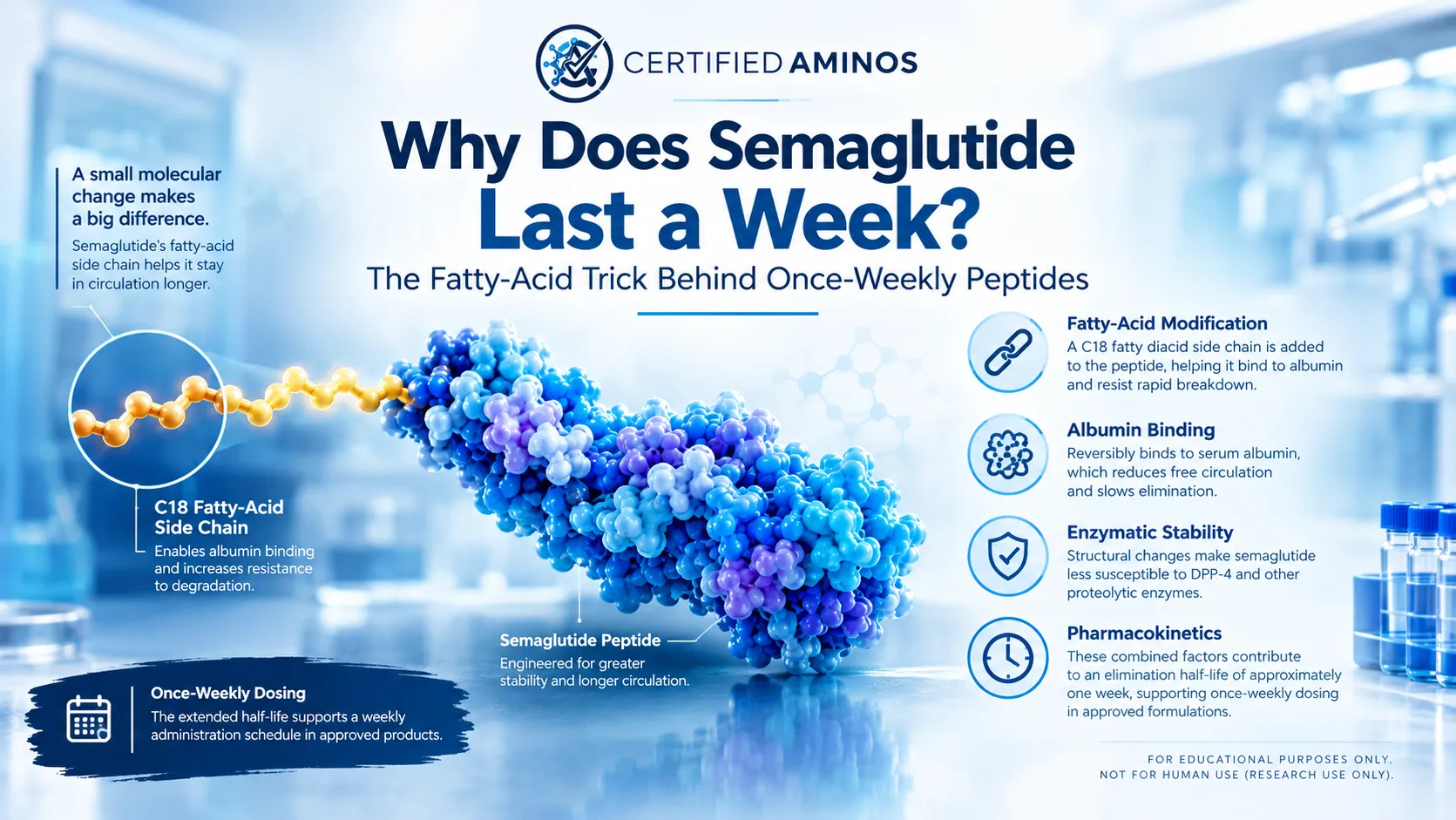
Semaglutide is a synthetic peptide — a 31-amino-acid chain — engineered as an analog of human glucagon-like peptide-1 (GLP-1), a hormone the body produces naturally to help regulate blood sugar and appetite. Structurally, semaglutide shares most of its amino acid sequence with native GLP-1, but it carries a small number of targeted modifications — including a fatty-acid side chain that lets it bind more tightly to albumin in the blood — that give it a much longer-lasting effect than the natural hormone, which the body otherwise breaks down within minutes.
Put simply: semaglutide is not GLP-1 itself. It is a modified, lab-engineered version of it, built to act on the same receptor for a much longer window of time.
Is Semaglutide a Peptide?
Yes. Semaglutide is a peptide — specifically, a 31-amino-acid peptide analog of human GLP-1, not a small-molecule drug in the traditional sense. Its classification as a peptide follows directly from its structure: it is a short chain of amino acids linked together, the defining feature of any peptide, with a fatty-acid modification attached to extend how long it stays active in the body. This is a structural fact, not a matter of interpretation or branding — semaglutide sits in the same broad peptide category as other GLP-1-class and incretin-based research compounds.
How Does Semaglutide Work?
The GLP-1 receptor and incretin signaling
Semaglutide works by binding to and activating the GLP-1 receptor, the same receptor that native GLP-1 — an incretin hormone released from the gut after eating — normally acts on. Incretin hormones are part of the body's feedback system for managing blood sugar: they're released in response to food intake and help coordinate how the pancreas and digestive system respond. By binding this receptor for a sustained period rather than the few minutes natural GLP-1 lasts, semaglutide amplifies and extends those same signaling effects.
Effects on appetite, gastric emptying, and glucose regulation
Through GLP-1 receptor activation, semaglutide is documented to influence several connected processes: it enhances glucose-dependent insulin secretion from the pancreas, suppresses glucagon release (a hormone that raises blood sugar), slows gastric emptying (the rate food leaves the stomach), and acts on appetite-regulating centers in the brain. These are documented pharmacological mechanisms of the molecule and the FDA-approved medicines built on it — they describe how semaglutide is understood to function, not an outcome any individual reader should expect, and nothing here constitutes guidance on using semaglutide for any personal purpose.
Semaglutide and GLP-1 — What Is the Relationship?
Semaglutide and GLP-1 are related but not identical, and the two terms are easy to blur in casual health coverage. GLP-1 is the natural hormone — released by the gut and broken down by the body within one to two minutes. Semaglutide is a synthetic GLP-1 receptor agonist: a separate, engineered molecule designed to act on the same receptor as GLP-1, but modified to remain active far longer. In short, GLP-1 is the hormone class and biological signal; semaglutide is one specific, long-acting molecule built to mimic and extend that signal. "GLP-1 drug" is a category semaglutide belongs to — it is not another name for semaglutide itself.
Semaglutide vs. Ozempic, Wegovy, and Rybelsus
This is the single most common point of confusion in semaglutide search results, and it deserves a direct answer: Ozempic, Wegovy, and Rybelsus are not alternate names for semaglutide — they are FDA-approved branded medicines whose active ingredient is semaglutide, each formulated, dosed, and indicated differently.
Brand
Active ingredient
Form
FDA-approved indication
Ozempic
Semaglutide
Injectable
Type 2 diabetes management (approved 2017)
Wegovy
Semaglutide
Injectable
Chronic weight management (approved 2021)
Rybelsus
Semaglutide
Oral tablet
Type 2 diabetes management (approved 2019)
Ozempic and Wegovy (injectable formulations)
Ozempic and Wegovy both deliver semaglutide by injection, but they are approved for different indications and at different dose ranges — Ozempic for type 2 diabetes management, Wegovy for chronic weight management. They are not interchangeable simply because they share an active ingredient; each has its own FDA-reviewed labeling, dosing schedule, and approved use.
Rybelsus (oral semaglutide)
Rybelsus is an oral tablet formulation of semaglutide, approved for type 2 diabetes management. It demonstrates that semaglutide itself isn't inherently injectable or oral — the molecule is the same active ingredient; the delivery form is a separate formulation choice made and approved for each specific branded product.
None of this changes when the active ingredient is sourced, sold, or labeled differently — a research-use-only version of the semaglutide molecule is not Ozempic, Wegovy, or Rybelsus, and carries none of their FDA approvals, dosing, or intended uses.
Semaglutide vs. Tirzepatide
Semaglutide and tirzepatide are both incretin-based peptides, and they're frequently searched together — but they are structurally distinct molecules with a real mechanistic difference, not simply two brand names for the same thing.
Semaglutide
Tirzepatide
Receptor target
GLP-1 receptor (single agonist)
GLP-1 and GIP receptors (dual agonist)
Structural class
GLP-1 analog peptide
Dual-incretin receptor agonist peptide
Example branded medicines
Ozempic, Wegovy, Rybelsus
Mounjaro, Zepbound
The practical distinction is in the receptor target: semaglutide activates only the GLP-1 receptor, while tirzepatide is engineered to activate both the GLP-1 and GIP (glucose-dependent insulinotropic polypeptide) receptors. That's a difference in mechanism class, not a claim that one molecule outperforms the other — research directly comparing outcomes between the two is an active and evolving area, and this article does not make an efficacy ranking between them.
What Does the Research Say About Semaglutide?
Semaglutide has one of the more extensive clinical research records among incretin-based peptides, and that record underpins the FDA approvals for Ozempic, Wegovy, and Rybelsus specifically — it is not a general endorsement of every product sold under the semaglutide name. Clinical trials supporting those approvals examined glycemic control in people with type 2 diabetes and, for Wegovy, chronic weight management outcomes, leading to label expansions over time, including cardiovascular risk-reduction indications added after initial approval.
It's worth stating plainly: this clinical evidence base describes the approved pharmaceutical products, tested at specific doses, in specific formulations, under regulatory review. It does not describe or validate any research-use-only semaglutide product, which has not been through that same approval and review process for human use.
Semaglutide Safety and Known Adverse Effects
Published research and FDA labeling for the approved semaglutide medicines report a set of commonly observed adverse-effect categories, most frequently gastrointestinal in nature — effects such as nausea, vomiting, and digestive discomfort are among those described in the clinical literature for these products. This section is a literature-level summary, not personal guidance: it does not cover contraindications, drug interactions, or an individual risk assessment, and nothing here should be read as advice about whether semaglutide is appropriate for any particular person. Anyone with questions about personal risk, interactions, or symptoms should speak with a licensed healthcare provider.
FDA Status, Approved Medicines, Compounding, and Research Use
Semaglutide-related products fall into categories that are often blurred together in casual coverage, but they are regulated — and should be understood — separately:
Semaglutide (the molecule): A specific chemical/peptide entity. On its own, it is not a regulatory category — what matters is how a given product containing it is manufactured, labeled, and intended to be used.
FDA-approved branded medicines (Ozempic, Wegovy, Rybelsus): Reviewed and approved by the FDA for specific indications, doses, and formulations.
Compounded semaglutide: Prepared by compounding pharmacies under a separate regulatory framework from FDA drug approval, intended for individualized prescriptions rather than mass-market distribution.
Research-use-only (RUO) semaglutide: Sold for laboratory and research purposes only — not reviewed or approved by the FDA for human or animal use, diagnosis, or treatment.
These four categories should never be treated as interchangeable. A research-use-only product carries none of the FDA approvals, quality-control requirements, or intended uses of the branded medicines above, and nothing in this article should be read as suggesting otherwise.
Semaglutide for Research — What "Research Use Only" Means
"Research use only" (RUO) is a classification applied to chemical and peptide compounds sold specifically for laboratory and scientific research settings — not for human or animal consumption, diagnosis, or treatment of any kind. An RUO designation means the product has not gone through the FDA review and approval process required of a pharmaceutical drug; it is intended for use by qualified researchers in controlled laboratory conditions, consistent with the product's labeling. This classification exists specifically to distinguish research-grade material from an approved medicine — it is not a lighter-touch version of drug approval, and it does not imply the product is safe, appropriate, or intended for use in or on a person or animal.
How to Evaluate Research-Grade Semaglutide Product Information
For researchers evaluating a research-use-only semaglutide product, documentation quality is one of the more useful things to understand — and one of the most commonly misunderstood. A certificate of analysis (COA) is lab documentation tied to a specific manufactured batch (lot), typically reporting two distinct things: identity (confirming the substance is in fact semaglutide, commonly established via mass spectrometry) and purity (how much of the sample is the target compound versus other material, commonly established via HPLC — high-performance liquid chromatography). A COA does not, by itself, establish that a product is safe, effective, or appropriate for any particular use — it documents what independent testing found in that specific batch, nothing more.
When reviewing documentation for a research compound, it's worth checking that the COA's lot number matches the lot number on the product itself, that both the identity and purity testing methods are stated (not just a purity percentage with no method attached), and that the testing was performed by an independent, named lab rather than left unattributed. These are reasonable baseline questions for evaluating any research-grade peptide's documentation, semaglutide included.
Certified Aminos lists its semaglutide research peptide with batch-specific certificates of analysis and stated HPLC/mass-spectrometry testing; researchers can review the current semaglutide research listing and its documentation directly on the product page.
Semaglutide FAQs
What is semaglutide?
Semaglutide is a synthetic, 31-amino-acid peptide engineered as a long-acting analog of human GLP-1 (glucagon-like peptide-1). It is the active ingredient in the FDA-approved medicines Ozempic, Wegovy, and Rybelsus, and is also sold separately as a research-use-only compound for laboratory research.
Is semaglutide a peptide?
Yes. Semaglutide is a 31-amino-acid peptide — a modified analog of human GLP-1 with a fatty-acid side chain added to extend how long it remains active.
How does semaglutide work?
Semaglutide binds to and activates the GLP-1 receptor, amplifying effects normally triggered by the natural GLP-1 hormone — including enhanced insulin secretion, suppressed glucagon release, slowed gastric emptying, and appetite-center signaling in the brain — for a much longer duration than natural GLP-1 provides.
Is semaglutide a GLP-1?
Not exactly. Semaglutide is a synthetic GLP-1 receptor agonist — a separate, engineered molecule designed to act on the GLP-1 receptor — while GLP-1 itself is the natural hormone the body produces. They're closely related, not identical.
What is the relationship between semaglutide and GLP-1?
GLP-1 is a naturally occurring incretin hormone that the body breaks down within minutes. Semaglutide is a modified analog built to activate the same receptor as GLP-1, but with a much longer duration of action.
Is Ozempic semaglutide?
Yes — semaglutide is Ozempic's active ingredient. Ozempic is the FDA-approved, injectable, branded medicine containing semaglutide, approved specifically for type 2 diabetes management.
Is Wegovy semaglutide?
Yes — semaglutide is Wegovy's active ingredient as well. Wegovy is a separately FDA-approved, injectable branded medicine, approved specifically for chronic weight management, at different dosing than Ozempic.
Is Rybelsus semaglutide?
Yes. Rybelsus is the FDA-approved oral tablet formulation of semaglutide, approved for type 2 diabetes management, distinguishing it from the injectable Ozempic and Wegovy formulations.
What is the difference between semaglutide and tirzepatide?
Semaglutide activates only the GLP-1 receptor, while tirzepatide is a dual agonist that activates both the GLP-1 and GIP receptors. They are related but structurally distinct peptides, each the active ingredient in its own separately approved branded medicines.
What are the known side effects of semaglutide?
Published research and labeling for the FDA-approved semaglutide medicines describe gastrointestinal effects, such as nausea and digestive discomfort, among the most commonly reported. This is general literature-level information, not personal medical guidance — consult a licensed healthcare provider for individual questions.
Is semaglutide FDA approved?
The branded medicines containing semaglutide — Ozempic, Wegovy, and Rybelsus — are FDA-approved for their specific indications. Semaglutide sold as a research-use-only compound has not been FDA-approved for human or animal use and is not intended for that purpose.
What is compounded semaglutide?
Compounded semaglutide is a version of the molecule prepared by a compounding pharmacy under a separate regulatory framework from FDA drug approval, typically for individualized prescriptions rather than as a mass-produced, FDA-approved drug product.
What does "research use only" mean?
"Research use only" (RUO) means a product is manufactured and sold strictly for laboratory and scientific research purposes — not for human or animal consumption, diagnosis, or treatment — and has not gone through FDA review for those uses.
What is semaglutide research used to study?
Semaglutide research broadly spans GLP-1 receptor pharmacology, incretin-based signaling, and related metabolic mechanisms. For the current, specific scope of research, laboratories should consult primary peer-reviewed literature and current FDA resources directly rather than relying on any single summary.
This article is for research and educational purposes only. It does not provide medical advice, dosing guidance, or treatment recommendations, and no product referenced for research use is intended for human or animal consumption. Consult a licensed healthcare provider for any personal health questions.
Got Questions?
Frequently Asked Questions
Semaglutide is a synthetic, 31-amino-acid peptide engineered as a long-acting analog of human GLP-1 (glucagon-like peptide-1). It is the active ingredient in the FDA-approved medicines Ozempic, Wegovy, and Rybelsus, and is also sold separately as a research-use-only compound for laboratory research.