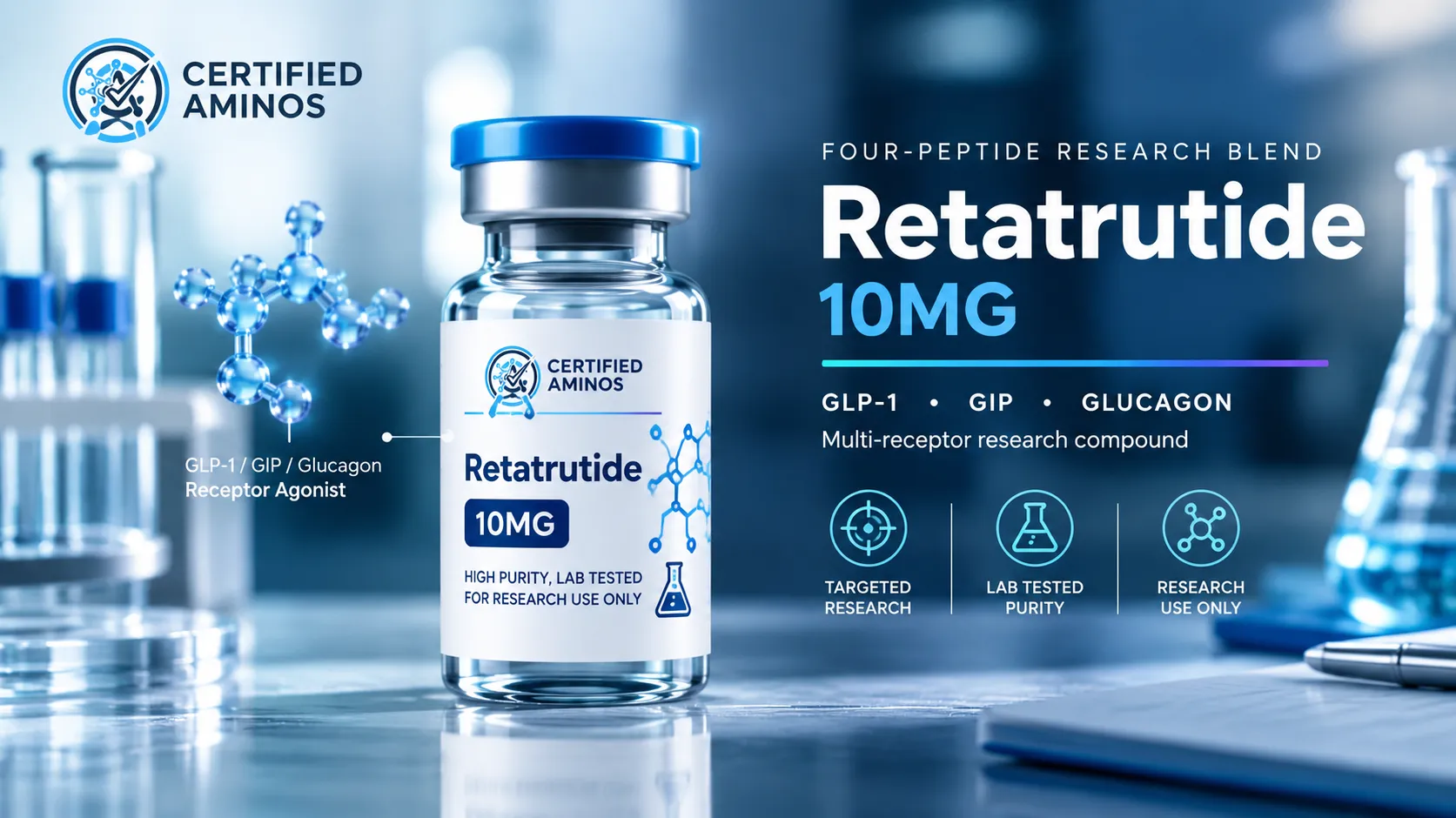
Retatrutide reached −24.2% mean weight change at 48 weeks in phase 2. What the NEJM and Lancet trials show, what's unproven, and how RUO batches are verified.
Phase 2, 12 mg: −24.2% mean body weight at 48 weeks vs −2.1% placebo (NEJM 2023, n=338).
TRIUMPH-2, 12 mg: −18.8% at 80 weeks in adults with obesity and type 2 diabetes, vs −5.1% placebo (Lancet 2026).
The glucagon receptor is what's new, and its individual contribution hasn't been isolated yet.
No head-to-head trial against tirzepatide or semaglutide exists. Not FDA-approved as of October 2026.
Research summary only, with no dosing or use guidance. Retatrutide is investigational and not FDA-approved; the full disclaimer is at the end of this article.
Featured In This Article
RESEARCH PEPTIDE
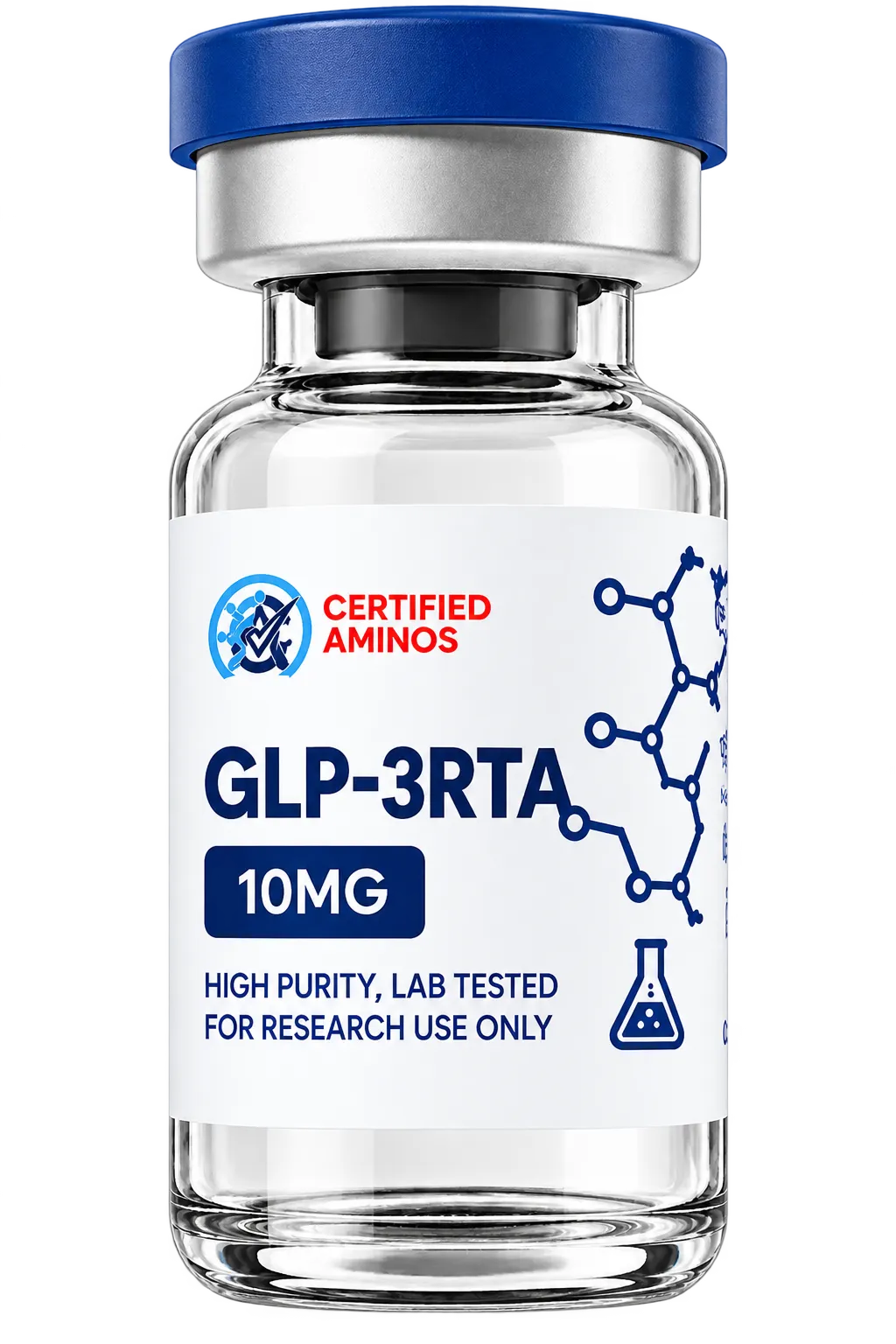
GLP-3RTA
Highly purified synthetic peptide prepared for rigorous laboratory research.
$119.00
What Is Retatrutide?
Retatrutide (LY3437943) is an investigational Eli Lilly peptide that activates three hormone receptors at once: GIP, GLP-1 and glucagon. In a 48-week phase 2 trial (NEJM, 2023), the highest dose produced a mean weight change of −24.2%, versus −2.1% on placebo. It is not FDA-approved.
What sets it apart from the GLP-1 and GIP/GLP-1 compounds that came before it is the glucagon receptor, a pathway studied for its possible role in energy expenditure. How much that third receptor actually adds is still an open question, and it is the question this guide keeps coming back to.
How Does Retatrutide Work?
Retatrutide is a single peptide molecule engineered to bind three G-protein-coupled receptors: the glucose-dependent insulinotropic polypeptide (GIP) receptor, the glucagon-like peptide-1 (GLP-1) receptor and the glucagon receptor. Earlier compounds hit one or two of these. Activating all three at once is the mechanism trial authors point to when explaining its effects on body weight and glycemic markers, though how much each receptor contributes is still being worked out.
What GIP, GLP-1, and Glucagon Receptors Each Do
Receptor
Primary research association
Native hormone
GIP receptor
Insulin secretion, lipid metabolism
GIP
GLP-1 receptor
Insulin secretion, gastric emptying, appetite
GLP-1
Glucagon receptor
Energy expenditure, liver glucose output
Glucagon
In practice the three pathways overlap, which is exactly why no one can yet say how much of retatrutide's effect comes from the glucagon arm.
Why Is Retatrutide Called a “Triple Agonist”?
Because it activates three receptors rather than one or two. Incretin-based compounds are usually grouped by how many receptors they hit:
Single-receptor agonists activate one receptor, usually GLP-1. Semaglutide is the best-known example.
Dual-receptor agonists activate two, usually GIP and GLP-1. Tirzepatide is the best-known example.
Triple-receptor agonists activate GIP, GLP-1 and glucagon together. Retatrutide falls in this group.
What Does Current Retatrutide Research Show?
The published record so far is one completed phase 2 trial and several phase 3 trials under the TRIUMPH program. The pattern across them is consistent: body weight and glycemic markers improved in a dose-dependent way, and gastrointestinal side effects were the most common adverse events. These results describe what happened in specific trial populations, not what will happen elsewhere.
Phase 2 Findings (NEJM, 2023)
In a randomized, double-blind, placebo-controlled phase 2 trial published in the New England Journal of Medicine (Jastreboff et al., 2023; ClinicalTrials.gov NCT04881760), 338 adults with obesity received once-weekly subcutaneous retatrutide or placebo for 48 weeks. At 48 weeks, mean body-weight change ranged from −8.7% (1 mg) to −24.2% (12 mg), compared with −2.1% for placebo. The most common adverse events were gastrointestinal, dose-related and mostly mild to moderate.
Phase 3 TRIUMPH Program Findings
Each TRIUMPH trial studies a different population. Some results are peer-reviewed and some are still company or congress reports, and the difference matters: topline numbers can change once the full paper goes through review. Each trial below is labeled accordingly.
TRIUMPH-2 (peer-reviewed) was published in The Lancet (2026; ClinicalTrials.gov NCT05929079). It enrolled 1,152 adults with obesity and type 2 diabetes across 92 research centers in eight countries. At week 80, mean body-weight change was −11.9% (4 mg), −16.8% (9 mg) and −18.8% (12 mg), versus −5.1% for placebo. Diarrhea and nausea were the most frequently reported adverse events.
TRIUMPH-1 (topline, not yet peer-reviewed) enrolled adults with obesity, with no type 2 diabetes requirement. It ran an 80-week core period plus a blinded extension to 104 weeks for a subset of participants. Topline results were presented at the ADA 2026 Scientific Sessions. We'll add exact figures once the full paper has been peer-reviewed.
TRIUMPH-3 (topline, not yet peer-reviewed) enrolled adults with obesity and cardiovascular disease. The sponsor has reported weight reductions broadly in line with TRIUMPH-1 and TRIUMPH-2. We'll add figures once the peer-reviewed paper is available.
Evidence Type: Preclinical vs. Clinical vs. Mechanistic
Evidence type
What it means
Retatrutide example
Mechanistic
Receptor binding and signaling, often in cell or animal models
GIP/GLP-1/glucagon receptor-activation studies
Clinical (peer-reviewed)
Controlled human trials with defined endpoints
NEJM phase 2; Lancet TRIUMPH-2
Topline / congress
Sponsor-reported, before full peer review
TRIUMPH-1; TRIUMPH-3
The most common mistake in writing about retatrutide is quoting a congress headline as if it were a peer-reviewed result, or a mechanistic hypothesis as if it were a proven outcome. This guide labels which kind of evidence each claim rests on.
Retatrutide vs. Tirzepatide vs. Semaglutide: What the Numbers Can and Can't Tell You
This is the comparison most people are looking for, so here are the headline numbers from each compound's key obesity trial:
Compound (top dose)
Receptors
Key trial
Mean weight change
Semaglutide 2.4 mg
GLP-1
STEP 1 (NEJM, 2021)
−14.9% at 68 weeks
Tirzepatide 15 mg
GIP + GLP-1
SURMOUNT-1 (NEJM, 2022)
−20.9% at 72 weeks
Retatrutide 12 mg
GIP + GLP-1 + glucagon
Phase 2 (NEJM, 2023)
−24.2% at 48 weeks
Read this table carefully. These are three different trials with different populations, durations and sizes, and retatrutide's number comes from a shorter, smaller phase 2 study. It's tempting to rank them, but a fair verdict needs a head-to-head randomized trial, and as of October 2026 none has been published.
What Remains Unknown or Still Under Investigation?
Four questions are still open in the published literature:
How much of the effect comes from the glucagon receptor versus the combined GIP/GLP-1 activity. The pathways overlap, which makes them hard to separate.
What happens beyond 104 weeks. The longest reported data come from the TRIUMPH-1 extension subset; multi-year safety and durability data aren't available yet.
How it compares directly with tirzepatide or semaglutide. Every comparison so far is cross-trial, not head-to-head.
When, or whether, it will be approved. Regulatory review is ongoing, so its status may change.
These gaps come from the cited trial papers and pharmacology reviews. The list isn't exhaustive, so check the current primary literature for updates.
Is Retatrutide FDA-Approved?
No. As of October 2026, retatrutide has no FDA approval for any indication. It is under regulatory review following its phase 3 results, so confirm its status against a current, dated regulatory source rather than inferring it from trial data.
One distinction worth holding onto: a COA tells you what's in the vial. A trial tells you what a compound did in one controlled study population. Neither proves the other, so the trial results above say nothing about the purity or identity of any supplied batch.
What RUO Means When Sourcing a Research Compound
Research Use Only is the supplier's stated intended use: the product is for laboratory and scientific research, not for human or animal consumption. It's a labeling decision, not a regulatory approval, and the acronym alone doesn't establish the same legal status in every jurisdiction.
How to Check a Retatrutide COA
Start by matching the lot number on the Certificate of Analysis (COA) to the one printed on your vial. A sample COA that isn't tied to your lot proves nothing. Then check for:
HPLC purity reported as a percentage.
Mass-spectrometry identity confirmation showing the observed mass matches the expected mass.
The name of the lab that ran the test. A named third-party lab means more than “in-house.”
RUO labeling on both the product listing and the physical packaging.
What Should You Look For in an RUO Supplier?
Beyond the paperwork, look at whether a supplier explains how it tests, states purity claims specifically rather than vaguely, and applies RUO restrictions consistently across its site. Our research and compliance FAQ sets out how Certified Aminos handles each of these.
Retatrutide is a Research Use Only (RUO) compound. It is not approved by the FDA for any human or animal use, and nothing in this article should be interpreted as medical advice, a treatment recommendation, or a guarantee of any outcome. This article is intended solely to summarize published scientific and clinical research for qualified researchers and laboratory professionals. Products sold by Certified Aminos are intended strictly for laboratory and scientific research and are not for human or animal consumption.
Got Questions?
Frequently Asked Questions
Retatrutide (LY3437943) is an investigational Eli Lilly peptide that activates three hormone receptors at once: GIP, GLP-1 and glucagon, which is why it's called a triple agonist. It is not FDA-approved, and Certified Aminos supplies it for Research Use Only.